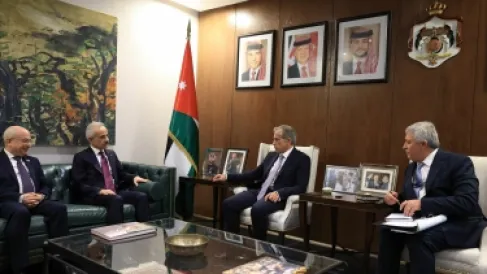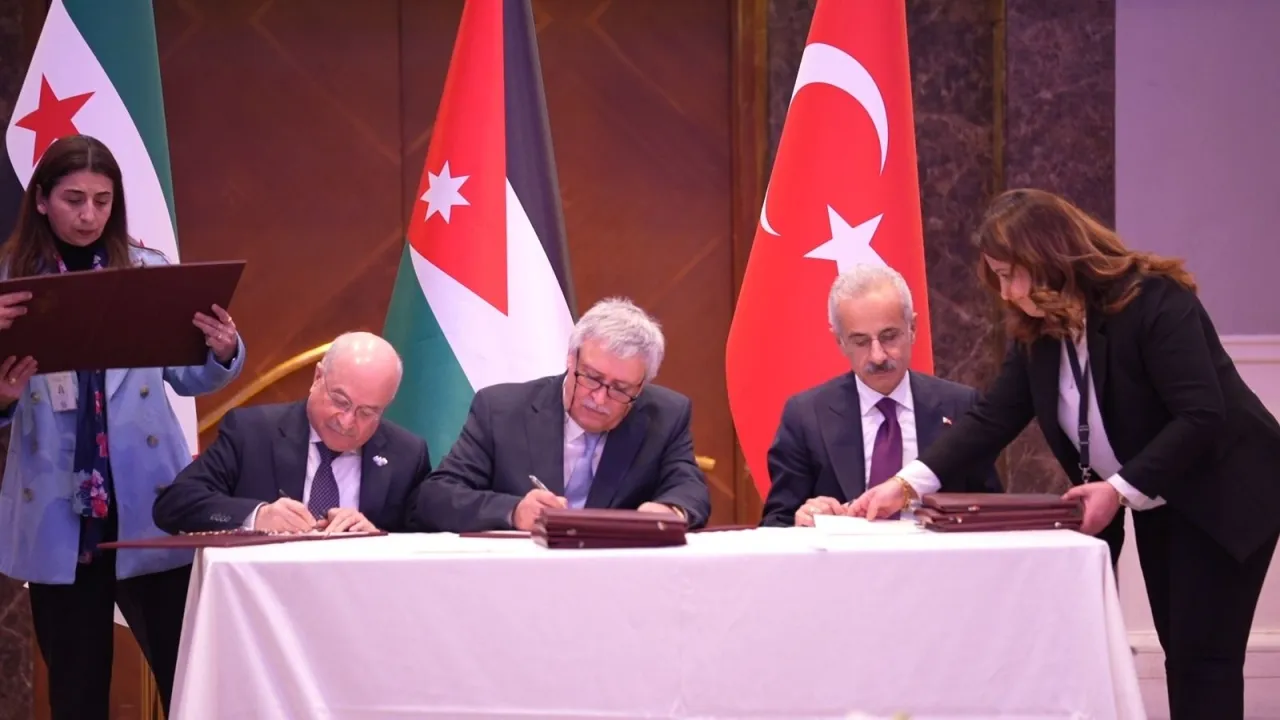
Khaberni - Minister of Transport Dr. Nidal Al-Qatamin, his counterparts, the Minister of Transport in the Syrian Arab Republic Dr. Yarub Badr, and the Minister of Transport and Infrastructure in the Turkish Republic Mr. Abdulqadir Oural Oglu, signed today, Tuesday, a tripartite memorandum of understanding aimed at enhancing cooperation and integration in the transport sector among the three countries. This happened during the joint ministerial committee meeting for cooperation in the transportation field between Jordan, Syria, and Turkey, held in the capital, Amman, attended by representatives from both the public and private sectors and transport and logistics experts, with active participation from the private sector and opening discussions on the sector's challenges and opportunities.
The memorandum aims to develop an integrated regional transportation system that facilitates the movement of individuals and goods, enhances the efficiency of supply chains, and boosts the region's position as a logistical hub linking regional and international markets, thereby enhancing its competitiveness on the global trade map.
Minister Al-Qatamin emphasized that this step represents a qualitative leap towards building an advanced transportation model based on integration, flexible and highly efficient supply chains, capable of adapting to geopolitical changes. He pointed out that Jordan places the transport and logistics services sector at the core of its economic modernization vision by developing multimodal transport, establishing logistics centers, modernizing border crossings, adopting digital solutions, and enhancing partnerships with the private sector.
On his part, Syrian Minister Yarub Badr affirmed that the meeting reflects a joint will to outline a real economic and logistical integration, noting that it represents a strategic station for setting a practical roadmap for cooperation. This roadmap is based on executive projects, foremost of which are enhancing railway connections, facilitating transit movements, and aligning procedures, serving the interests of the region’s peoples and enhancing its geographical position as a link between the East and West.
Meanwhile, Turkish Minister Abdulqadir Oural Oglu emphasized the importance of developing various modes of transport and linking the countries of the region with the Kingdom of Saudi Arabia and the Arab Gulf states. This enhances integration between Asia and Europe, highlighting the importance of developing land transport and railway infrastructure, enhancing sea transport and ports, and the pivotal role of the Aqaba port in supporting regional trade movements.
The memorandum includes establishing an institutional and technical framework for cooperation that encompasses forming joint committees and work teams and developing unified sectoral plans, ensuring the coordination of efforts and harmonization of procedures among the three countries. This cooperation will translate into executive projects supported by digitization and investment through simplifying systems and applying smart solutions, performance monitoring, and capacity building to ensure sustainability. The memorandum also focuses on enhancing regional railway connections by establishing a tripartite technical committee to oversee implementation, in addition to developing land, sea, and railway transport and improving infrastructure, facilitating the movement of freight and passengers, and simplifying border procedures, all contributing to enhancing the efficiency of supply chains, boosting trade exchange, and supporting transit between the three countries.
This trilateral ministerial meeting follows the technical committees’ meetings, which paved the way for outlining agreements among the three countries. These efforts were culminated in signing the memorandum of understanding and establishing a practical framework for joint cooperation, contributing to enhancing the efficiency of transport networks, modernizing infrastructure, improving logistics services, reducing transit time, stimulating investment, and supporting sustainable development pathways in the region.