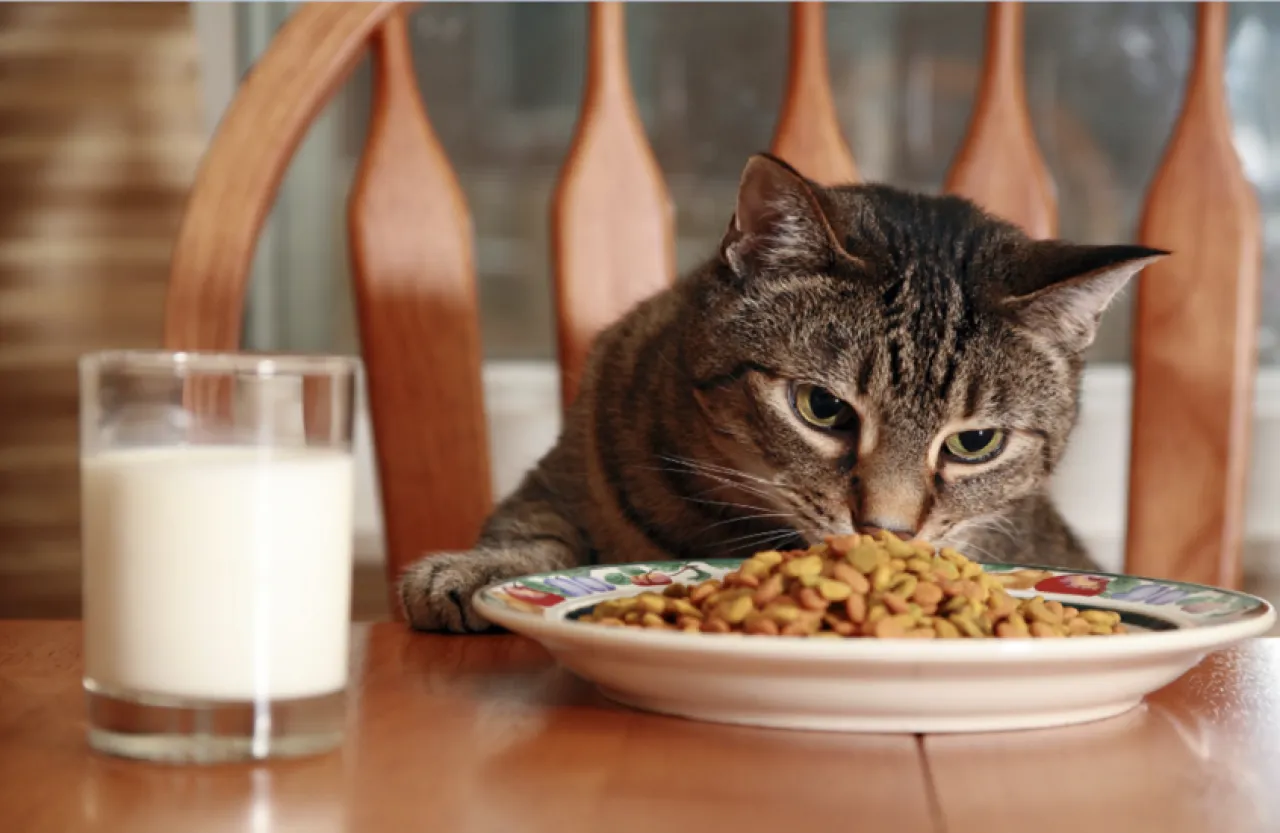
Khaberni - A recent study found that cats which suddenly stop eating may not be full, but might have lost interest in the food itself due to becoming accustomed to its smell, a phenomenon known as "olfactory sensory saturation".
This phenomenon in humans explains our ability to stop eating a certain type of food despite being hungry, and then immediately regain appetite when a different smelling food is presented, like moving from pizza to dessert.
However, this mechanism is still not fully understood in cats, which led researchers from Iwate University in Japan to study their eating behavior to determine whether their stopping eating is linked to true satiation or a decrease in sensory interest in the food.
The researchers clarified that cats often stop eating before finishing their meal, even after long fasting periods, then return shortly afterward to eat the same food, indicating that satiation alone does not explain this behavior.
This dietary pattern is linked to the evolutionary history of cats, as their ancestors, like the African wildcat, were used to hunting several small prey daily, being solitary predators. Thus, cats tend to eat small, multiple meals rather than one large meal.
In contrast, dogs tend to devour food quickly and voraciously, which is believed to stem from their past as predatory animals living in groups and competing for food.
The study relied on 12 healthy house cats of mixed breeds, none of which were neutered, and all were placed on a controlled diet.
Initially, the cats fasted for 16 hours, then were given 20 grams of dry food. During 10 repeated trials, only four cats managed to finish the whole meal within 10 minutes, while the rest stopped eating after consuming about a third of the portion only.
The researchers also tested six different types of cat food with distinctive smells to determine the extent to which smell influenced appetite.
The results showed that when the same type of food was repeatedly presented, the cats' consumption gradually decreased, even if the food was palatable. However, when the type of food or even just its smell was changed while keeping the same content, the cats' appetite returned, and they ate more.
The researchers noted that cats which had previously been exposed to the same food smell ate less, while their consumption increased when exposed to a different food smell, which confirms that smell plays a crucial role in stimulating appetite.
Animal behavior scientist Masao Miyazaki said that cats stop eating not just because they are full, but because their motivation to eat decreases with familiarity with the same smell, and it can be easily restored by introducing a new sensory experience.
The researchers pointed out that this habituation to smells seems less pronounced in dogs, which may explain why they are relied upon instead of cats in tasks like detecting bombs and prohibited substances.
These results could open new ways to improve the health of cats, whether to reduce overeating in cats with obesity or to stimulate the appetite in elderly or sick cats through modifying food smells instead of resorting to harsh dietary regimes.