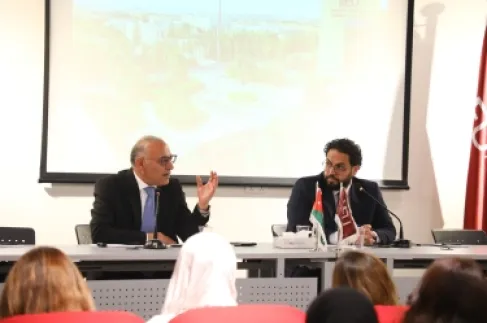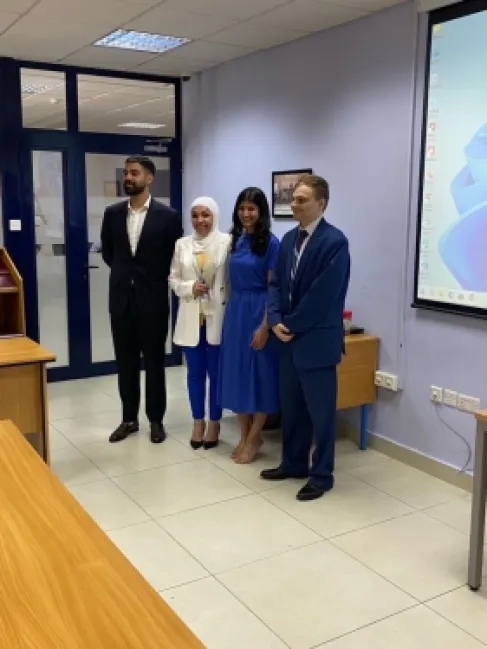
Khaberni - Dr. Muhammad Ali Al-Muaytah from Petra University presented an innovative computational model aimed at improving the accuracy of planning in cosmetic surgeries, during a scientific lecture organized by the Jordanian Dental Association and the Facial Cosmetic Surgery Association, attended by Jordanian medical associations, at the Hilton Hotel Amman.
Al-Muaytah reviewed in front of about eight hundred doctors and specialists in facial and maxillofacial surgeries, cosmetic and dermatology an analytical study that breaks traditional concepts around the "ideal face," stating that complete symmetry in features grants beauty, but does not guarantee personal attractiveness.
The distinction between the two concepts is based on rules adopted by medical colleges and schools of classical art; beauty is defined computationally as "complete symmetry" or the matching of both the right and left sides of the face. Decoupling beauty from attractiveness allows surgeons an avenue to move beyond rigid beauty molds that may lead to "face similarity," achieving cosmetic outcomes in clinical practice that balance correcting flaws while preserving unique features that give the individual their special charisma.
This vision was supported by research published from the University of St. Andrews in Scotland (according to its cognitive research unit website), which indicates that complete symmetry in facial features gives a visually comforting beauty impression but does not necessarily guarantee "attractiveness" to others. Experiments have also shown that faces with "slight deviations" from computational standards are most impactful in first impressions.
Al-Muaytah pointed out that "a calculated deviation" from ideal standards is a fundamental element in facial attractiveness, explaining that men are often drawn to more symmetrical female faces, while women tend to favor faces with less gentle and more rugged features, as they convey a sense of strength and distinctiveness.
Al-Muaytah's algorithm transforms cosmetic planning into a precise engineering process based on a person's actual features, rather than visual estimation or emulation of famous faces. The algorithm works by precisely measuring angles and distances to the millimeter using "digital maps," ensuring natural results that align with each patient's unique anatomical structure, away from artificiality.
The Jordanian Association for Cosmetics, during discussions that followed the lecture, expressed a desire to organize joint scientific activities with Dr. Al-Muaytah to transfer this methodology into practical practice for doctors. Dr. Al-Muaytah thanked and appreciated the continuous support of Petra University for scientific research and its leadership in embracing innovative initiatives that contribute to the development of medical sciences at both local and international levels.