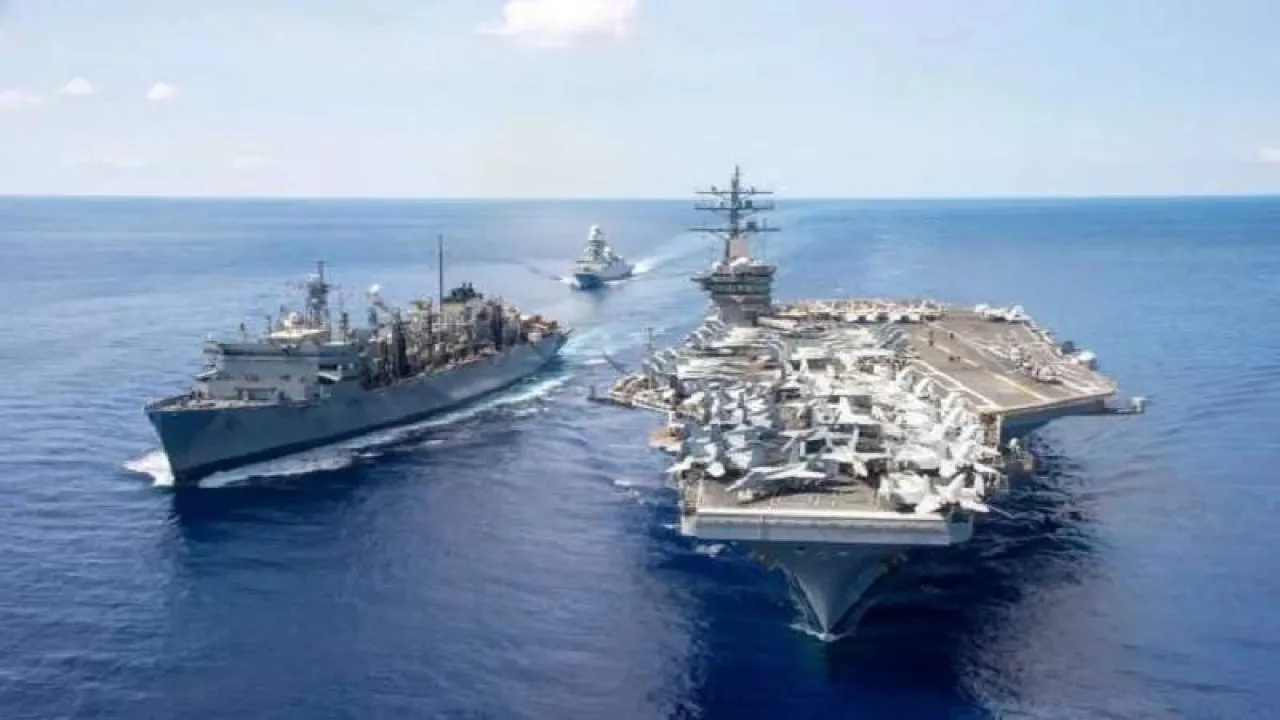
Khaberni - Both the destroyer and the aircraft carrier are among the most important ships in modern naval fleets, but each has a totally different role in military operations, in terms of size, tasks, or combat ability.
With the escalation of maritime tensions around the world, naval power has emerged as a crucial element in the balance of conflict, especially with the increasing importance of controlling maritime passages and protecting supply lines.
In this context, the role of two pivotal ships in any modern fleet appears: the aircraft carrier, which represents "the giant" with its immense aerial attack power, and the destroyer, which operates as "the guardian" quickly protecting the fleet and addressing various threats. With ongoing events in several tense maritime regions, the importance of understanding the difference between these two elements and their integrated role in managing modern naval wars becomes clear.
Aircraft Carrier
An aircraft carrier is considered the largest and most important piece in any modern naval force, resembling a floating air base at sea. Its primary function is to carry and launch warplanes such as fighters, reconnaissance, and early warning aircraft, which enables a nation to conduct long-range military operations without needing land-based airfields. An aircraft carrier can carry dozens of aircraft, in addition to hundreds of soldiers and operation staff, making it a comprehensive command center for air and naval operations.
Aircraft carriers are characterized by their enormous size, with some types exceeding 300 meters in length, and are among the most technically complex platforms, featuring takeoff and landing runways, guidance systems, advanced radars, and central command rooms. However, despite their power, they need continuous protection because they are an important strategic target and thus do not usually move alone, but are surrounded by a group of other warships.
Destroyer
On the other hand, the destroyer is a smaller, more flexible warship, primarily designed to protect naval fleets from various threats. Its tasks include defense against submarines, aircraft, and missiles, in addition to executing limited offensive strikes when needed. The destroyer is distinguished by its high speed and maneuverability, making it suitable for protection, reconnaissance, and escort missions.
The destroyer serves as a fundamental component in protecting aircraft carriers, operating within what is known as the "naval combat group," utilizing advanced radar systems and anti-aircraft and submarine missiles. It can also conduct independent operations such as securing maritime routes or supporting ground forces through missile shelling.
In terms of size, there is a significant difference between the two; the aircraft carrier may be several times larger than the destroyer, whether in terms of length, crew number, or capacity. While the destroyer relies on speed and flexibility, the aircraft carrier relies on the massive air power it carries.
Thus, the roles of modern warships complement each other within major fleets, combining the aircraft carrier as a main offensive force and the destroyer as a defensive and quick protection element to achieve a complete balance in naval operations.
The world's largest destroyer
The American destroyer "USS Zumwalt" is one of the largest and most advanced destroyers in the world in terms of design and technologies. This ship is characterized by its stealthy shape, which reduces its radar visibility, and includes advanced weapons systems featuring long-range missiles and advanced cannons. It measures about 182 meters in length and is designed to perform offensive and defensive tasks with high stealth and maneuverability capabilities, making it one of the most advanced destroyers in modern history.
The world's largest aircraft carrier
The American aircraft carrier USS Gerald R. Ford is currently the newest and largest aircraft carrier in the world, featuring very modern technologies compared to previous generations, such as the electromagnetic aircraft launch system instead of traditional steam catapults, in addition to advanced radars and a higher capability to operate aircraft quickly and more efficiently. It is also designed to reduce the required crew number and operate more automated systems, making it more advanced and effective in modern naval operations.