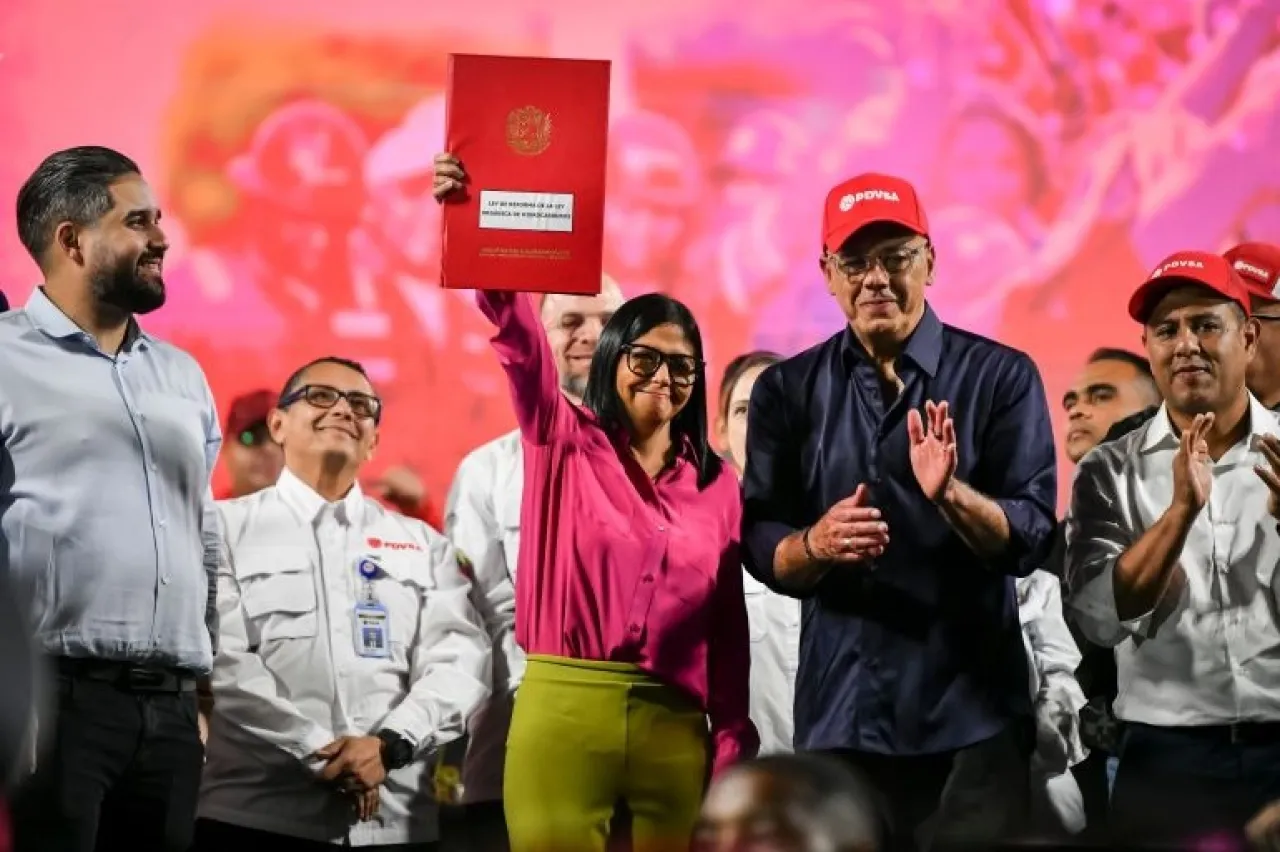
The Venezuelan parliament, on Thursday, approved radical amendments to the hydrocarbons law that end the state's monopoly of the oil sector and open it up to private companies and foreign investments, along with an announcement from the U.S. administration lifting some sanctions imposed on Caracas and reopening Venezuelan airspace for commercial flights.
Hydrocarbons Law Reforms
The new version of the law, which was unanimously approved, allows contracts that enable private companies to manage exploitation, distribution, and marketing operations without mandatory state participation.
The interim Venezuelan President Delcy Rodríguez stated that the new law represents a "historic leap", and the head of the National Assembly (parliament) Jorge Rodríguez described it as a "historic step for our future and for our sons and daughters", praising the workers in the sector who will implement these amendments.
Previously, exploitation of the oil sector was exclusive to government companies or mixed companies in which the state owned a majority of shares. In 2006, the government of former Venezuelan President Hugo Chávez restricted private sector participation and imposed additional constraints.
The amendment includes replacing various taxes with a uniform maximum contribution rate of 15%, in addition to royalties amounting to 30% of total revenues.
Venezuela currently produces about 1.2 million barrels per day, after production had fallen from its peak of 3 million barrels at the beginning of the millennium to about 350,000 barrels in 2020.
New U.S. Licenses
In Washington, the U.S. Treasury Department issued a general license authorizing transactions that involve the Venezuelan government and the national oil company "Petróleos de Venezuela", which are "ordinary and necessary" for loading, exporting, selling, storing, transporting, or marketing Venezuelan-origin oil, including its refining by a recognized American entity.
This decision represents a shift from a previous strategy that relied on granting individual exemptions.
The license does not allow payment terms that are commercially unacceptable or involve debt swaps or gold payments, and it excludes any transactions involving persons or entities in Russia, Iran, North Korea, or Cuba.
Companies such as "Chevron", "Repsol", "Reliance", and some American oil service providers have recently sought licenses to expand production or exports from the OPEC member state. These companies are partners and clients of "Petróleos de Venezuela".
This move coincides with President Donald Trump's administration's plan to rebuild the Venezuelan oil sector with investments worth $100 billion, intending to manage oil sales "indefinitely".
Reopening of Commercial Airspace
Additionally, the U.S. President announced that Venezuelan airspace will be reopened to commercial flights, stating that he has directed the Department of Transportation and the military to remove travel barriers.
Trump said: "American citizens will be able to visit Venezuela soon and they will be safe there", noting that major oil companies have already begun exploring sites in the country.
Following the announcement, the Federal Aviation Administration removed the warning alerts directed at airlines, and "American Airlines" announced plans to resume service pending security assessments.
It should be noted that Trump had previously announced that his administration now controls the Venezuelan oil sector, following developments after the arrest of Maduro and his transfer for trial in the United States on charges related to drug trafficking and corruption.