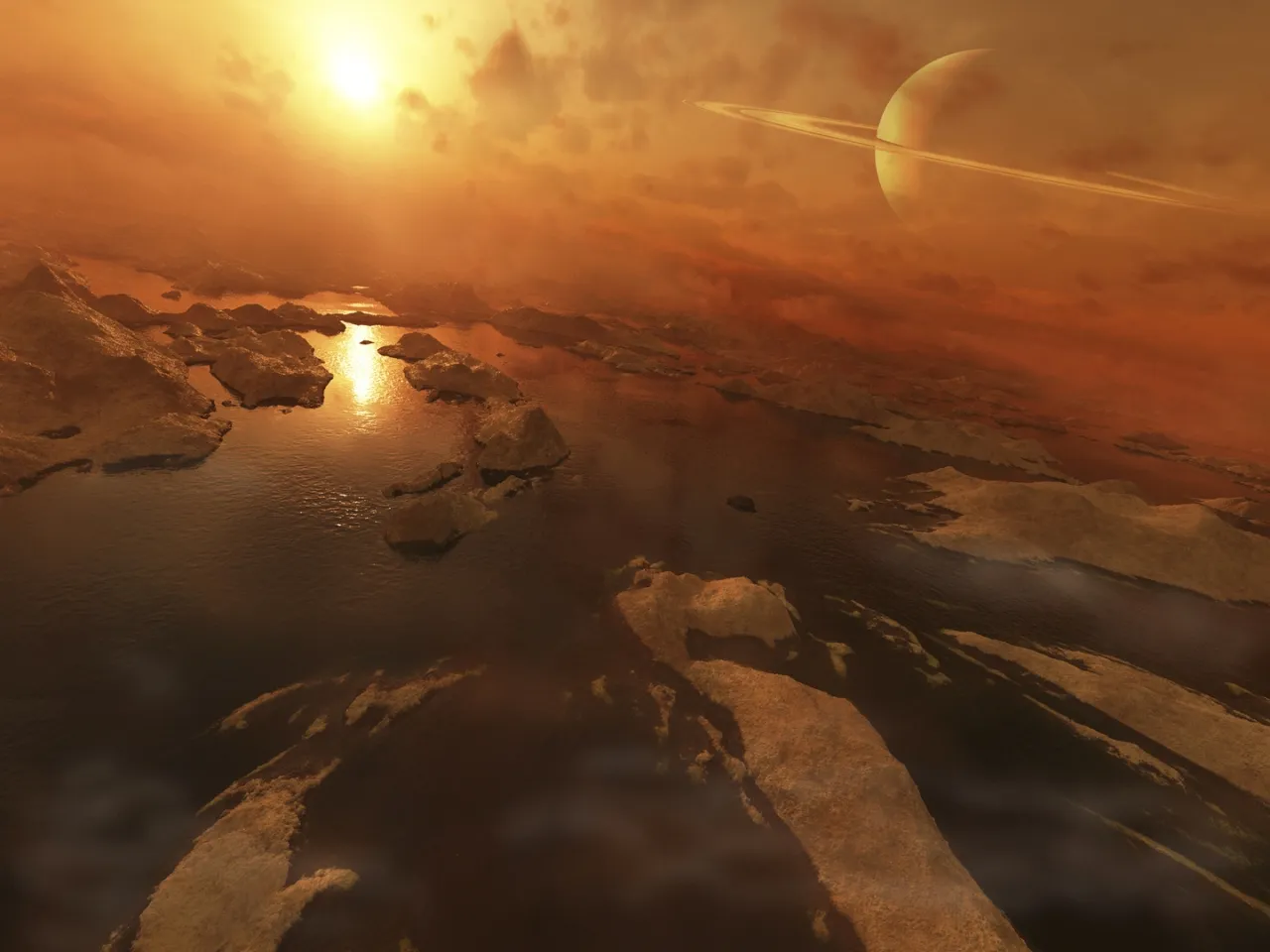
Khaberni - Titan, a moon of Saturn, has long been an intriguing puzzle for astronomers, especially with the prevailing belief over the past decade that it hides a vast ocean of salty water beneath its icy crust.
However, a recent study led by researchers at NASA's Jet Propulsion Laboratory has turned this assumption upside down, revealing a more complex and perhaps even more thrilling picture of the largest moon in the solar system.
After reanalyzing data collected by the Cassini spacecraft during its historic journey around Saturn, the team concluded that the interior of Titan might not be entirely liquid. Instead, it may consist of deep layers of soft and semi-melted ice, similar to polar regions on Earth, with scattered pockets of liquid water. This discovery could change our perspective on the possibility of life on this distant world.
Titan is a unique world, being the only moon in our solar system with a thick atmosphere. Its surface features lakes and rivers composed of liquid methane and ethane at temperatures around -180 degrees Celsius. Below this frozen surface, scientists believed there was a global ocean.
Now, the study team says this ocean might have been originally frozen and is in the process of thawing, or that its entire water system is slowly moving towards complete freezing. To verify their hypothesis, the researchers focused on studying the effects of Saturn's massive gravitational force on Titan's shape.
Since the moon is tidally locked to its planet (always showing the same face to it, just as our Moon does with Earth), Saturn's gravity pulls and distorts its surface, causing what resembles "solid tides" that manifest as bulges up to 10 meters high.
The irony here lies in the timing of this response. If Titan's interior were entirely liquid, the surface's response to gravity would be immediate. However, the refined data showed a 15-hour delay between the peak gravitational force and the rise of the moon's surface. This delay strongly suggests that the interior is not a free-flowing liquid but rather a semi-solid muddy mass of ice mixed with pockets of water, requiring time to respond to pressure and deformation.
Computer models supported this result, indicating that Titan's icy crust could be up to 170 kilometers thick, followed by layers of soft ice and water potentially extending to a total depth of 550 kilometers, with temperatures in some areas reaching -20 degrees Celsius.
Scientists believe that this environment of soft, semi-melted ice with relatively warm water in isolated pockets might be a more promising habitat than previously thought for the evolution and emergence of primitive life forms.
Dr. Baptiste Journo of the University of Washington, a participant in the study, says, "There is a strong justification to continue being optimistic about the possibility of extraterrestrial life."
This study sparks scientific debate, as scientist Luciano Esse, whose earlier research was fundamental to the aquatic ocean hypothesis, insists that the new findings are unconvincing, finding them "interesting and sure to spark discussion," but believes the current evidence is insufficient to exclude Titan from the list of oceanic worlds in our solar system, which includes moons like Europa of Jupiter and Enceladus of Saturn.
Now, the scientific community eagerly awaits NASA’s "Dragonfly" mission, an ambitious project that will launch an robotic helicopter to Titan's surface by the end of this decade. This mission will be capable of examining the moon's surface and environment closely and may provide us with decisive answers about the true composition of this mysterious world's interior, determining whether its ocean is merely a beautiful dream or a stunning scientific reality hidden beneath the ice.