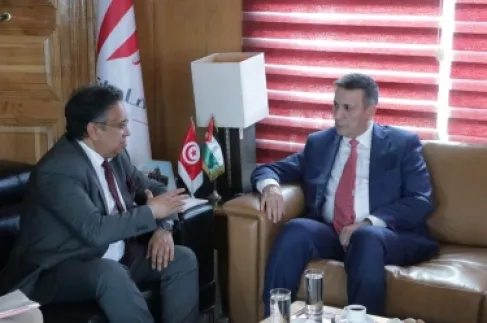
Khaberni - Minister of Local Administration, Walid Al-Masri, placed the foundation stone on Sunday for the development and rehabilitation project of the Al-Akider landfill, one of the kingdom's most crucial environmental and service projects.
The funding for the development and rehabilitation of the project was fully granted by the European Union, totaling 40 million euros, as part of a broader support program provided by the European Union to the waste management sector in Jordan, which amounted to 100 million euros; to implement projects of the national strategy for solid waste management.
Al-Masri emphasized the strategic importance of the project, which reflects the government's commitment to implementing the directives of His Majesty King Abdullah II, including comprehensive modernization, enhancing the efficiency of basic services, and achieving sustainability in infrastructure.
He explained that the landfill, established in 1981, is the second largest landfill in the Kingdom after the Ghbawi landfill, serving 33 municipalities from the provinces of Irbid, Jerash, Ajloun, and part of the Mafraq province. The site receives an average of 1500 tons of waste daily, over a total area of 969 dunams.
He noted that the site experienced significant pressures over the past years due to the increasing amounts of waste and the direct repercussions of the Syrian refugee crisis, which made its development a national and environmental necessity.
He stated that the development project includes rehabilitating the old landfill and current cells, and constructing new sanitary cells over an area of 200 dunams, in addition to implementing a comprehensive system for collecting, storing, and treating leachate from the waste, and a system for collecting gas from the old landfill and existing cells. The project also includes refurbishing and developing all site facilities including buildings, roads, and support services, ensuring the landfill operates according to the highest environmental standards.
He mentioned that the contractor began its work last March, and the execution period will last for 26 months, with the project expected to be fully completed in May 2027.
Al-Masri affirmed that the European grant of 100 million euros was a cornerstone in launching the projects of the national waste management strategy, and he praised the French Development Agency, international partners, and implementers such as the United Nations Development Programme, the German Agency for International Cooperation, and the Japanese International Cooperation Agency, for their efforts in supporting the municipalities and enhancing the infrastructure of services.
The European Union ambassador to the Kingdom, Pierre Christophe Chatzisavvas, affirmed that the inauguration of the Al-Akider project reflects the positive results of the partnership between the Ministry of Local Administration, the French Development Agency, and the European Union, noting that the project, fully funded by the European Union at about 40 million euros, is progressing as planned and is a pivotal part of the European Union's support for Jordan valued at 100 million euros; to modernize the waste management system in the Kingdom.
The ambassador commended Jordan's ambition to enhance the role of the private sector within this vital sector, as it represents a significant step towards innovation and achieving sustainability in waste management.
In turn, the French ambassador in Jordan, Frank Gellet, stressed the importance of the ongoing cooperation between the European Union, France, and Jordan, pointing out that it represents a successful model of international partnerships supporting the Kingdom's environmental priorities.
He mentioned that the rehabilitation and expansion of the Al-Akider landfill, the closure of old sites, and the modernization of the operational infrastructure of the site are part of comprehensive efforts aimed at protecting the environment and improving municipal services, contributing to the improvement of the quality of life for residents in the northern provinces.
He added that the project is not limited to infrastructure development but also includes a comprehensive program to enhance the institutional capacities of the Ministry of Local Administration and Ministry of Environment and municipalities in the areas of operation, environmental monitoring, and maintenance, reaffirming the commitment of France and the European Union to continue supporting Jordan in its journey towards a more sustainable economy, and encouraging circular economy initiatives and modern waste management approaches that benefit local communities.
A representative of the Mosugieos and United Path coalition, Sherif El-Saifi, reviewed the project components and environmental goals and the main components that will be completed, including sanitary landfill cells, a leachate treatment unit, and a bio-gas collection unit for future energy production.