Khaberni - Written by: Ghassan Charbel (Middle East) -
A strange and attractive man entered the antique shop in Khartoum. The lady who owned the place never imagined that fate had arranged a significant appointment for her. The visitor noticed a photo of a high-ranking military officer on the wall and the lady explained that she was his widow. She indicated that if he had lived, he would have been Sudan's president.
Zeinab Mustafa talked about her late husband, Al-Hadi Al-Mamoun Al-Maridi, who founded the Islamic organization in the army and was appointed Minister of Public Works after the "Salvation" coup on June 30, 1989, but illness did not allow him much time.
Zeinab did not realize the danger of the visitor. International intelligence agencies were looking for him, and French agencies were seeking an opportunity to arrest or eliminate him because he had killed two of their security men in 1975 and managed to escape. A bond of friendship formed between the visitor and the lady. During a visit, he told her he was an important politician and wanted to meet President Omar al-Bashir or Dr. Hassan al-Turabi. He gave her a book by David Yallop titled "To the Ends of the Earth" and asked her to send it to Turabi's office.
Zeinab went and met Dr. Al-Mahboub Abdel Salam, Turabi’s office manager, and conveyed the request. Al-Mahboub placed the book in Turabi's hands, who asked if Yallop was here, to which he replied, "No, the one here is Carlos." The news certainly had an impact. Carlos is the famous name of the Venezuelan Ilich Ramirez Sanchez. He is the man who was launched by Palestinian leader Wadih Haddad to kidnap the OPEC ministers in Vienna in 1975 following the orders of Haddad and in line with Muammar Gaddafi’s wishes.
For this reason, Al-Mahboub knew the story of Carlos from A to Z, especially since he handled the translations in the complicated negotiations between the French and Sudanese intelligence, which concluded with Carlos being handed over on August 15, 1994, to France, where he now ages in one of its prisons.
Al-Mahboub saw Carlos in the hospital and watched as they took him aboard the French plane, which he woke up late on, due to the sedatives he was given, only to discover his story reached its final chapter.
Sudanese security tricked Carlos and moved him from the hospital to a "safe place" due to an alleged targeting attempt and then the guards pounced on him and handed him over to the French, who took him aboard the plane.
In the 1980s, Carlos roamed the capitals of Eastern Europe. Security agencies discovered the difficulty of controlling this man passionate about night life with everything that might accompany it from drinking, adventures, and recklessness. With the fall of the Soviet Union, those refuges were no longer available. And going to Baghdad was not appealing as Iraq was besieged. Hafez al-Assad’s regime used Carlos in operations in France and Lebanon, but later asked him to leave as part of the efforts to improve its image with the West. Colonel Muammar Gaddafi ultimately preferred the friendship of Sabri al-Banna “Abu Nidal” over the tired and embarrassing friendship with Carlos. Jordan also got tired of the heavy guest and asked him to leave, hence the journey to Sudan.
My following of Carlos’s file taught me a lesson in patience. Over two decades, this problematic man’s file was open on the table of the French intelligence officer Philippe Rondo, who traveled to many countries to get close to him and take him to the French prison. Carlos would exercise in the swimming pool of "The Big Hotel" in Khartoum. He had no idea that a fake tourist was spying on him and taking pictures. This “tourist’s” name was Philippe Rondo.
It was my job to interview Turabi and Carlos. The former said that Carlos "came to us from a country near yours," referring to Jordan. The latter said that Turabi and al-Bashir sold him in a deal with France. Their answers raised more questions, and here I am, years later, bringing them to the politician and researcher Dr. Al-Mahboub Abdel Salam.
* What is the story of the Venezuelan Carlos with Sudan, since you know it from A to Z?
- I know it because I was the translator between the Sudanese security service and the French security service. France is the only country entitled by an Interpol decision to receive Carlos. He came to Sudan in 1993 from Jordan, entering the airport as an Arab citizen with a South Yemeni passport and spent a year in Sudan.
* Did he enter under the name Abdullah Barakat or something like that?
- Yes, exactly. I used to tell Philippe Rondo that this passport was fake, and he would say it was not fake, meaning it was indeed issued by the Yemeni Ministry of Foreign Affairs. I meant that it was not his real name. Sudan discovered Carlos after he arrived. Turabi described him as a poisoned gift from Jordan at that time, and we spent about a year telling him to leave Sudan.
* Did you meet Carlos?
- At the last moment. In the last two moments, when he was in the hospital and when he was handed over to French security at the airport.
* Carlos came to Khartoum. Is it conceivable that Sudanese security needed all this time to discover that this man was the kidnapper of the OPEC ministers in Vienna? This narrative is hard to believe?
- Of course, regarding Jordanian or Libyan or Syrian security, this security is ancient and spans many years and keeps files, but for Sudanese security, we are not adjacent to Palestine, we are not from the frontline states, therefore our knowledge of the heroes and issues of this cause is not that accurate. And Carlos was not mentioned among us, nor did we have a kidnapped oil minister.
* Was Carlos going to the Armenian club in Khartoum?
- Yes.
* When did Turabi learn about this poisoned gift named Carlos?
- Maybe early on, a few months after his arrival. He tried to come to our office and requested to meet Turabi.
* Carlos requested a meeting with Turabi?
- But the guards at reception did not know he was Carlos.
* He came to the office?
- He came to the office and requested to meet Turabi. But no one knew who he was until I notified the security services that we had someone here.
* He never met him?
- He never met him. It was purely a security file. It was different from Osama bin Laden’s file, which involved economic and Islamic relations.
* Did Carlos meet Bin Laden in Khartoum?
- I don’t know that. I don’t know.
* Carlos told me that he crossed the street, and Osama bin Laden was crossing from the other side, and they exchanged greetings from afar.
- Maybe, I don’t know. I don’t know.
* I conducted an interview with Carlos, and he told me: Turabi and al-Bashir sold me, is that true?
- Perhaps his assessment of the situation in Sudan differs from the Sudanese understanding of their condition. When he met the doctor supervising his treatment, he informed him that he was a major politician, at the level of Turabi and al-Bashir, and when he met his Sudanese wife, he informed her that he wanted to meet al-Bashir or Turabi.
He thought this regime was Islamic like the Iranian regime and hostile to the West and would accept him and benefit from his expertise, as he mentioned that he had expertise that could be utilized. But the regime in Sudan was not in that state, ready to face the region and the world in such a matter. And that’s what prompted Syria to get rid of him, and Libya as well.
* Did he introduce himself as a Muslim?
- I believe so.
* And tried to sell his expertise or put his expertise at the disposal of the al-Bashir regime?
- Yes.
* He never met Turabi, you can assure that?
- I assure you, he never met Turabi.
* Was there a day when a meeting for Islamic movements was held, was the Secretary-General of the Pakistani “Zulfikar” organization Murtaza Bhutto one of those who went to Sudan?
- Murtaza Bhutto. That specific name did not come. You might mean the first meeting of the congress that took place after the Gulf War, and there was a second session two years after that first meeting, as described by Western newspapers as “all the terrorists in the world are now in Khartoum.”
Turabi during the conference of Islamic movements in Khartoum in 1991 (AFP)
Turabi during the conference of Islamic movements in Khartoum in 1991 (AFP)
* Who was participating in this meeting?
- For example, there were Yasser Arafat, Nayef Hawatmeh, Rashid al-Ghannushi, the Iraqi Mufti, and Islamic leaders and all the popular Islamic world were there at that moment.
* Carlos told me, in the correspondence between us, that Murtaza Bhutto was the first to propose attacking a tower in America during a meeting of nationalist and Islamic movements?
- Of course, there was a general meeting, in front of the media, in formal sessions in Al-Sadaqa hall, our largest formal hall. There were also many meetings, for example, I witnessed a meeting between (the leader of the banned “Islamic Salvation Front” in Algeria) Anwar Haddam and the French Intelligence. At that time, Turabi was mediating between the “Salvation” movement of Algeria and the Algerian authorities but with French support.
* Let's return to Carlos. You had a good relationship with General Philippe Rondo, one of the prominent French intelligence officers... What do you say about him?
- An extraordinary character. He was born in Tunisia, as he told me and as I later read. He was among the pied-noirs (French settlers in North Africa), and he used to come to us sometimes during Ramadan and fast all of Ramadan and did not eat until after iftar like Muslims exactly. And he told me that he spent 30 years performing special tasks, and he held the position of operations director in the last three years of the year he came to us, and I found him at the opening of the Lyon mosque in France.
French intelligence officer Philippe Rondo handled the Carlos case and received him from Sudan (AFP)
French intelligence officer Philippe Rondo handled the Carlos case and received him from Sudan (AFP)
He has a PhD in sociology, and so does his father, a major sociologist with a very close connection to the Islamic world and the Arab world in particular. He has special relations with all Arab intelligence agencies and describes them accurately.
He describes Iraqi intelligence and says that it is driven by ideas, and he describes Algerian intelligence as unable to see except what it wants to see, and he describes Egyptian intelligence and has deep knowledge.
* What did he specifically say about Iraqi intelligence?
- He said that they are driven by ideology and resemble you.
* And the Syrian?
- I don’t remember that he said anything about it.
* And the Algerian?
- He said that its problem is that it doesn’t like to see except what it sees, that is, it does not see reality with an objective eye. It sees it with a subjective eye.
* Philippe Rondo, as I read in his memoirs, spent 20 years chasing Carlos, and it was facilitated for him to see him in places I believe included Algeria and Malta. But it was impossible for him to get close to him or try to arrest him for legal reasons, when did the process of handing over Carlos to the French begin?
- It started about 4 months after his presence in Sudan. He came on August 12, 1993, and perhaps in October, Philippe Rondo came to Khartoum after a visit by Dr. Nafi Ali Nafi, director of the Sudanese intelligence agency, to France. From the fourth month, the negotiations for his handover began, but they lasted a long time.
* From the first moment, they benefited from your expertise in French, and you were the translator?
- Of course, because the matter is very sensitive. There are translators who know French in the security device, and in the presidency, but they chose me to keep the matter in a tight circle.
* The process needs a trusted person who can be trusted with the secret?
- Of course.
* Was Turabi accompanying this operation?
- The file was, as I told you, a security file, perhaps he was consulted at the moment of delivery, and he issued a legal fatwa and said since you are signatories to the “Interpol” agreement, you must adhere to your covenants and charters and proceed with handing him over.
* There was a meeting held with Charles Pasqua, who was the French Minister of the Interior?
- The meeting aimed to return Carlos to Jordan.
* We want details about this matter?
- When it became difficult for us to find a way for Carlos to leave Sudan, and Sudan was besieged and internationally targeted, the most suitable thing was for him to return to where he came from. Then Charles Pasqua, the French Minister of the Interior, intervened, and spoke to the peak of the hierarchy in Jordan, but they apologized for not accepting him.
* Pasqua asked Jordan to take back Carlos?
- Yes, because Sudan was in a squeeze, and wanted to relieve the pressure.
* They refused?
- Yes.
* What happened after that? Was there a meeting between Turabi and Pasqua?
- No, the mediation was done by Philippe Rondo who conveyed what happened to Sudan, which asked to return to where it came from. It couldn’t bear this poisoned gift any longer.
* Carlos is a black box involved in many operations and knows many things. Did Sudanese intelligence interrogate him? Did they take information from him? Did they get anything?
- I think he was fully aware that the fashion that was in the 1970s and the operations he was carrying out and the surroundings he was moving in and the information he possessed had been overtaken by time. The whole concern was directed towards getting him out of Sudan.
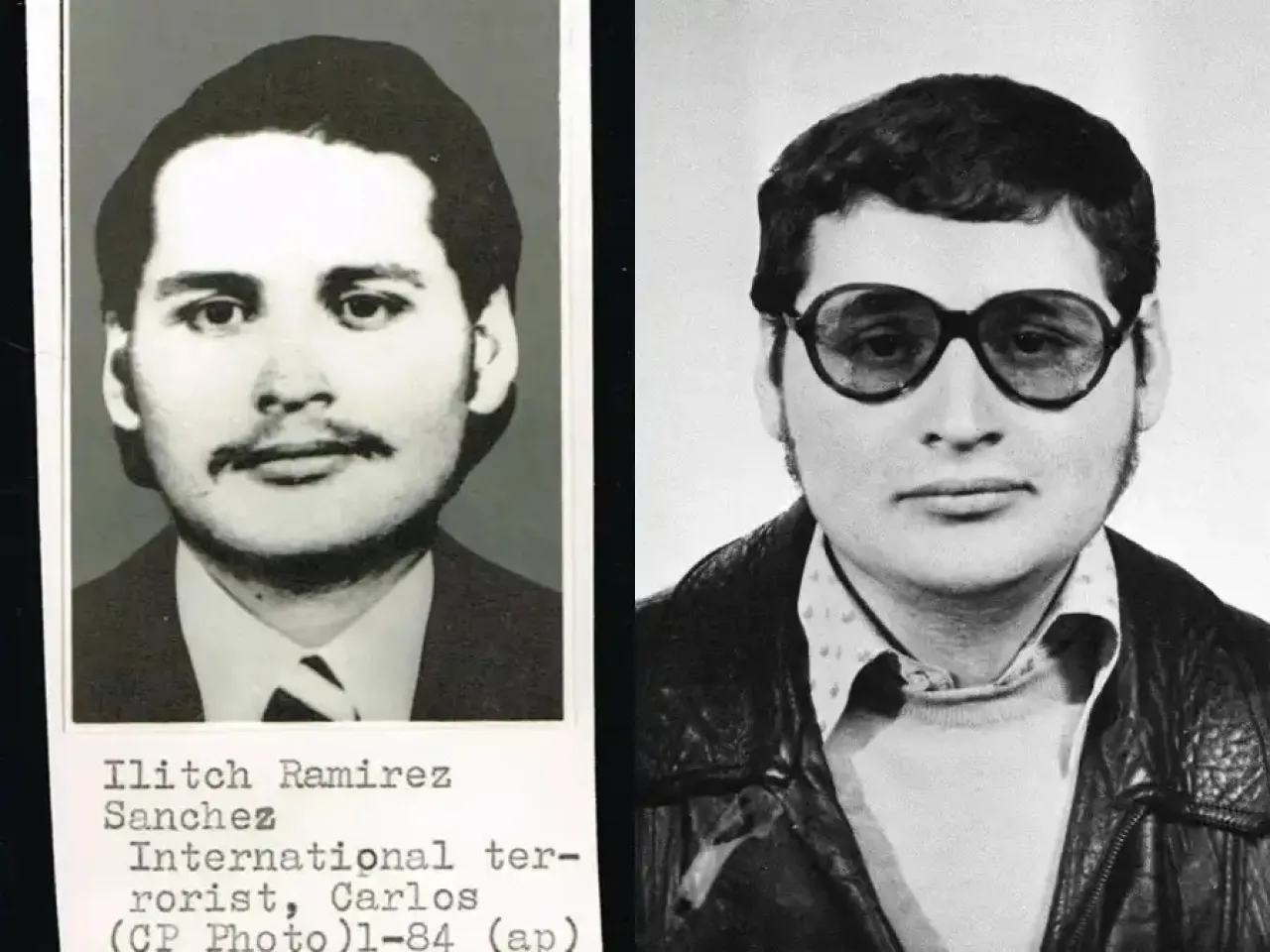
Carlos in two appearances as shown in Interpol bulletins (AFP)
Carlos in two appearances as shown in Interpol bulletins (AFP)
* Was he the most difficult guest?
- To a large extent. There were guests whose cases were difficult but the world was not as interested in them as it is interested in Carlos, or sought by a major great power like France.
* When did it appear that the handover process was possible?
- When it became completely difficult for him to leave. He was offered several options, to go to Uganda or Kenya or Eastern Europe. He said that there was a danger if he went by ship or plane because he could not reach, for example, Iran or the Soviet Union, Russia, or one of the Eastern European countries, without passing through a place where there was a great danger to him.
* Was he proposing?
- This was a joint action between him and Sudanese security. They look at airline routes and shipping lines, and there was always the problem of what would happen if this route or that was taken.
* Was he delaying and maneuvering?
- He was afraid.
* Did he get married in Sudan?
- Yes, perhaps. There was a Sudanese lady, perhaps he married her.
* Did Sudanese security reach him through some means?
- No, I don’t think there was a plan to reach him. He presented himself directly and quickly, that he was so-and-so and wanted to cooperate. And through the same lady.
* Negotiations began for transferring Carlos from Sudan to France. What did Philippe Rondo say? Who prepared the plan, what was the contribution of Sudanese security to that?
- As soon as Sudan expressed its readiness to hand over Carlos to France, according to the legal fatwa I mentioned to you, the preparation process began by French intelligence that they would arrive in Khartoum at one in the morning, and the French “Interpol” would meet with the Sudanese “Interpol” and signing for the handover by French security would take place and he would board a private plane, and they asked Sudan not to announce the news until after 6 hours during which the plane would have entered French airspace.
* As far as I know, was he transferred to a hospital? Was he being treated in a hospital?
- It’s a funny story. He was suffering from varicose veins, so he underwent surgery. And as the hospital director described it, it was a secondary operation but needed supervision. He did not know who the patient was.
He was in the Ibn Khaldun Hospital in the Al-Amaraat area in Sudan, and fortunately, the operations director in the Sudanese device was Dr. Matarf Siddiq, who was a doctor and was working in his first year of internship with the same doctor, the hospital director. There is knowledge (between them), so he informed him that they wanted to move him to a place because this person was dangerous for the hospital, Israeli, and infected with AIDS.
It was just a trick to convince him, so he agreed immediately to move, and mentioned that it was a secondary operation, but you know it needs a doctor to supervise it until delivery, so it was moved. On the day he entered the hospital, the device director did not know, nor did the operations director who was following up the case, know precisely where Carlos was. For the first time, he was not at his home because he does not go out after 11.
* At night?
- No, in the morning. But on that day, he left at eight. Not found so there was concern. But at two o’clock, they discovered that he was in Ibn Khaldun Hospital and this operation was performed on him.
* Was