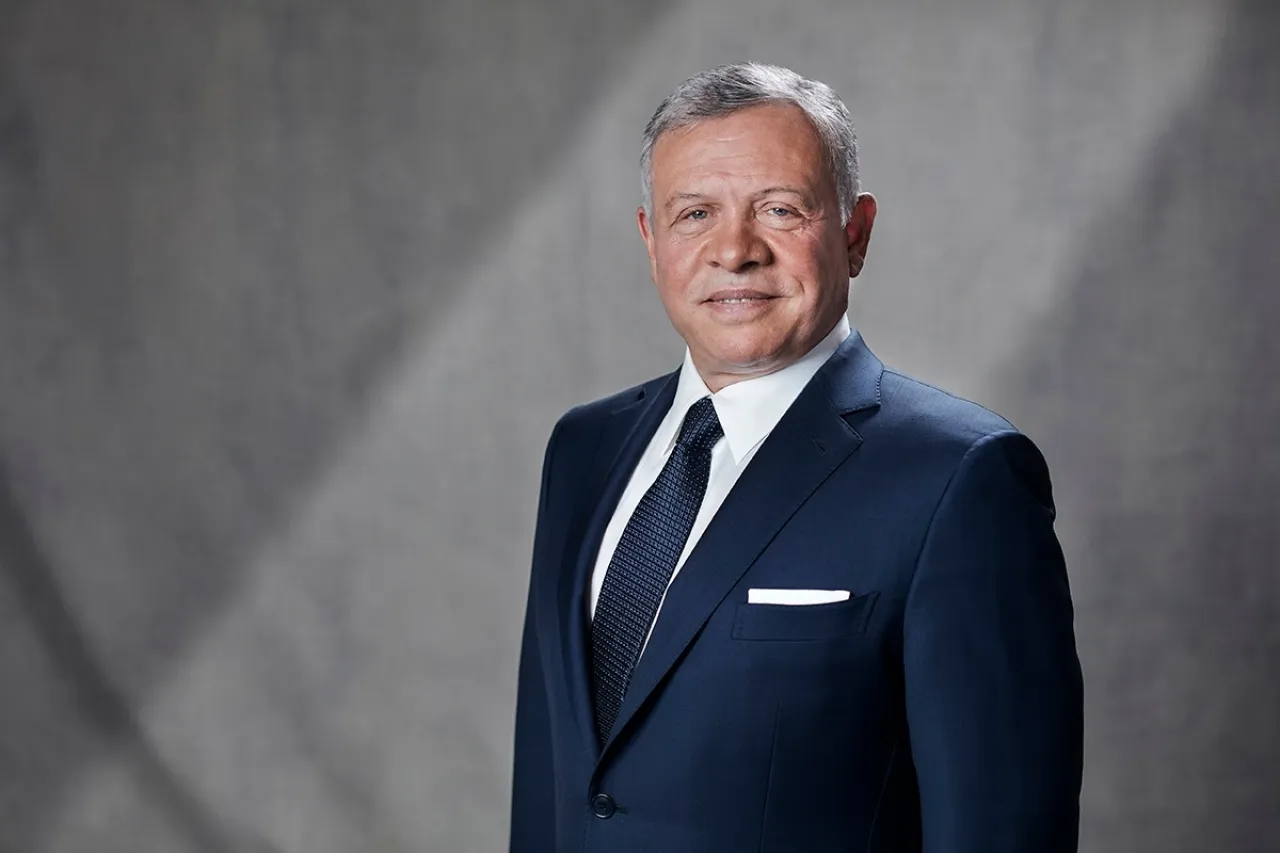
Khaberni - The British "BBC" channel broadcast, on Monday evening, two interviews with His Majesty King Abdullah II, and Her Majesty Queen Rania Al Abdullah, as part of a documentary titled "King of Jordan and Children of Gaza", focusing on the Jordanian humanitarian efforts to aid the Palestinians in Gaza.
During the interview, conducted by the channel's special correspondent Fergal Keane for the "Panorama" program, His Majesty spoke about the suffering of civilians in Gaza, saying, "As a former soldier, I never imagined, through the countless stories that reach me from our field hospitals, that a government could inflict such a level of suffering on a people."
Commenting on observing the destruction in the sector during his participation in some of the air drops carried out by Jordan to send aid, His Majesty said, "When I looked at the extent of the destruction in that part of Gaza, it was a real shock to me."
His Majesty added in the same context, "I did that (participated in air drops) because I was going to speak to the West, to tell them: I looked with my own eyes from the relief plane, I saw it with my own eyes, and how we as an international community allow this to happen is beyond understanding."
His Majesty described what happened in Gaza as, "For me, it's genocide. The international community, and many countries, think that too."
His Majesty continued, "There are movements in international courts describing it as genocide. In this era, and after the lessons that humanity has learned from our recent history, allowing such a thing to happen is beyond all limits."
Commenting on the news of the outbreak of the war on Gaza in October 2023, His Majesty said, "Everyone was in shock and disbelief. We realized that what had happened would be so serious that it would cause the entire region to undergo violent shocks."
His Majesty explained, "It was perfectly clear where things were heading, but I never imagined that we would continue like this for more than six months."
His Majesty was asked about his invitation and regional leaders to a meeting in New York last September to hear details of President Donald Trump’s peace plan, and said, "The message he conveyed to all of us was: This needs to stop, it must stop now," referring to the war on Gaza.
His Majesty added, "And during the explanation of the plan, most of us were surprised because a large part of it—about eighty-five percent—was very similar to what we had been discussing with the Europeans. We said, 'Mr. President, if anyone can achieve this, it's you.'"
In response to a question about whether he shares President Trump's belief that peace achieved through the American plan to end the war in Gaza could be everlasting, His Majesty said, "It must be (lasting peace). Because if we go through this again, I don’t think the region would survive. So, after eighty years of conflict, enough is enough."
His Majesty answered a question about whether he was asked as part of the peace process to send security and military personnel to train local security forces or to provide security in Gaza, saying, "The short answer is no, because we believe we are too politically close to this issue. However, returning to the details, what is the mission of the security forces inside Gaza? We hope it would be to keep peace, because if it was to enforce peace, no one would want to engage with that."
His Majesty continued in the same framework, "Keeping the peace means staying there to support the local police (Palestinians), Jordan and Egypt are ready to train them in large numbers, but this requires time. However, if we were patrolling Gaza with armed units, that’s a situation no country would want to engage in."
His Majesty was asked, "Do you trust Hamas when they say they accept not to participate in the political future?", He replied, "I do not know them personally, but those who work closely with them, Qatar and Egypt, are very optimistic that they will commit to it. If we cannot solve this problem, if we cannot find a future for Israelis and Palestinians, and relations between the Arab and Islamic world and Israel, then we are doomed."
In a question directed by the channel's correspondent to His Majesty, whether the conflict between Israel and the Palestinians could destabilize Jordan, His Majesty said, "I remember my father, in his later years, saying: I want peace for my children and for their children."
His Majesty continued, "I have two granddaughters, and they deserve this peace. How dreadful it would be for them to grow up saying the same thing my father said years ago!"
Her Majesty Queen Rania, during her interview as part of the program, spoke about the perilous conditions in Gaza, wondering, "Can you imagine what it means to be a parent over the past two years? To watch your children suffering, starving, shaking with fear, and you are completely powerless to do anything, and to know that the whole world is watching and doing nothing."
Her Majesty continued, "That nightmare is every parent's nightmare, but it was the daily reality for Palestinians over the past two years."
Her Majesty added in her discussion of the consequences of the war, "It's not just about numbers, but about the means used, and the dehumanization, and the fact that items such as food were used as a weapon of war. Painkillers and anesthetics were not allowed into the lands. There is no justification for that."
Her Majesty praised President Trump for his efforts in achieving a ceasefire in Gaza, saying, "To be fair, Trump was the first president in a long time to actually put real pressure on Israel."
Her Majesty added, "In the past, when Israel crossed lines, an American president might have been content with a few words of reprimand or just a simple warning. But President Trump actually succeeded in getting (Israeli Prime Minister Benjamin) Netanyahu to agree to a ceasefire. I hope he continues to engage in this process, because as I said, this is just the first step."
Her Majesty pointed out that the road to rebuilding Gaza "will be long and tough."
The journalist Keane narrated the idea of his producing the documentary and interviewing His Majesty the King and Her Majesty the Queen, which came after he followed two children wounded during the war on Gaza who were treated in Jordan, named Abdulrahman and Habiba.
The program covered the treatment stages of the girl Habiba in Jordan, and her meeting with her mother and brother with His Majesty the King.
Habiba, the girl, came from Gaza with her mother and brother in critical health, as discussed by the medical staff in charge of her case, in interviews within the BBC documentary program.
The program addressed the extent of the destruction suffered by Gaza and its people, as well as Jordan's endeavors led by His Majesty the King in mobilizing international efforts to stop the war and enhance humanitarian response in the sector.
The program highlighted the efforts of Jordan to send aid by land and air, and the commitment of Jordan to treat two thousand Gazan children in its hospitals, which His Majesty the King discussed during his meeting with President Trump last February.