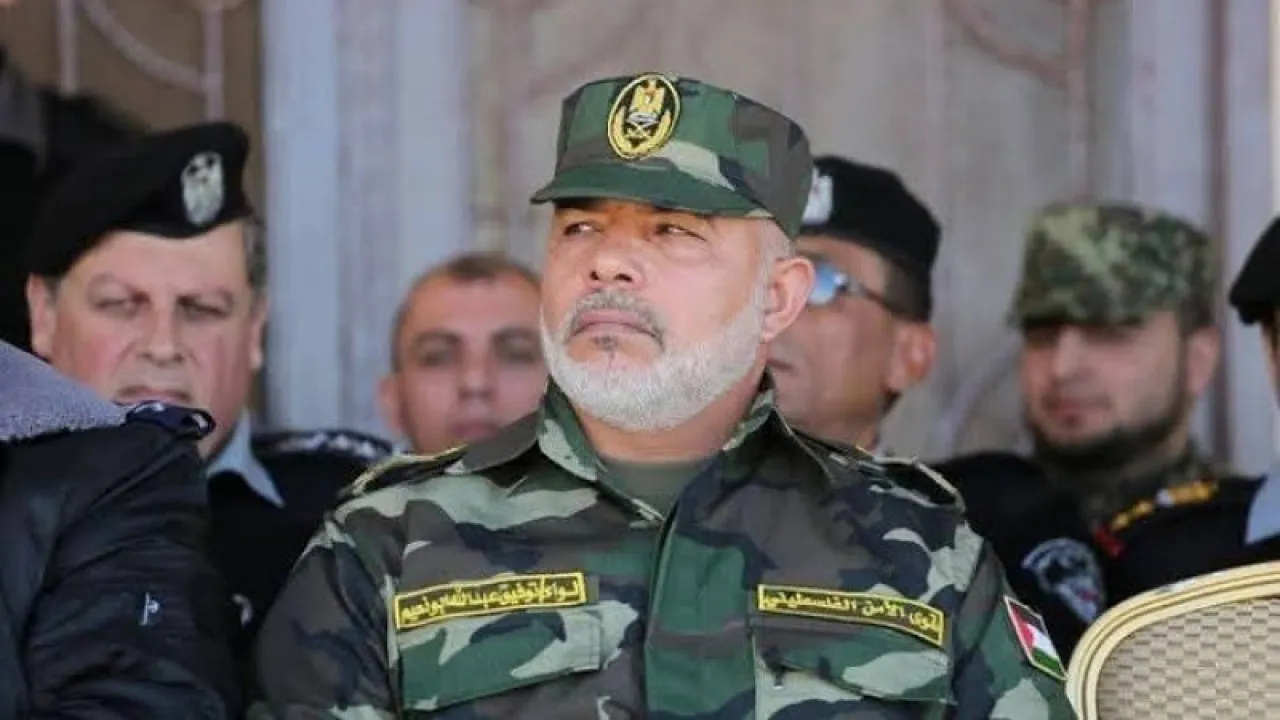
Khaberni - In the context of the leadership vacuum left by the assassination of Yahya Sinwar in the Gaza Strip and the failure of the latest exchange deal to release prominent leaders from occupation prisons, a report by "Israel Hayom" highlighted a prominent security figure, Tawfiq Abu Naim, strongly nominating him to succeed Sinwar, and playing a pivotal role in shaping the post-war landscape in the sector.
Who is Tawfiq Abu Naim? A security career from "Al-Majd" to leading Hamas's security services Origins and upbringing: Tawfiq Abu Naim is 63 years old, born in the Al-Bureij refugee camp in central Gaza Strip.
Education and early affiliation: He studied Islamic law at the Islamic University of Gaza and was a student of Sheikh Ahmad Yassin. He joined a local cell of the Muslim Brotherhood in 1983.
"Al-Majd" agency and life imprisonment: He was a founding member of the "Al-Majd" security agency affiliated with Hamas, alongside Yahya Sinwar and Ruhi Mushtaha, the unit that was tasked with pursuing and liquidating "collaborators" with the occupation. He was arrested in 1989 and sentenced to life imprisonment, and he learned Hebrew during his captivity.
Shalit deal and return to Gaza: He was released in 2011 as part of a prisoner exchange for the soldier Gilad Shalit, and returned to the Gaza Strip.
Building security force after liberation: After his return, Abu Naim did not settle for nominal administrative roles. In addition to his responsibilities related to overseeing the affairs of martyrs' families and prisoners, and managing the reception of Palestinians returning from Syria, he was appointed in 2015 to a highly sensitive security position.
With the transformation of the old "Al-Majd" agency into a strong and dominant security body under Sinwar's leadership, Abu Naim became responsible for all security devices in Gaza. His main tasks included:
Thwarting any intelligence breaches by the occupation.
Enhancing the police branches and internal security forces.
Suppressing any political protests or internal opposition with an iron fist.
Neutralizing extremist groups influenced by the ideology of "ISIS."
Why Abu Naim now? The leadership vacuum and the need for a strong security person "Israel Hayom" sees the rise of Abu Naim in the context of the widening leadership gap in Gaza. After the assassination of Sinwar and other leaders, and with exile leaders remaining abroad, only a few of the founding generation remain inside, notably the elderly Mahmoud al-Zahar.
Assessments indicate that Abu Naim, like other prominent security figures, has been called upon to fill this void and occupy key positions in the movement.
The coming shadow man? A potential role in "the day after" The newspaper anticipates that Abu Naim, along with prominent military wing leaders (such as Izz al-Din al-Haddad and Raed Saad), will participate in shaping the post-war phase.
Given his broader political experience compared to the military leaders, Abu Naim might emerge as a "key figure pulling strings from behind the scenes," even if a technocratic administrative committee is formed to manage the civilian sector, as Trump's plan stipulates.
The newspaper points out that the "criminal mechanism" (referring to the security apparatus) built by Abu Naim has expanded, and Hamas is now exploiting the surveillance and eavesdropping mechanisms he established to track those suspected of collaborating with the occupation, and conducting "mock trials" even at the height of the war.