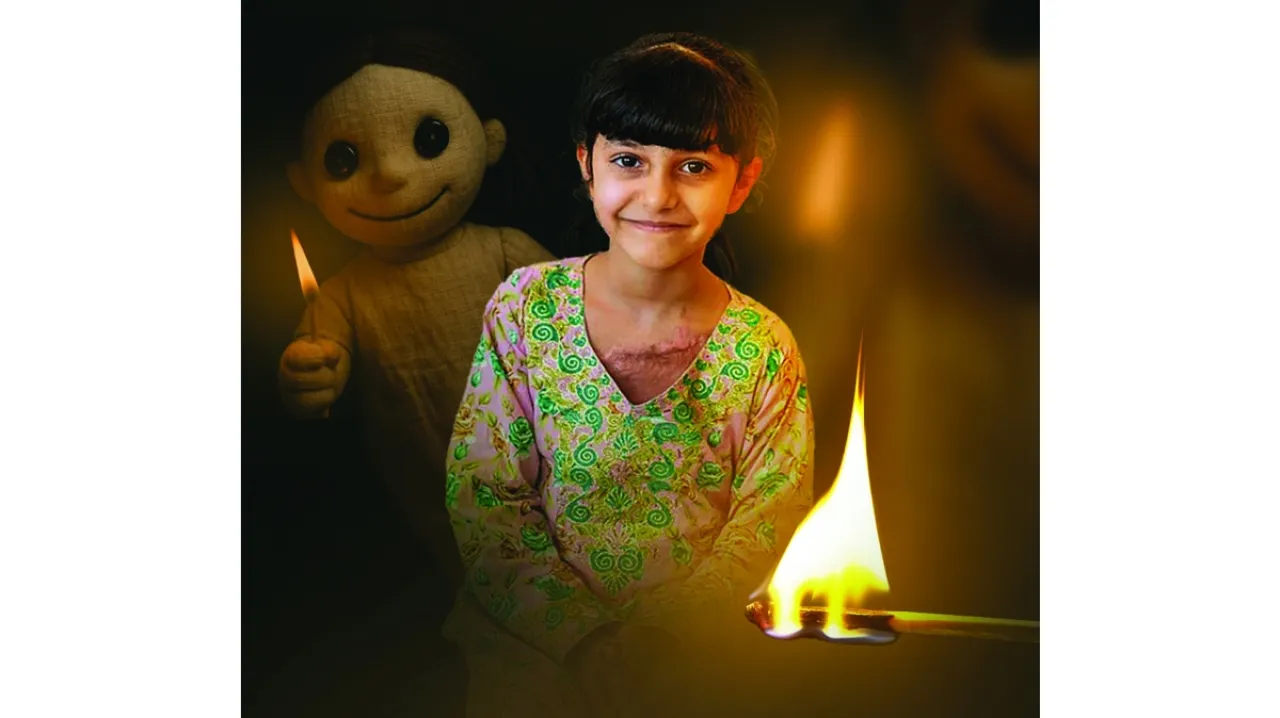
Khaberni - The Emirati girl Moza Kasib (seven years old) survived severe burns after she tried to imitate a viral clip on social media showing a doll catching fire, known as the "Evil Doll Trend".
The incident coincided with her birthday celebration in Ras al-Khaimah, causing burns that extended from her chest to her back and abdomen, requiring prolonged treatment lasting more than two months at Sheikh Shakhbout Medical City in Abu Dhabi.
The girl's mother told "Emarat Al Youm" that Moza was celebrating her seventh birthday with her cousins when they decided to imitate a viral clip on social media showing a doll catching fire as part of what is known as the "Evil Doll Trend". As soon as they ignited the fire for the experiment, the flames instantly engulfed Moza's clothes, as she was wearing the traditional Emirati "Mukhawar" adorned with beads and decorations, which caught fire as soon as it came into contact with the flames.
She added that her daughter, after her clothes caught fire, ran terrified outside driven by fear, instead of heading towards the family, which increased the severity of the burns due to the heat of the midday sun. She noted that her brother, who happened to be passing near the house, saw her and the fire engulfing her clothes, quickly tore them off and rescued her before immediately transferring her to the hospital.
Moza's mother mentioned that her daughter was initially taken to Khalifa Specialty Hospital in Ras al-Khaimah, then transferred by ambulance to Sheikh Shakhbout Medical City for specialized treatment, adding that she "was crying in extreme pain all the way, but calmed down as soon as she reached the hospital, where the medical team immediately took her into the treatment room and began dealing with her condition urgently." She highlighted that the burns affected the area from the chest to above the navel, including the shoulders, back, and part of the hair, pointing out that the doctors used advanced treatment techniques, including temporary biologic matrix (BTM) and precise grafting operations using the "MEC" technique, to speed up the healing process and reduce pain.
She continued: "We spent 66 days in the hospital, it was a very difficult experience, but it taught us a lot about patience, as the medical team explained to us every detail of the treatment step by step, and treated my daughter with great kindness to ease her fears."
She added that despite what she went through of pain and suffering, Moza showed remarkable courage during her long treatment journey, quickly adapting to the hospital environment, forming friendships with other children, sharing games and gifts with them, and eventually aspiring to become a physiotherapist when she grows up, to help patients as the doctors helped her.
After a treatment journey that lasted for more than two months, Moza regained her smile, returned to school walking confidently and playing with her classmates, carrying with her a valuable lesson in awareness and caution from imitating digital content without supervision.
Her mother affirmed that her health condition has significantly improved, and the medical team has reassured the family that her skin will gradually recover over time, pointing out that Moza has overcome the pain phase and resumed her usual activities.
Despite her young age, Moza showed significant awareness of what she went through, saying: "I am now a little afraid of fire, and I will not imitate any dangerous trend again."
From this harsh experience, Moza emerged with a profound lesson; today, she not only bears the scars of the burns but also carries a message she broadcasts to her classmates in class, to be a small voice warning against the dangers of blindly imitating content spread on the internet.
In this regard, the head of the Programs and Activities Department at the Juvenile Awareness and Care Association, social worker Aisha Rashid Said Al Kendi, confirmed that the spread of "dangerous trends" on social media poses a real threat to the psychological and physical safety of children, noting that "some of the widespread clips transform the natural curiosity of children into reckless behavior that exposes them to serious risks". She asserted that "such phenomena reflect an urgent need to raise the level of digital awareness in the family and the community, as children today live in an open digital environment that requires increased awareness from those around them to protect them from hidden negative influences." She explained that "digital platforms are filled with misleading entertainment content depicting dangerous experiments or challenges as humorous or safe situations, such as lighting fires or jumping from high places, or conducting chemical experiments at home", emphasizing that "these scenes are often produced solely for viewing and interaction purposes, but they deceive children who do not have the ability to distinguish between acting and reality". Al Kendi added that "children in this age group tend to imitate what they see on screens without realizing the consequences, which necessitates that families enhance aware monitoring and continuous dialogue with their children, to build digital awareness that protects them from the dangers of blindly imitating widespread trends". She pointed out that "dialogue with children about what they watch represents an effective protective shield, as every minute spent by parents discussing and educating with them may prevent an accident or dangerous experiment", emphasizing that "digital education has become a part of parents' fundamental responsibilities". She stressed that "the responsibility for protection does not lie with the platforms alone, but starts within the family, through monitoring the type of content that the child is exposed to, and accompanying him in using modern technologies", confirming that "effective monitoring not only means prohibition but is based on awareness and participation in understanding the digital world in which their children live today." She said that "the presence of parents as partners in the digital experience gives the child a sense of security and belonging, making him more willing to share with them what he sees or experiences from suspicious content, thereby enhancing his self-confidence, and reducing risks before they occur."