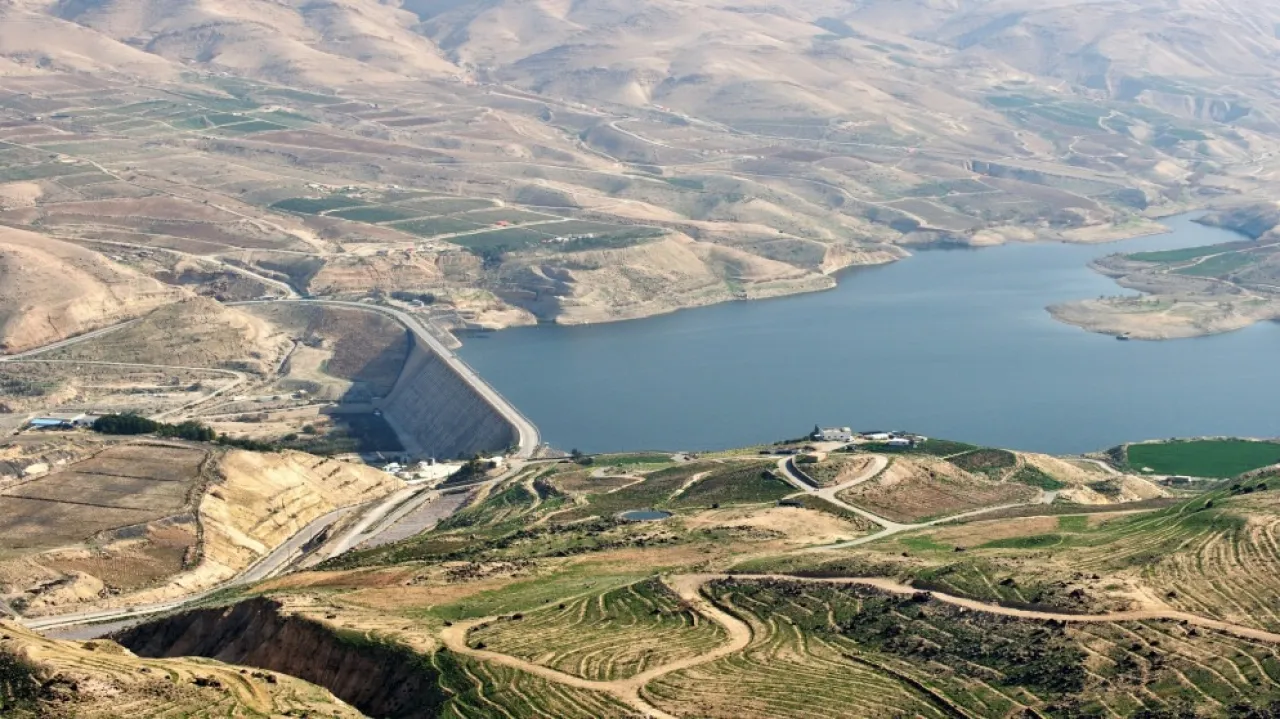
Khaberni - The Minister of Water and Irrigation, Raed Abu Al-Saud, revealed on Thursday that there are studies to establish new dams in different areas, cleaning and maintaining some dams, and building pits and earth dams. Currently, Jordan has about 420 earth dams and pits with a capacity of 200 million cubic meters.
Raed Abu Al-Saud said during a meeting organized by the Jordanian Strategy Forum in Amman that the size of the projects whose financing is secured and are currently under implementation and study in the water sector amounts to 2.4 billion dinars; including 29 projects currently under implementation, pointing out that the projects being undertaken by the ministry will reflect on improving the level of service provided to citizens in various areas.
He added that the water sector continues its efforts to overcome various challenges and find sustainable solutions to secure water, affirming that the National Carrier Project is not just a mere water security for Jordan but it is a national security project that provides solutions for upcoming generations.
Regarding reducing losses in the water sector, Abu Al-Saud stated that the water sector has achieved success in reducing the financial losses incurred from operating and maintenance costs by about 150 million dinars annually, and saved an additional 14 million dinars from energy costs due to achievements in alternative and renewable energy.
Regarding the increasing reliance on unconventional sources, there was a recent increase of 16.8% in treated water to reach 200 million cubic meters annually. Also, the ministry is working to reach 250 million m³, and cultivating about 90,000 dunums in the Jordan Valley and Wadi Araba areas relying on saline water in high-quality dates that generate income for the national economy and provide direct and indirect job opportunities.
He reviewed the challenges faced by the water sector in Jordan, mentioning that the per capita water quota has dropped to less than 60 cubic meters for all uses, and hence securing sustainable sources such as the National Carrier project is a high priority.
He disclosed many technical, financial, and legal details related to completing the financial closure procedures and that work is ongoing with local Jordanian banks and the social security to establish a national public shareholding company that contributes to financing the National Carrier and initiating its implementation at the beginning of next year in partnership with the local and international private sector.
Abu Al-Saud pointed out that the ministry was able to overcome disturbances and challenges during the last summer with strenuous efforts amid the decline in water quantities available from various sources and securing them for citizens, agriculture, and industry. It continues its work through the strategic plan and implementing the economic modernization vision and adopting 12 new water policies to deal with the water reality to secure the needs of citizens and various uses, proud of surpassing the set percentage in reducing non-revenue water, having achieved a reduction of 6.7% recently through implementing plans and programs to reach global levels.
He noted that the current non-revenue water is 45.6%, and work is ongoing to achieve greater milestones in reducing losses and facing assaults on water sources that have provided water quantities that reflect on improving water supply for citizens and implementing the harshest penalties against anyone attempting to infringe upon citizens' water rights.
He added that more effective measures will be taken to reduce water wastage, mentioning that the ministry is in the process of conducting modern, advanced technological experiments to enhance rain enhancement in the kingdom and cooperation with Syria in this field.
He explained that the use of modern technologies to benefit from innovation especially in improving the efficiency of industrial and agricultural water and irrigation efficiency, affirming that national agriculture has a social and economic impact on the Jordanian community.
Raed Abu Al-Saud said that a station for treating industrial water has been operated to benefit from the used water by 100%, and work is ongoing to generalize the experience across various Jordanian industries, expanding the use of artificial intelligence in various areas, digital transformation, and launching the new water app that offers various services.