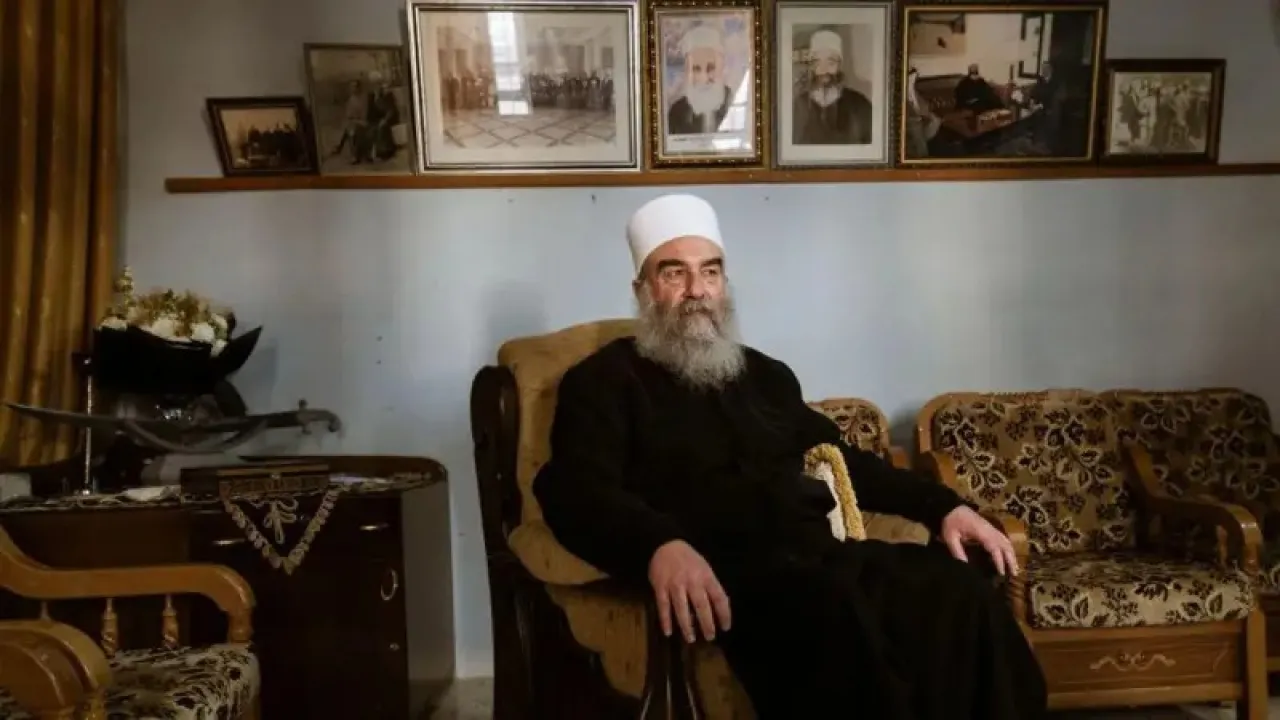
Khaberni -"A humiliating statement was imposed on us," described Sheikh Hikmat Al-Hijri, the spiritual leader of the Druze Monotheist Sect, in a statement previously issued in his name on Tuesday morning in which he had expressed his welcoming of the "intervention" by the Syrian government in Sweida.
Al-Hijri accused the Syrian authorities of "breaking promises and commitments" through the "continued indiscriminate bombing of unarmed civilians."
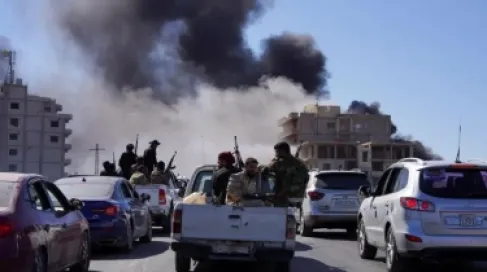
His statements came after the escalation in the Sweida governorate, following bloody clashes between Druze fighters and Bedouin tribes, which left about 100 dead. Al-Hijri stated that the Druze "are facing a total genocide."
From Venezuela to the Leadership of the Reasoning
In this context, the name Sheikh Al-Hijri emerges as one of the most prominent voices opposing the government in southern Syria. Who is this sheikh, and how have his positions evolved in recent years? And to what extent do his current positions reflect the general mood of the Druze community in Sweida?
Sheikh Hikmat Al-Hijri was born in Venezuela in 1965, where his father was working. He then returned to Syria to complete his education in Sweida, before joining the Law School at the University of Damascus and graduating in 1990.
Al-Hijri grew up in a conservative religious environment and gradually climbed the ladder of religious references until he succeeded his brother Ahmad as the head of the reasoning leadership in 2012 after his death in a mysterious traffic accident.
Turn against Damascus
Initially, Al-Hijri was reserved towards Assad's regime, but over time, he gradually began to distance himself from supporting the regime, especially after what he called a "verbal insult" by a security officer in 2021 during a phone call, which triggered a wave of protests in Sweida and marked a turning point in his relationship with the former regime.
In an interview conducted by the BBC with the Druze leader in January, Sheikh Hikmat Al-Hijri expressed an "open" stance towards the new phase in Syria following the fall of the Assad regime. He said he accepted the change peacefully and expressed readiness to cooperate with the new government to ensure a peaceful transition, emphasizing that "the positives outweigh the negatives despite some reservations."
He also called for genuine partnership among Syrians and the drafting of a new constitution, and the formation of a government and a national army that represents everyone, declaring the Druze's readiness to integrate into the Syrian army on national grounds, and stressed the importance of Syria's comprehensive unity, rejecting the logic of majority and minority.
However, since then, his position towards the current government has completely changed, following the bloody confrontations that began in the outskirts of Damascus, specifically in Jaramana and Ashrafiyat Sahnaia, which resulted in the deaths of dozens of civilians and armed security personnel. Al-Hijri held the government responsible for what happened, and called for providing international protection for the members of the sect, in statements that sparked widespread controversy.
Unprecedented escalation and calls for the internationalization of the crisis
In March, Sheikh Hikmat Al-Hijri described the new Syrian constitution project as "illogical," calling for it to be rewritten on democratic grounds that ensure genuine participation. In an official statement, he criticized the current transitional management, which is "done in a one-sided manner without real participation from the various components of the nation."
Regarding the bloody events on the Syrian coast, Al-Hijri described them as "massacres against innocents that bring to mind the atrocities of ISIS." He added: "When asked about who is responsible, it was said that these are individual acts, but we affirm that your factions represent you, and you bear full responsibility."
The tones of Sheikh Hikmat Al-Hijri continued to escalate against the Syrian government, especially after the clashes that erupted in the primarily Druze regions of Jaramana and Ashrafiyat Sahnaia, where he intensified his tone in a statement calling on the international community for urgent action, saying: "We don't need words but actions," and stressing that the members of the Druze community "are not separatists, but demand genuine participation in building a federal democratic state that preserves the dignity of Syrians and ensures their security."
He added that the loss of trust in the government was complete, saying that it "kills its people through extremist militias affiliated with it," and emphasized that what is happening is "systematic and documented murder," necessitating "urgent international intervention" to protect civilians and a prompt cessation of violations.
In an interview conducted by the Washington Post in May, Sheikh Hikmat Al-Hijri, expressed a notable position towards Israel, contradicting the traditional positions adopted by successive Syrian governments. Al-Hijri said: "Israel is not the enemy," noting that what the Syrians have experienced for decades from anti-Israel slogans did not serve the people's interest. He added: "We have lived under these slogans for decades. In Syria, we should only care about the Syrian cause."
Syrian writer and researcher Jamal Al-Shoufi said in a conversation with the BBC that Sheikh Hikmat Al-Hijri's call for international intervention came "without sufficient political scrutiny and lacked a precise reading of the complexities of the Syrian scene," describing the statements as "unfortunate."
Internal division
Shoufi explained that the internationalization of the Syrian issue is extremely difficult, regardless of the party requesting it, noting that "the Syrian experience from 2012 to today has clearly shown that the international community is not in the process of internationalizing the crisis, given the conflicting international interests about Syria and the implicit agreement to maintain the status quo."
He added that the position of the Druze community towards the current government is not unified but varies, with some voices leaning towards the necessity of de-escalation and stopping the incitement against the people of Sweida, while other parties adopt more severe positions. However, the common denominator is the concern about the security chaos and the desire to spare the region further escalation.
The statements of the Druze leader Sheikh Hikmat Al-Hijri do not necessarily reflect the position of the rest of the religious leaders in the community. Sheikhs Hamoud Al-Hannawi and Yusuf Al-Jarboua, in a statement issued by them recently on behalf of "the leadership of the Druze Monotheist Muslim Sect, religious authorities, notable figures, and all members of the community," emphasized "the need to adhere to national unity and to shun discord." This came in the wake of the armed clashes that took place south of Damascus. They stressed that the members of the community "form an integral part of the united Syrian nation," rejecting any calls for division or separation."
In this context, Syrian researcher Ismail Abu Assaf sees the contradictions in the Druze religious scene "not as a result of substantial internal disagreements as much as they are the result of accumulations nurtured by the former regime to impose control and weaken the independence of religious decision-making."
He points out that the adversities between the leaders "are not new, but appear in certain environments and disappear in others according to the circumstances, and do not necessarily reflect a national position that unites all." Abu Assaf primarily blames the officials, explaining that "the state that has relinquished its role in building its institutions and has let national needs be tossed around by narrow interests is the reason for inflaming positions."