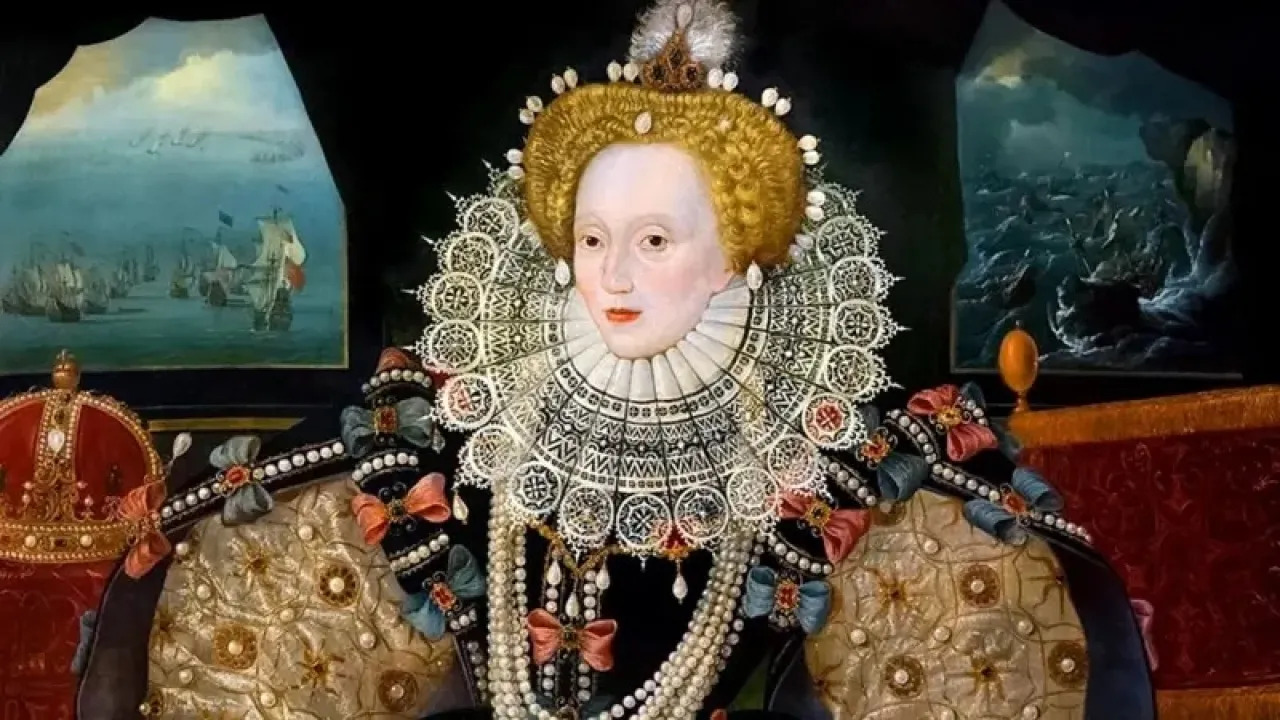
Khaberni -Queen Elizabeth I, daughter of King Henry VIII, is the only one in England's history who never married at all. Her last visit to Kenilworth Castle 450 years ago might reveal some threads that explain this vow she took upon herself, highlighted by a new art exhibition held inside the castle, featuring artistic scenes of betrayal and beheadings, as well as a detailed declaration of love.
One evening in July 1575, Queen Elizabeth I, who was then 41 years old, arrived at Kenilworth Castle in Warwickshire, UK, for what was her longest and final visit.
The queen had gifted the castle to Robert Dudley in 1563, and the following year, she granted him the title of "Earl of Leicester". Dudley was among her closest confidants, believed to have been her friend since childhood. The close nature of their relationship stirred much gossip and controversy.
Robert Dudley undertook major renovations at the grand castle, in preparation for the arrival of the unmarried queen. He erected new buildings and created an elegant garden, besides meticulously arranging the surrounding lands. He spared no effort in presenting exceptional entertainment offerings, including music, dance, acrobatics, and attractive fireworks, in addition to artistic pieces performed by actors in theatrical costumes.
Dudley spared neither effort nor money, as the cost of the event reached one thousand pounds sterling per day (equivalent to 1400 dollars back then), which is now valued at millions of pounds. These lavish celebrations were interpreted as a grand and costly marriage proposal, equivalent to the rental of an airplane to raise a banner saying "Marry me" in our current era.
Jeremy Ashbee, head curator of the English Heritage Museum, told BBC: "The celebrations of 1575 were an attempt to woo Elizabeth, as marriage was one of the topics apparent in some activities."
Elizabeth Goldring, who conducted an extensive study on Dudley, Lord Leicester, described this occasion as "his last throw of the dice."
Dudley's venture seemed to be going well until there was a sudden shift in events. It was scheduled that the highlight of the stay would be a theatrical show known as "The Mask" on Wednesday, July 20. However, the show was never performed. Was it impeded by bad weather as the official narrative claims? Or did the queen read the content of the performance and become furious? The show included the goddess Diana, goddess of chastity, in search of one of her pure nymphs named "Zabita", a clear implication of the name Elizabeth.
The theatrical performance was supposed to conclude with a messenger from the goddess Juno, goddess of marriage, directly addressing Queen Elizabeth I, imploring her not to follow the path of Diana, but rather to choose marriage instead of aversion.
Despite Dudley having some leeway in his relationship with the queen, this message might have crossed the line, and whatever the case, the performance was not presented, and the festivities ended, with the queen staying in her suite a few more days before leaving the castle on July 27.
"Filled with pride and sharp temper"
Artist Lindsay Mendick commemorated the 450th anniversary of the queen's visit by designing a large sculptural work titled "The Wicked Game" inside the castle, drawing inspiration from ancient mythology and the details of Queen Elizabeth I's visit, as well as the way her image as a virgin was employed in smart political maneuvers throughout her 45-year reign.
The work consists of 13 diverse scenes, some of which have an evil nature, and others a black comedic tone. The sculptures depict the queen and those around her in the form of animals, with the main work representing Elizabeth as a lioness, and Dudley as a bear, arranged on pieces of a giant chess board.
Mendick told BBC: "Playing chess is the perfect metaphor for what Elizabeth had to do to ensure her survival."
She added: "I see her as a very important character, and a significant entryway for understanding how we deal with women today. The event organized by Dudley in Kenilworth was supposed to be a grand celebration for Elizabeth, filled with luxury and pleasure. Yet at the same time, it was charged with hidden meanings, as the aversion to marriage or childbirth, for strong women like Elizabeth, was considered an extreme act aimed at self-protection and maintaining personal sovereignty."
Queen Elizabeth I, daughter of Henry VIII, was the only English queen who never married at all, ascending the throne in 1558 at the age of 25. She inherited from her predecessors, her half-brother Edward VI (1537–1553) and her half-sister Mary I (1516–1558), complex religious, political, and economic crises.
Advisors and Parliament members continuously urged her to marry to ensure the country's security, as the idea of a woman ruling alone was unimaginable at that time. The prevailing belief was that the queen must marry, not only to secure a male heir and avoid disputes over the throne but also to allow a man to manage political and military affairs.
Despite the ongoing marriage proposals from several figures, whether through intermediaries or themselves, Elizabeth consistently rejected these offers and evaded them repeatedly. What was the reason?
"No master over her"
Elizabeth was fully aware that a woman could govern efficiently without a man's supervision or guidance. In the summer of 1544, she saw Catherine Parr, Henry VIII's wife, exercising firm power during the king's absence on his military campaign in France.
Catherine proved her capability as a regent, imposing her respect on ministers and noblemen despite their influence and status.
Moreover, Elizabeth's close family did not provide a model of marriage to emulate, as her father had her mother, Anne Boleyn, arrested on false charges of adultery and conspiracy, then shockingly decided to have her executed by beheading. Elizabeth was barely three years old at the time.
Crafted by Mendick, one of the sculptures represents this execution, showing Anne in the form of a kneeling fox in prayer, facing the executioner embodied as a malevolent dog.
Some analysts suggest that Elizabeth might have suffered from a deep fear of sexual relationships. For example, Alison Weir in her book titled "Elizabeth, the Queen" contemplates the possibility that the queen "complexly associated sexual relations with death."
A BBC television series produced in 2005 titled "The Virgin Queen," as reported by The Telegraph, portrayed her as a queen terrified of sex. Screenwriter Paula Milne told the newspaper at the time: "If I were asked to write about a contemporary woman whose mother was killed by her father, I would naturally explore the psychological effects of that."
Elizabeth indeed tended to accompany attractive men and occasionally displayed flirtatious behavior towards them. However, she had valid reasons to fear pregnancy and the dangers of childbirth. She described childbirth during the Tudor era as risky. For instance, Jane Seymour, Henry VIII's third wife, died during childbirth, and Catherine Parr died from an illness following the birth of her child. Additionally, Elizabeth's grandmother, Elizabeth of York, also perished after giving birth.
"How was Elizabeth represented?"
Beyond her personal motives, there were political considerations that led Elizabeth to avoid marriage. Among these considerations, she likely wished to keep the country free from foreign influence. Moreover, the potential for her marriage served as a "pressure point" enhancing her diplomatic stance in dealings with France, Spain, and other nations.
On the other hand, if she had married one of the English nobles, with Robert Dudley as a potential candidate were it not for his wife Amy Robsart's mysterious death in 1560, it would have displeased other nobles and disrupted the internal balance of power in the country.
Thus, Elizabeth kept everyone in a state of anticipation and waiting. It seems she had an instinctive understanding of what is known today as public relations management. She was keen to present herself as a queen entirely devoted to serving her people. From the beginning of her reign, she began to establish her image as "The Virgin Queen." In 1559, in response to Parliament members who pressed her to marry, she said: "A marble stone will one day testify that a queen who reigned for a time lived and died a virgin."
In the final scene of the film "Elizabeth" directed by Shekhar Kapur in 1998, actress Cate Blanchett portrayed the young queen, reenacting it again in the second part in 2007 titled "Elizabeth: The Golden Age." In the first film, she is seen deliberately transforming into the character of "The Virgin Queen," appearing in a white dress before her astonished court and declaring: "I am married to England."
Although Kapur's film does not adhere strictly to historical accuracy, the dialogue reflects an authentic statement by the queen in 1559 when she announced that she would not marry because she was "already married to a husband, namely the Kingdom of England." Notably, her sister Mary I, known as "Bloody Mary," made a similar statement but later married Philip II, King of Spain.
Queen Elizabeth's decision not to marry was a pivotal element in depicting her character in popular culture, clearly illustrated in a BBC series.