Khaberni -"Heat, in particular, must be seen as a ringing alarm," warned the International Federation of Professional Footballers (FIFPro) about the conditions accompanying the hosting of the Club World Cup in the United States, which is also hosting the national teams World Cup next year.
This warning comes among a group of complaints and observations that sparked controversy over the suitability of the conditions for the United States to host both the Club and National Teams World Cups.
Before the 2026 World Cup, a FIFPro study warned that six out of 16 hosting stadiums pose "very high risks" for players to suffer from heat stress.
The International Federation of Football Associations (FIFA) considers the tournament successful and expressed its readiness for dialogue regarding the regulatory measures for World Cup 2026.
48 teams will participate in the World Cup next year in the United States, Canada, and Mexico, and 104 matches will be played in the tournament.
What are the main problems?
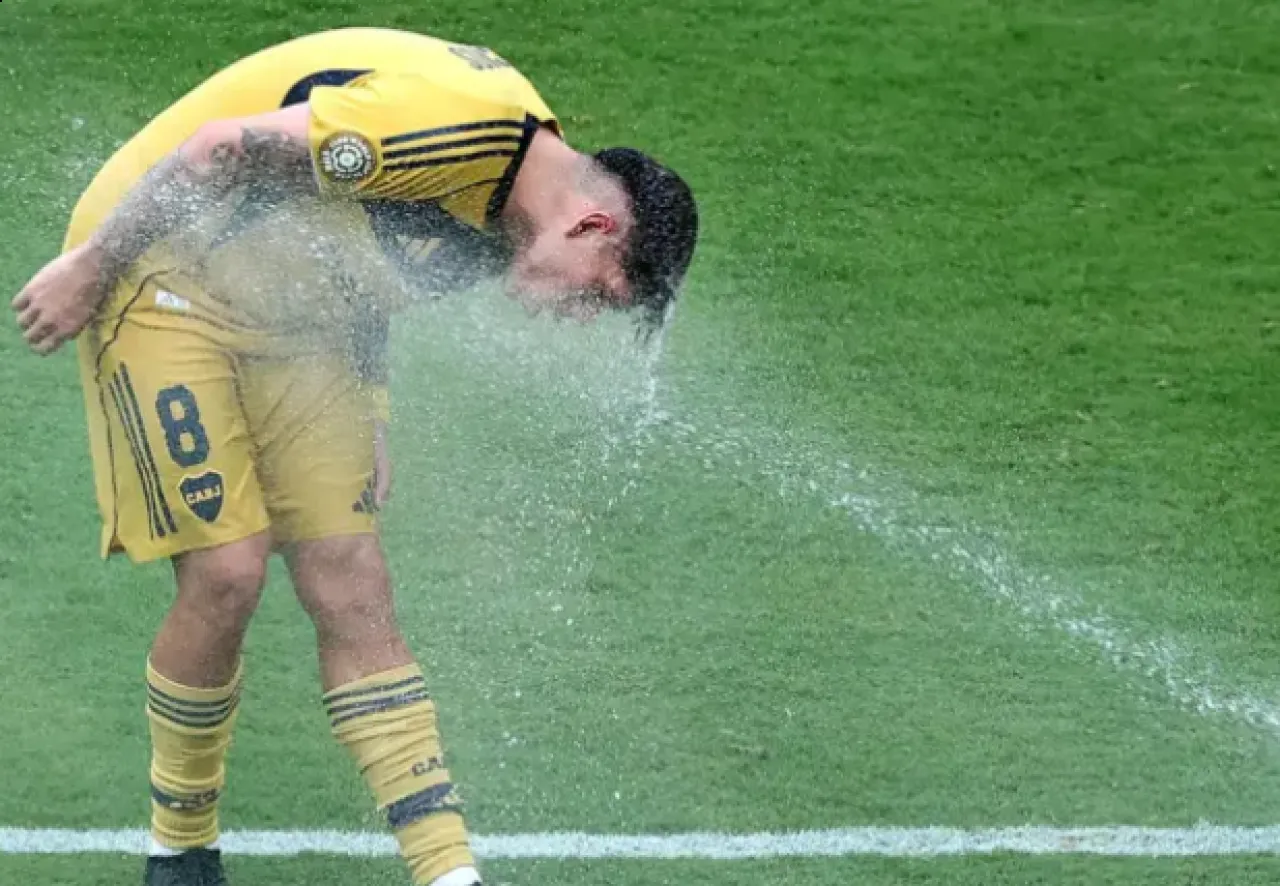
The summer heat in the United States made conditions difficult in several matches.
During the tournament, a heatwave in Eastern North America led to dozens being hospitalized for treatment of heat-related illnesses.
On June 24, temperatures in New York rose to 39°C, a record number for June.
Juventus coach Igor Tudor mentioned that ten players from his team asked to be substituted during their match against Real Madrid.
Borussia Dortmund’s substitute players watched the first half of their match against Sundowns from the changing room to avoid the sun.
The team's coach, Nico Kovac, said he was "sweating as if he had just come out of a sauna."
Police dogs at the "Lincoln Financial" stadium in Philadelphia wore shoes because of the high concrete temperatures underfoot.
MetLife Stadium in New Jersey is scheduled to host eight matches in the 2026 World Cup, including the final match.
Like most other stadiums in the United States, Canada, and Mexico, there is no roof, and the shade is limited for those inside "MetLife."
FIFPro said that nine cities out of the 16 hosting World Cup 2026 have "very high risks" concerning heat stress injuries during the tournament.
Matches experienced long stops due to storm warnings.
US rules state that play stops when lightning is recorded within a 10-mile radius and can only resume 30 minutes after the last lightning strike.
Six matches were delayed for periods ranging between 40 minutes and two hours.
Italian Enzo Maresca, coach of England’s Chelsea, sharply criticized the suspension of his team's match against Benfica for almost two hours following a storm warning.
Maresca added: "Personally, this is not football. Six matches were suspended here. I think this is ridiculous."
Maresca continued: "I understand that for safety reasons the match must stop. But if you stop seven or eight matches, it likely means this is not the right place to hold this competition."
"More like a golf course."
Complaints emerged about club World Cup stadiums concerning the different way the ball bounces and rolls compared to European stadiums.
Kovac highlighted this after the loss to Real Madrid on the turf of MetLife Stadium in New Jersey.
Kovac said: "The quality of the grass at this stadium, and in Cincinnati and Atlanta is different."
He added that it is "more like a golf course. The grass is very short. This is not the grass we are used to playing on in the German league and other arenas."
Kovac believes that "the irrigation was not good enough."
A FIFA source spoke about the time available to prepare for the 2026 World Cup, while sources highlight that the United States is a large country with differing climates to the extent that grass suitable in one city may not be suitable in another.
What are the main proposals?
FIFPro, representing more than 70,000 professional players from 72 different countries, called for extending the halftime break in World Cup 2026 to lessen the effects of intense heat.
Alexander Belfield, Director of Policy and Strategic Relations at FIFPro, said: "This competition might really be a wake-up call for everyone to reconsider the timing of future tournament matches."
Many Club World Cup matches were held at noon or three in the afternoon local time.
Alex Phillips, General Secretary of FIFPro, said that the union has entered discussions with FIFA on avoiding playing matches during the hottest times in some stadiums.
FIFPro expressed partial satisfaction with some of the measures taken in the competition to cope with the high heat, such as providing more water and wet towels along the sidelines.
Phillips said, "We are partially satisfied because FIFA showed a good response after the competition started."
FIFPro medical director Vincent Goutberg proposed extending the halftime break from 15 to 20 minutes in case of high temperatures.
He said that the current protocols related to water break stops need adjustment, noting that stopping play once in the middle of each half is not sufficient.
He added: "We are considering introducing more regular but shorter cooling periods, possibly every 15 minutes."
FIFA applies "a preventative concept effectively in all the stadiums, including cooling breaks in the 30th and 75th minutes, whenever needed, and all teams are given at least three days' rest between matches to facilitate recovery," according to a FIFA spokesperson to the BBC.
The spokesperson through the BBC, welcomed fans bringing reusable water bottles to the stadiums.
In stadiums where temperatures are extremely high, local authorities may implement additional measures, such as fluid intake reminders, cooling buses, water stations, and distributing "overcoming the heat" tips to all ticket holders, according to the spokesperson.
FIFA president Gianni Infantino described the Club World Cup as "the most successful club tournament in the world."
Infantino told reporters at "Trump Tower" in New York, where FIFA recently opened an office: "The golden age of club football has begun. We can definitely say that this Club World Cup was a spectacular success."
Infantino acknowledged that the heat posed a "real problem," a year before the 2026 World Cup.
Infantino said: "We need to think about what we can improve. We implemented cooling breaks and irrigated the pitches. We have indoor stadiums, so we will use them more during the day."
Only five out of the 16 stadiums designated for the 2026 World Cup are equipped with retractable roofs, including Atlanta, Dallas, Houston, and Vancouver.
A FIFA spokesperson to the BBC emphasized the need for collective discussions on how to handle high-temperature conditions, adding: "FIFA is fully prepared to facilitate this dialogue... and player protection must remain a top priority."
Infantino's statements apparently did not please the Professional Players Union, as described by FIFPro president Sergio Marki: "It's nothing more than fantasy."
Marki saw that FIFA "chose to continue increasing its revenues at the expense of the players' bodies and health."
"The tournament was held in unacceptable conditions... and put the physical safety of the players at risk," says Marki.
Marki added: "This situation should not only be condemned, but also strongly warned against. What happened should not be repeated under any circumstances in next year's World Cup."
A FIFA spokesperson to the BBC said that the international federation gives the highest priority to the health of all those involved in football, and FIFA medical experts remained in constant contact with the clubs participating in the Club World Cup to address the issue of managing rising temperatures and adaptation.
"FIFA appointed specialist doctors at the stadiums, working closely with local medical authorities to address major health issues, including the management of rising temperatures," according to FIFA.