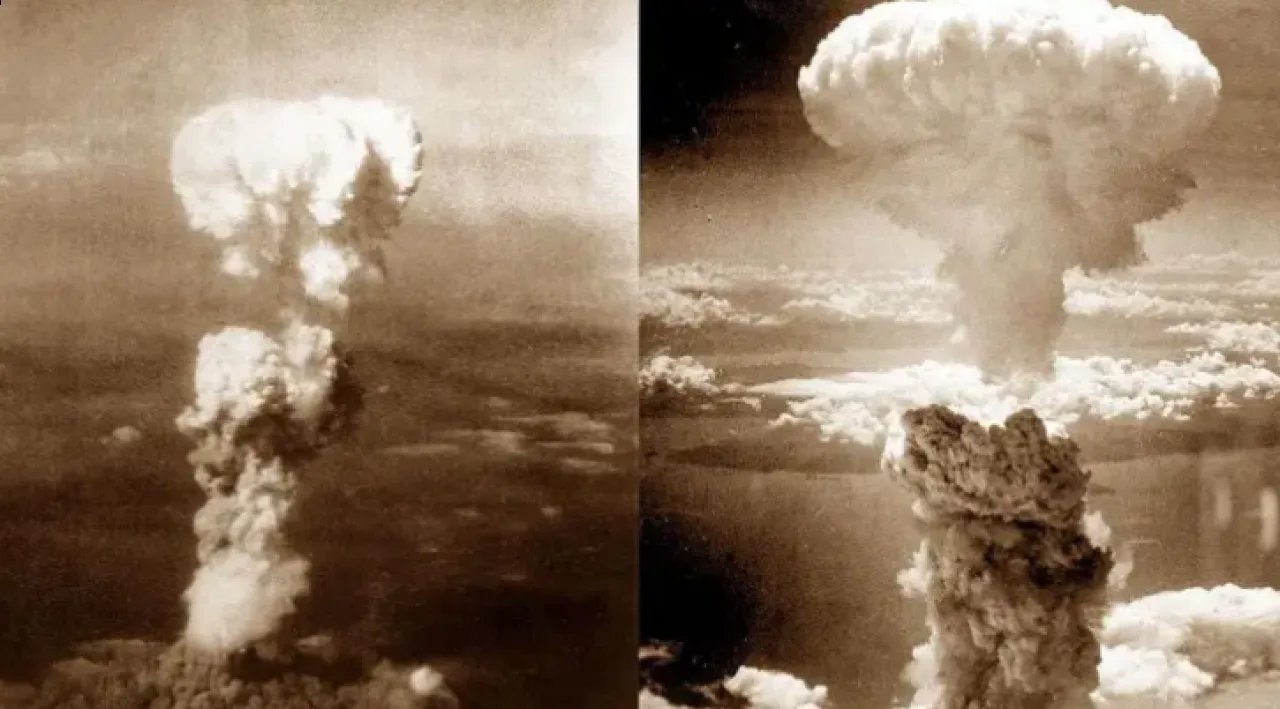
Khaberni -Eighty years after the United States detonated the first nuclear bomb in human history, the Iranian nuclear program has come under scrutiny and has been a factor in escalating hostilities in the Middle East.
On July 2nd, Iranian President Masoud Bazshakian signed a law to suspend cooperation with the International Atomic Energy Agency, after Israel and the United States attacked Iran's nuclear facilities in June.
Israel and the United States justified these attacks as necessary to prevent Iran from developing nuclear weapons.
The extent of the damage caused by the attacks on those facilities, and its potential repercussions for the region and the United Nations' Nuclear Non-Proliferation Treaty, which came into effect 55 years ago and has helped limit the spread of nuclear weapons, has not yet been clarified.
With the treaty in place, there are currently nine known nuclear-armed states. But how did they acquire them? And can other countries currently work to possess them?
It is known that the United States, Russia, the United Kingdom, China, France, India, Pakistan, Israel, and North Korea are the states that have nuclear weapons, with Israel being the only one among them that has not officially confirmed this.
The United States was the first nuclear power in the world, having secretly developed its nuclear weapons program as part of the Manhattan Project during World War II.
After acquiring the weapon, the United States decided to use it destructively in 1945, dropping nuclear bombs on Hiroshima and Nagasaki in Japan, which had joined Axis powers Germany and Italy, fighting against the Allies.
The nuclear explosions killed more than 200,000 people. Japan remains the only country in history to have been struck by nuclear weapons, and the United States the only one to have used them in conflict.
Dr. Patricia Lewis, a weapons reduction expert, says this was "the real initiation of the nuclear arms race," prompting other countries, especially the Soviet Union, to urgently seek to build nuclear weapons, as a deterrent against potential attacks and to showcase regional and global power.
What happened next?
Less than two years after World War II ended, the Cold War began; a global conflict over influence between the United States and the Soviet Union and their respective allies, which lasted for more than 40 years and included nuclear escalation threats.
The Soviets began attempts to acquire a nuclear bomb during World War II, but succeeded in 1949 with their first successful test, ending America's monopoly on nuclear weapons. But the race did not end there; both sides sought to develop more destructive nuclear weapons.
Three other countries entered the nuclear club and acquired nuclear weapons within the following 15 years.
In 1952, Britain, which had collaborated with the United States in developing nuclear weapons during World War II, became the third nuclear power, followed by France in 1960 and China conducting a nuclear explosion in 1964.
By the 1960s, the five nuclear powers, the United States, Soviet Union, Britain, France, and China, solidified their stance. However, concerns grew significantly about the potential increase in the number of nuclear-armed states.
To address these concerns, the United Nations proposed the Nuclear Non-Proliferation Treaty (NPT), aimed at preventing the spread of nuclear weapons, promoting nuclear disarmament, and facilitating the peaceful use of nuclear energy.
The treaty came into effect in 1970, but not all world countries signed it, and nuclear weapons spread to other countries.
India became a nuclear power in 1974, then Pakistan in 1998, and neither signed the treaty, due to the conflict between them and the security concerns each had against the other.
Israel also never signed the treaty.
Israeli officials have always justified their stance with regional threats and hostility from many neighboring countries, adopting a policy of nuclear ambiguity, i.e., neither confirming nor denying the possession of nuclear weapons.
However, North Korea initially signed the treaty, then withdrew from it in 2003, citing military exercises between the United States and South Korea near its borders. In 2006, Pyongyang conducted a nuclear weapon test.
Currently, South Sudan, established in 2011, is the only United Nations member state that has not signed the treaty.
Andrew Futter, a professor of international politics at the University of Leicester in the UK, says: "As far as we know, Iran has not yet made a nuclear bomb," but he adds that technically or technologically, "there is no real reason preventing it from doing so."
Iran, a signatory to the Treaty on the Non-Proliferation of Nuclear Weapons, has always asserted that its nuclear program is peaceful and that it never intends to develop nuclear weapons.
However, a 10-year investigation conducted by the International Atomic Energy Agency found evidence that Iran had conducted "a range of activities related to the development of a nuclear explosive device," specifically from the late 1980s until 2003, when the projects stopped under what was known as "Project Amad."
In 2015, Iran reached an agreement with six world powers that accepted restrictions on its nuclear activities and allowed the monitoring of its nuclear activity by inspectors from the International Atomic Energy Agency, in return for easing crippling international sanctions.
But US President Donald Trump withdrew from the agreement during his first term in 2018, stating that the agreement "did not do much to prevent Iran from developing nuclear weapons," and reimposed sanctions on it.
Iran responded to Trump's withdrawal with repeated violations of the International Atomic Energy Agency's restrictions, especially those related to uranium enrichment.
On June 12, 2025, the International Atomic Energy Agency's Board of Governors, comprising 35 countries, announced for the first time in 20 years that Iran had violated its commitments related to non-proliferation of nuclear weapons.
The next day, Israel launched a series of strikes on Iranian nuclear and military targets. The United States later joined, striking three Iranian nuclear facilities, including the underground Fordo site.
Israel has not officially confirmed its possession of nuclear weapons, but there is a strong belief that it owns a substantial arsenal.
The first secrets of Israel's nuclear capability were revealed in October 1986 by an Israeli nuclear technician named Mordechai Vanunu when he disclosed details to the British newspaper The Sunday Times, indicating that Israel had a larger and more advanced nuclear weapons program than previously believed.
After this disclosure, Vanunu was arrested and tried, sentenced to 18 years in prison in Israel, and was released in 2004.
According to the Stockholm International Peace Research Institute, Israel is working on updating its nuclear arsenal.
In 2024, Israel tested a missile propulsion system, "which may be linked to the Jericho family of ballistic missiles capable of carrying nuclear warheads," and it also seems to be updating its plutonium production site at the Dimona reactor, according to the Institute.
Israel has taken military actions to prevent its regional rivals from acquiring nuclear capabilities; besides the recent attack on Iran, Israel bombed a nuclear reactor in Iraq in 1981 and a nuclear site in Syria in 2007 suspected of involvement in nuclear activities.
What are the countries that abandoned their nuclear programs?
Besides some countries striving to acquire nuclear weapons, other countries have stopped working on producing these weapons, such as Brazil, Sweden, and Switzerland, and later abandoned their programs, either voluntarily or under external pressure.
South Africa is the only country in the world that successfully built nuclear weapons, then disarmed and dismantled its nuclear program.
Futter states, "This still is an anomaly in the nuclear era, a country that built its own nuclear weapons and then decided to disarm."
South Africa made the decision for several reasons, including the end of the apartheid regime, reduced regional conflicts, and changing global political dynamics.
Other examples of abandoning nuclear weapons include, after the collapse of the Soviet Union in 1991, three newly independent states, Ukraine, Belarus, and Kazakhstan, inherited nuclear weapons but relinquished them.
Ukraine dismantled its weapons in exchange for security guarantees from the United States, Britain, and Russia under the Budapest Memorandum in 1994.
However, Ukrainian President Volodymyr Zelensky often claims that his country, which had been in conflict with Russian forces for over 10 years, did not gain much in return for giving up the weapons.
How many nuclear weapons are there?
Because governments rarely disclose the full details of their nuclear arsenals, it is difficult to determine the exact number of weapons each country possesses.
However, the Stockholm International Peace Research Center estimates the nuclear weapons in the world at about 12,241 nuclear heads as of January 2025, with Russia and the United States owning about 90 percent of the global stock.
Although the dismantling of old nuclear heads exceeded the production of modern nuclear weapons, this could change and the reverse might happen "in the coming years," according to the center.
Could a greater number of countries manufacture nuclear weapons?
Experts say that targeting the Iranian nuclear program may affect the thinking of other countries that may seek to build nuclear weapons.
Following the Israeli and US strikes on Iranian nuclear facilities in June, US President Donald Trump announced that the Iranian nuclear program had been set back "decades."
In July, the Pentagon announced that the US strikes had weakened the Iranian nuclear program for up to two years.
If Iran eventually develops a nuclear weapon, other countries in the Middle East, especially Saudi Arabia, may seek to develop their nuclear weapon, as Futter states.
He adds, "I think Saudi Arabia has been very clear that it does not currently want to possess a nuclear weapon, but Iran's possession of it would completely change the rules of the game."
He emphasizes that "how quickly or easily this can be done will be another question."
Dr. Lewis says there is "a significant risk" of Iran withdrawing from the Treaty on the Non-Proliferation of Nuclear Weapons, which would increase the likelihood of other countries withdrawing.
She adds that this would be "a painful blow" to the treaty, but not necessarily a fatal one.
Even if other countries decide to acquire nuclear weapons, Lewis clarifies that they would face "significant challenges" that must be overcome, especially in obtaining enriched uranium or weapons-grade plutonium, both of which are subject to strict control.
She also highlights the presence of a financial burden, adding, "It's expensive and takes years, especially if done secretly. But this has not prevented poorer countries like North Korea and Pakistan from pursuing it."