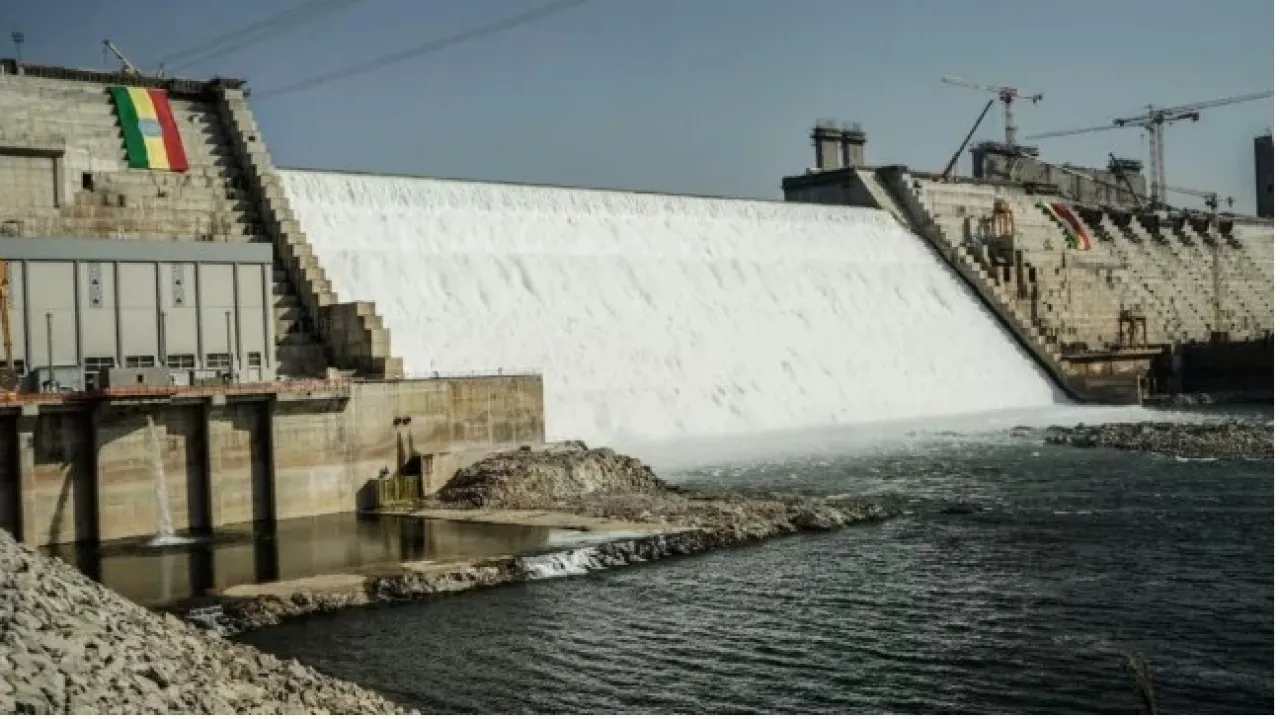
Khaberni -U.S. President Donald Trump ignited widespread controversy after his recent comments on the Ethiopian Renaissance Dam, during his meeting with NATO Secretary General Mark Rutte at the White House, describing it as obstructing the flow of Nile waters to Egypt, and expressing his desire to "quickly resolve the crisis."
Trump said in front of journalists, in the context of talking about several global hotspots he aims to contain the crises of, according to his words: "We and Ethiopia are friends but they built a dam that prevented the water from reaching the Nile," noting that the Nile is a source of life and a very important income resource by saying "it is Egypt's life."
Trump added: "I believe the United States funded the dam, I don’t know why the problem wasn’t solved before construction. But it's good to have the Nile full of water."
Hours after these statements, Egyptian President Abdel Fattah el-Sisi welcomed what Trump had stated, expressing his appreciation for what he described as the "seriousness of the American administration under his leadership in resolving conflicts," and affirming that "Egypt trusts Trump's ability to end this file."
Sisi stated in a post across his social media accounts: "We value President Trump’s keenness to reach a fair agreement that preserves the interests of all around the dam, and his reaffirmation of what the Nile represents to Egypt as a source of life."
Sisi added that Egypt supports Trump's vision in establishing peace and stability in conflict areas, whether in Africa, Ukraine, or the Palestinian territories.
Trump's statements come weeks before the scheduled official opening of the dam in September, which – according to observers – has refocused attention on one of the most complex files in the Nile Basin countries' relations, amid the failure of all previous trilateral negotiation rounds to reach a binding agreement.
The dam is not a matter of life or death
In his comment on Trump's statements, Abbas Sheraki, a professor of water resources and geology at Cairo University, said: "The Renaissance Dam is not the major problem facing Egypt now."
Sheraki added in an interview with BBC Arabic: "The Renaissance Dam did indeed have damaging effects in previous years during the filling process, but now things have calmed down a lot after the completion of the filling process."
Sheraki continued: "Egypt was able to overcome the difficulties it faced during the dam filling years through huge water projects, which prevented harm to the Egyptian citizen during those difficult years. Now, the dam has been completely filled, and water will reach Egypt in its full share starting from this year."
Sheraki welcomed Trump's statements if they represent a "real strong will stemming from a real sense of a critical situation and the danger of not having an agreement between Egypt, Sudan, and Ethiopia," considering that they might contribute to paving the way for reaching an agreement before the dam's official opening as scheduled next September.
Sheraki pointed out that "the situation now, after the completion of the filling and construction, is much better than the previous periods for establishing such an agreement."
About Sisi's welcoming of Trump's statements, Sheraki said that Sisi thereby "opens the door for American intervention and gives it a role in reaching an agreement on the Renaissance Dam."
On his part, Ethiopian political analyst Abdul Shakur Abdul Samad said in an interview with BBC News Arabic, that he believes Trump's statements "do not lead to any stance."
Abdul Samad added: "The Renaissance Dam is now in its sixth filling and has not caused any harm to Egypt, and this is acknowledged by our brothers in Egypt, and the Aswan High Dam (a dam in southern Egypt) contains a large amount of water more than expected."
Abdul Shakur also believes that Trump wants Egypt to make concessions in different files as it happened in 2020 or what was then called the deal of the century, and today he sees that it might be related to the Gaza file.
The Ethiopian political analyst confirms that his country "is not concerned with this discourse and this statement, and has nothing to concede, and I believe that the Agreement on the Declaration of Principles signed in 2015 between Ethiopia, Sudan, and Egypt has drawn the roadmap in the negotiations of the Renaissance Dam."
Abdul Samad sees that the file of the Renaissance Dam has ended with its filling and the preparation to celebrate its opening, and that the relationship that will govern afterwards between the three countries, Egypt, Ethiopia, and Sudan, will be through the "Entebbe" agreement, which organizes the relationship and governs it among the Nile Basin countries.
This agreement - which was not signed by Egypt and Sudan - is known as the Cooperative Framework for the Nile Basin, where it was signed in 2010, and came into effect last year, imposing a legal framework to resolve disputes and conflicts between Nile Basin countries, and re-dividing the waters, and allowing upstream countries to establish water projects without consenting with downstream countries, which Egypt and Sudan refuse.
And 6 countries signed the "Entebbe" agreement: Ethiopia, Rwanda, Tanzania, Uganda, Burundi, and South Sudan, while Egypt, Sudan, Congo, Eritrea, and Kenya did not sign it.
An extended role for Trump
Trump's engagement in the Renaissance Dam is not new, as in October 2020, during his first term, he made statements saying Egypt might have to "blow up the dam," during a phone call with then-Prime Minister of Sudan, Abdalla Hamdok.
Then, Ethiopian Prime Minister Abiy Ahmed did not respond directly, but said in a statement: "Ethiopia will not submit to any aggression of any kind. Ethiopians have never kneeled before their enemies, but respected their friends. And we will not do so today or in the future."
He added that threats regarding this issue are "misleading, ineffective, and a clear violation of international law."
In a separate statement at that time, the Ethiopian Ministry of Foreign Affairs said that "inciting war between Ethiopia and Egypt by a current American president does not reflect the long-standing partnership and strategic alliance between Ethiopia and the United States, and is not accepted in the international law governing relations between states."
The Trump administration had decided in 2020, cut 100 million dollars from U.S. aid to Ethiopia, before President Joe Biden reinstated it after taking office.
The United States previously hosted in 2019, during Trump’s first term, several rounds of talks between Egypt, Sudan, and Ethiopia with the participation of the World Bank, but they also failed after Ethiopian accusations of Washington's bias towards Egypt's position."
Following his return to the White House at the beginning of this year, the dam file was also the focus of the first phone call between Trump and Sisi in February of this year, according to a statement from the White House following the call, without clarification regarding what was discussed in this regard.
Trump also expressed his astonishment in a post during June about the U.S. government funding of the Renaissance Dam, which was denied by a senior official in the committee concerned with the dam.
On the other hand, Ethiopia immediately denied Trump's allegations, confirming that the dam was fully funded by internal resources and public contributions, without any external support.
Arigawi Berhe, the head of the General Coordination Office of the Renaissance Dam, stated officially: "The dam was built with the efforts of the Ethiopian people alone, and there is no American funding at all."
Berhe described Trump's statements as "having political goals unrelated to the reality of the project," emphasizing that the dam "is a symbol of sovereignty and national development."
Egypt rejects unilateral actions
Despite what the Egyptian professor of water resources Abbas Sheraki mentioned, this does not mean that Egypt is backing down from its fixed position on the Renaissance Dam, which it considers a "unilateral action" since Ethiopia announced its start of construction in 2011."
In a regular government meeting last week, Egyptian Prime Minister Mostafa Madbouli confirmed that Egypt does not oppose development in Ethiopia or the dam project itself, but it insists on a core demand represented in the presence of a "written document" that is binding regarding the management and operation of the dam, which Ethiopia has refused for years as it considers it touches "national sovereignty."
Water Resources and Irrigation Minister Hani Sweilam also reaffirmed Egypt's rejection of what he described as "Ethiopian unilateral policies" in the dam file, accusing Ethiopia of seeking to impose "water dominance," and emphasizing that Egypt will not allow "the imposition of a fait accompli in an issue that affects national water security," describing the promotion of completing the dam's construction without reaching a binding agreement with Egypt and Sudan as a "blatant violation of international law principles."
Prime Minister Abiy Ahmed announced on July 3 that his country is preparing for the official opening of the Renaissance Dam in September, inviting Egypt and Sudan to participate in the celebration.
The official account of the Ethiopian Prime Minister's office quoted Ahmed as saying in a speech before parliament: "The Ethiopian Renaissance Dam is now complete, and we are preparing for its official opening," adding: "Our message is clear to our neighbors downstream, Egypt and Sudan, the dam is not a threat, but a shared opportunity."
Ahmed confirmed that "Aswan High Dam (a dam in southern Egypt) did not lose a single liter of water because of the Renaissance Dam," emphasizing his country's commitment not to harm Egypt or Sudan, and its desire for "constructive engagement" with both.
Following Trump's recent statements, calls from opinion writers and Ethiopian media have emerged urging Prime Minister Abiy Ahmed to confront Trump's "erroneous" statements about the dam's funding and its negative impact on Egypt, considering them as not based on a factual basis.