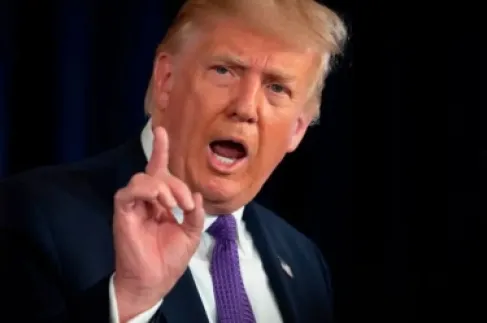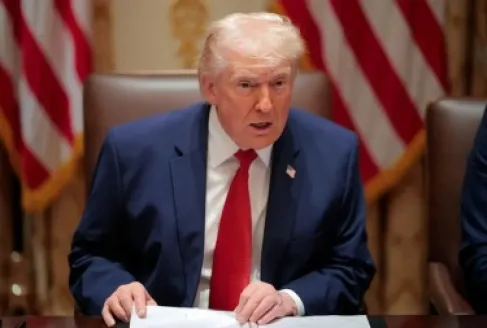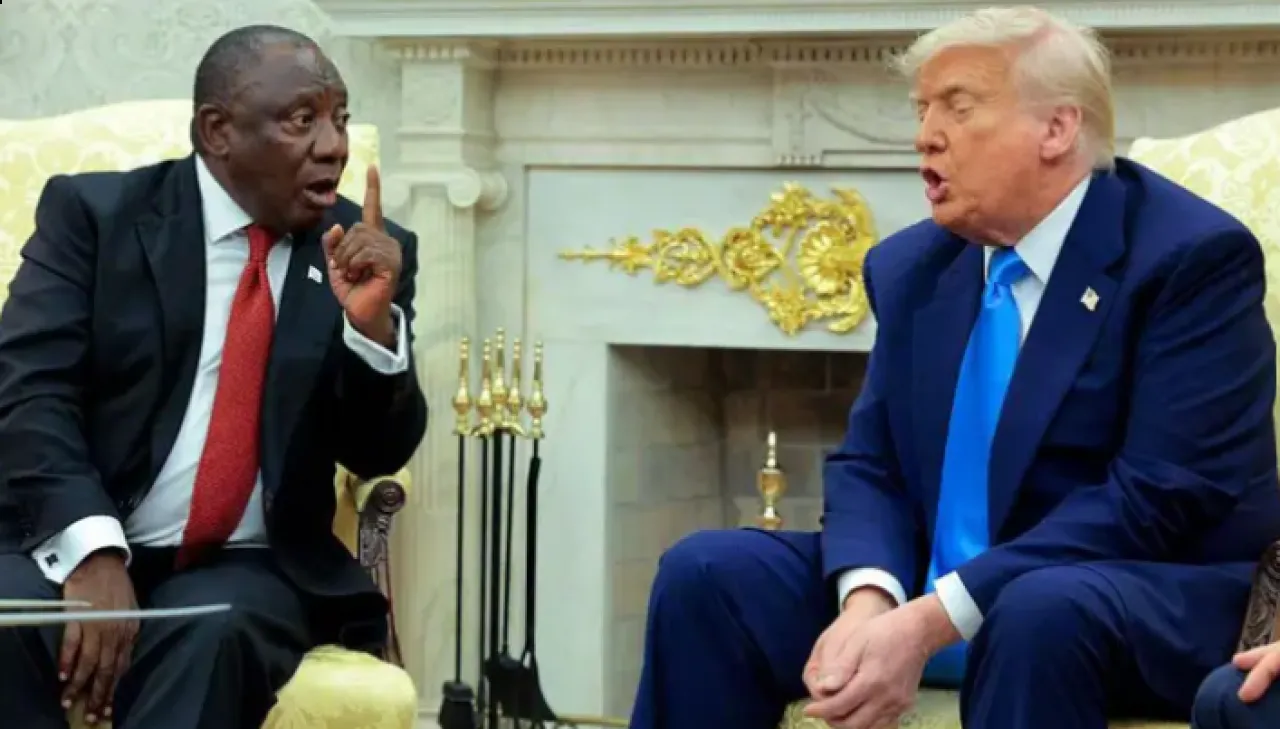
In a tense scene inside the White House on Wednesday, US President Donald Trump directed controversial accusations at the President of South Africa, Cyril Ramaphosa, regarding alleged targeting of white-skinned farmers in his country.
The meeting between the two presidents began in a friendly and jovial atmosphere, but soon took a different turn when Trump asked his team to display a video clip that mostly showed one of the prominent opponents in South Africa, Julius Malema, chanting a song that incites violence against white-skinned farmers.
The video also included scenes showing rows of crosses, which Trump claimed indicated the burial site of white-skinned farmers after their murder, and Trump handed Ramaphosa copies of articles he claimed to document rampant cases of violence targeting the white minority in South Africa.
Supporters of the Trump administration have long resorted to exaggerating claims aimed at inciting violence against the white minority, among whom are prominent supporters, Elon Musk, and the former Fox News broadcaster, Tucker Carlson, who reported on what he described as an alleged genocide during the president's first term, and it has been proven that some of these claims are clearly incorrect.
The clip shown by Trump in the Oval Office included scenes of rows of white crosses along a rural road, and Trump said: "These are burial sites here, they are cemeteries, more than a thousand white farmers".
However, those crosses do not indicate actual graves, as the video dates back to protests organized to condemn the killing of a white-skinned farming couple, Glenn and Vida Rafferty, who were shot dead in their farm after being ambushed in 2020. The clip was circulated on YouTube on September 6, the day after the protests.
Rob Houtson, one of the event organizers, told the BBC: "The site was not a cemetery, but a temporary memorial," adding that the crosses were put up as a "temporary memorial" to honor the couple.
Houtson mentioned that the crosses were later dismantled.
The BBC fact-checking team was able to determine the geographic location of the video, which was found to be within Kwazulu-Natal province near the city of Newcastle. Pictures from "Google Street View" taken in May 2023, nearly three years after the video was published, show that the crosses no longer stand at the location.
During the meeting, Trump said: "Many are concerned about what is happening in South Africa. We have many people who believe they are being persecuted, and they are migrating to the United States, and hence we accept applications from several places if we feel there is persecution or genocide".
Trump has previously made statements regarding "white genocide", and it seems that he was referring to this matter.
During a press conference held earlier this month, he said: "This is a genocide that is happening now," referring to the killing of white-skinned farmers in South Africa.
South Africa is among the countries with the highest murder rates in the world. According to statistics from the South African Police Service, last year saw more than 26,000 murder cases.
Among these cases, 44 fatalities were recorded within the farming community, including eight farmers.
The general statistics available do not classify these numbers by race. Nevertheless, they do not provide evidence supporting Trump's repeated claims about "white genocide".
In February, a South African judge rejected the idea of a genocide, describing it as "clearly fictitious" and "unrealistic".
The Transvaal Agricultural Union, which represents farmers, compiles data offering insight into the racial identity of the victims, relying on reports from media outlets, social media posts, and reports from its members.
Last year's union figures indicated 23 white-skinned individuals were killed during attacks on farms, in addition to 9 black-skinned owners. So far this year, the Transvaal Agricultural Union has recorded three white-skinned and four black-skinned deaths in South African farms.
During the tense meeting, Trump displayed clips from political rallies where attendees performed the song "Kill the Boer", a term in South Africa referring to farmers of European origin, an anti-apartheid song critics describe as inciting violence against white-skinned farmers.
South African courts have described this song as a call that incites hatred, although recent judicial rulings have allowed its legal performance at gatherings, considering it expresses a political viewpoint and does not directly incite violence.
Trump claimed that those who led the singing were "responsible" and "government officials".
Among the leaders of the gathering was Julius Malema, who had previously led the youth wing of the ruling African National Congress and had left the party in 2012 without holding any official government position, currently leading the "Economic Freedom Fighters" party, which secured 9.5 percent of the vote in last year's elections, entering the ranks of the opposition against the new multiparty coalition.
In response to Trump's accusations, Ramaphosa confirmed that the "Economic Freedom Fighters" are a "small party for a minority", indicating that "our government's policy is completely contrary to the statements made".
In the video, another person was heard singing the phrase "Shoot the Boer" at another gathering. It was former President Jacob Zuma, whose term ended in 2018; the video dates back to 2012 when he was in office, and the African National Congress had pledged to stop performing this song later.
Zuma later left the African National Congress and currently leads the opposition "Nation's Spear" party, which secured more than 14 percent of the vote in last year's elections.
During the meeting, Trump displayed a number of articles he claimed provided evidence of the killing of white-skinned farmers in South Africa.
A clear image appeared during Trump's speech, saying: "Look! Here are burial sites everywhere. All of these are white-skinned farmers buried".
It turned out that the image was not from South Africa but was actually from a report about the killing of women in the Democratic Republic of Congo.
And the BBC fact-checking service verified the images, confirming they were excerpts from a Reuters news agency video filmed in Goma city, Democratic Republic of the Congo, in February.