Khaberni - The U.S. State Department announced that Washington has approved the sale of a military hardware system dedicated to intercepting drones to Israel for $992.4 million, at a time when Tel Aviv faces a different kind of threat with Lebanese Hezbollah introducing fiber-optic operated drones, which the Israeli army is unable to counter.
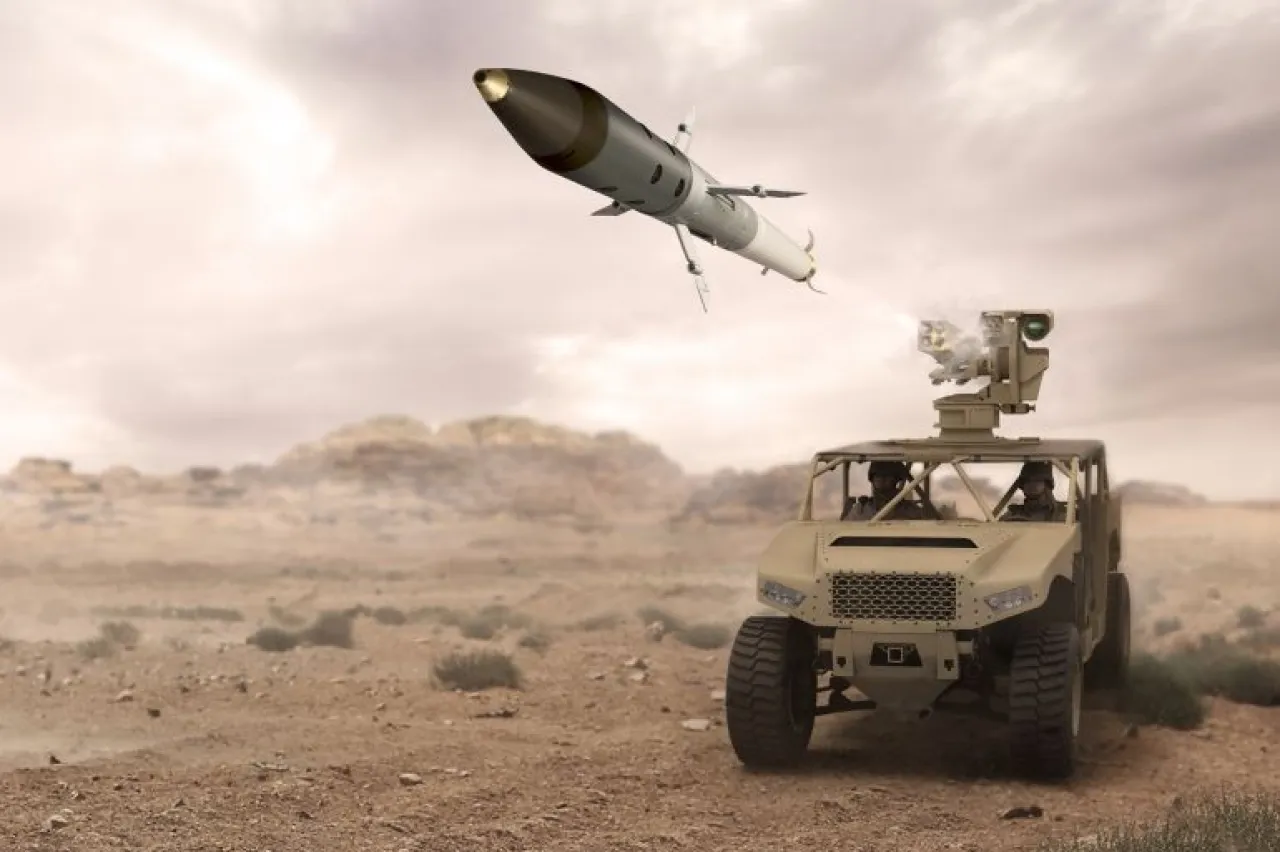
Haaretz, an Israeli newspaper, reported that under the agreement the United States will provide Tel Aviv with 10,000 sets—relatively low-cost—of the Advanced Precision Kill Weapon System (APKWS) for intercepting drones.
Haaretz explained that this system turns unguided "air-to-ground" missiles into precisely guided munitions capable of striking ground targets, pointing out that the main feature of the system is intercepting drones.
However, despite the high effectiveness of the APKWS system—according to the newspaper—it is unable to intercept Hezbollah's wired guided drones.
The system has proven effective against roaming munitions like Iranian "Shahed" drones, but it was not designed to counteract small "quadcopter" type drones that are now troubling the Israeli army in southern Lebanon.
What is the APKWS System?
Regarding the details of the APKWS system, the newspaper reported that it operates by retrofitting old "Hydra 70" rockets with small wing assemblies that include a laser-guidance system, characterized by the ability to more effectively track targets using infrared.
In its earlier versions, the system was designed for its traditional role—precise strikes on ground targets—and over the past five years, "BAE Systems" has upgraded it to intercept aerial threats such as helicopters and drones, as the newspaper said.
Haaretz noted that the United States has supplied Ukraine with this system, including versions launched from the air for "F-16 Fighting Falcon" aircraft, to intercept Russian roaming drones, "as used by Washington to shoot down several drones during the multifront war in the Middle East that began on October 7, 2023."
Besides its field efficiency, cost emerges as a crucial factor—according to Haaretz—where each guided munition's cost is about $30,000, compared to about $500,000 for an "AIM-9 Sidewinder" missile and a million dollars for an AIM-120 AMRAAM missile, previously used in drone interception.
It also pointed out that the cost of guided missiles in the American system is cheaper than the "Iron Dome" interception rockets, which are estimated at about $45,000 per missile.
Increasing Challenge
The Israeli newspaper quoted Israeli officials as saying that the Israeli army is facing an increasing challenge from drones that succeed in evading air defense systems.
The Israeli army estimates that Hezbollah could increase the launch of such drones at Israel and the Israeli army forces in southern Lebanon in the coming days.
In recent weeks, Israeli defense companies have tested various countermeasures for Hezbollah drones that operate on optical fibers, but the Israeli army acknowledged that there is no system yet that has proven effective against Hezbollah's fiber optic-guided drones that surpass navigation jamming.
Optical Fiber Drones
These are drones controlled via extremely thin, small, and camouflaged optical fiber cables, which have quickly become a lethal weapon in the hands of Hezbollah tracking Israeli army soldiers in southern Lebanon.
This technology strongly caught attention after successfully—last Thursday—killing an Israeli soldier in southern Lebanon and injuring at least 12 others in northern Israel, two of them in critical condition. It also killed a soldier and a military contractor with the Israeli army in Lebanon earlier last week.
Hezbollah announced that it started using drones—guided by optical fibers—for the first time during the round of fighting that began on March 2, after years of deploying other types of drones.