Khaberni - A rescue excavation mission under the Supreme Council of Antiquities, working in the Muharram Bek area in central Alexandria in Egypt, has uncovered a distinct collection of archaeological and architectural elements. These elements shed light on the evolution of urban life in Alexandria through its historical epochs.
The Egyptian Minister of Tourism and Antiquities, Sherif Fathy, described the discovery as a qualitative addition to the city's archaeological record.
He confirmed that the discovery reflects the historical and civilizational importance of Alexandria as one of the foremost global cultural centers, highlighting its unique status as one of the major historic cities, with its wealth of cultural diversity and accumulated civilization.
He noted that the results of the discovery contribute to redesigning the urban map of ancient Alexandria. It also confirms the ongoing Egyptian efforts in protecting and preserving archaeological heritage, particularly through rescue excavations associated with development projects. This achieves a balance between preserving heritage and supporting sustainable development plans.
A Comprehensive Civilizational Sequence
The Secretary-General of the Supreme Council of Antiquities, Hisham El-Leithy, explained that the excavations revealed a complete civilizational sequence. It starts from the Ptolemaic era, through the Roman, and up to the Byzantine period, reflecting the continuity of settlement at the site over successive time periods.
He pointed out that the most prominent discoveries include a circular public bath of the Tholoi type from the late Ptolemaic period. In addition, remains of a Roman residential villa equipped with mosaic floors of various styles were found, reflecting a high level of luxury and urban planning during those periods.
The head of the Egyptian Antiquities Sector, Mohamed Abdel Badie, added that the site provides a comprehensive model of the development of residential and service architecture in ancient Alexandria. The excavations unveiled advanced water facilities, including a bathing pool (small swimming pool) associated with the Roman villa, equipped with an integrated water management system.
He also mentioned the variety of mosaic floor execution techniques discovered, including the styles (Opus Tessellatum) and (Opus Sectile). This reflects the richness and diversity of artistic schools in Alexandria during the Ptolemaic and Roman periods.
In the same context, the head of the Central Administration for Antiquities of the North Coast, Hisham Hussein, confirmed that the discovery contributes to bridging an important archaeological gap in the southeastern sector of ancient Alexandria. This area had not received sufficient studies previously.
He clarified that the new results support and reevaluate the historical maps of the city, particularly the works of Mahmoud Bek the astronomer, which are among the earliest scientific attempts to reconstruct the urban planning of Alexandria. They used a methodology that combined astronomical measurements, topographic studies, and historical analysis.
The results confirm that the area was within the urban area inside the walls of Alexandria until the Byzantine period, before its importance declined later due to changes in urban planning.
The Discovered Elements
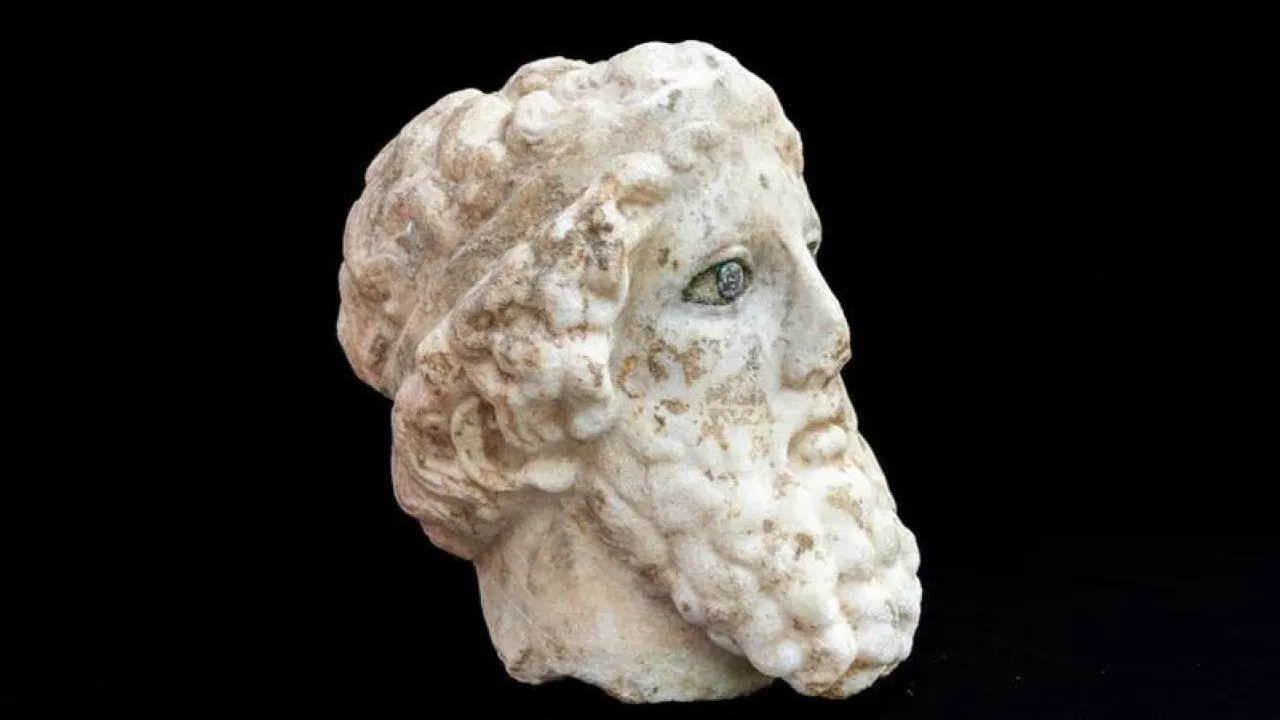
The discoveries also included a distinguished collection of movable archaeological finds, including marble statues of various deities such as Bacchus and Asclepius, in addition to a headless statue likely of the goddess Minerva. Coins, lamps, pottery vessels, and parts of stamped amphorae were also found. Collectively, these reflect the prosperous commercial and cultural activity in ancient Alexandria, and its broad relations with its Mediterranean surroundings.
In this context, the head of the mission and the director of Central Alexandria, Ibrahim Mustafa, reported that the excavation work lasted several months and yielded exceptional results. He confirmed that the team has already begun preliminary restoration work on the discoveries in preparation for their transfer to specialized labs.
He mentioned that currently, there is consideration to display the most prominent pieces discovered at the Greco-Roman Museum in Alexandria. This will enhance visitors' experience and highlight the importance of this discovery. Excavation work at the site continues, which may yield more discoveries in the upcoming period.