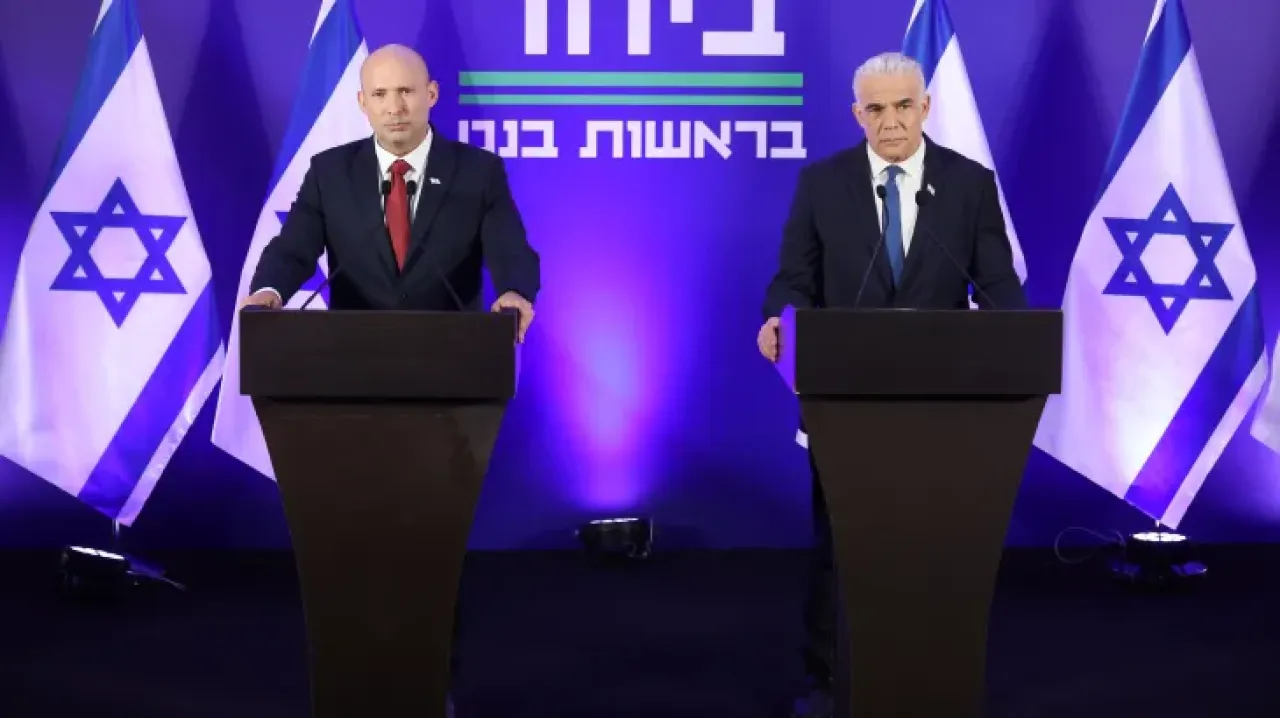
Khaberni - Former Israeli Prime Ministers Naftali Bennett and Yair Lapid announced today, Sunday, that they will ally in the upcoming elections expected to be held later this year, in a joint attempt to overthrow Prime Minister Benjamin Netanyahu.
Bennett and Lapid previously held the prime ministership as part of a rotation agreement within a coalition government formed in 2021 and are now planning to merge their parties into a single entity headed by Bennett.
Naftali Bennett from the right and Yair Lapid from the center issued statements announcing the merger of their parties "Bennett 2026" and "There is a Future", and Bennett's office announced that the new party will be called "Together" and that he will lead it.
Naftali Bennett emphasized that the new alliance aims to "manage the state better through a government that includes professionals and executors focused on the interest of Israel," affirming that his anticipated government would act swiftly to implement ready plans without wasting time.
He announced his intention to form an official inquiry commission into the events of October 7, alongside passing a law for mandatory military service for everyone, considering that "dodging service will no longer be funded."
Bennett, during the joint press conference with Lapid to announce the new alliance, adhered to strict security positions, emphasizing no concessions on any part of the land, while calling for the improvement of the situations of Israeli youth and enabling them to build their future within the country.
He also invited political figures, including Gadi Eisenkot, to join this alliance, considering that the next phase requires "collective leadership" that reflects the will of the majority of Israelis.
For his part, Lapid described the alliance as a step towards major reform in Israel, emphasizing the country's need for unity after years of internal division. He said that this coalition aims to "form a strong, stable Zionist government that connects the center and the right, and brings together various community components without extremism."
Lapid indicated that the alliance bets on attracting a wide spectrum of voters, calling the center to rally around Bennett, describing him as a liberal rightist capable of leading the upcoming government. He also confirmed that the goal is to address the files of security, education, and economy, and to reduce prices and fight corruption.
In response to journalists' questions, Bennett addressed voters of the Netanyahu camp directly, criticizing what he described as "administrative corruption" and the issue of dodging military service, and inviting them to join the new alliance as an alternative home. He also emphasized the need to reform vital sectors such as education and transportation.
In turn, Lapid considered that this alliance guarantees preventing a new government led by Netanyahu, asserting that the goal is to effect real change in the Israeli political scene. He added that the coalition seeks to attract the majority of Israeli society, except for those he described as "dodgers of military service."
Ideological Differences
The coalition agreement of 2021 ended 12 years of Netanyahu's rule, where Bennett served as Prime Minister in the first year before the coalition disintegrated, then Lapid held the position temporarily during the last six months, until elections returned Netanyahu to power.
Since then, Lapid has held the position of leader of the opposition in Israel, while Bennett has stepped away from political life for a period.
The two men hold ideological differences, as Bennett is an Orthodox Jew and holds hardline positions towards the Palestinians, while Lapid is secular and considered more moderate. However, the two enjoyed a close working relationship during their brief coalition period.
Their alliance aims to unify a divided opposition, sharing little else but their common opposition to Netanyahu.
Two weeks ago, a poll conducted by "Maariv" newspaper showed that, according to the current situation, Netanyahu's camp would secure 49 seats out of 120 in the Knesset in the upcoming elections, compared to 61 seats for the opposition camp, in addition to 10 seats for Arab deputies, which is not enough for Netanyahu to form a government, as that requires the support of at least 61 deputies.
If no early elections are held, the current Knesset term will end in October next year, and general elections will be held.
Reactions
Yair Golan, leader of the Democratic Party, expressed his welcome for any unity within the bloc.
Avigdor Lieberman, leader of the "Our Home Israel" party, also welcomed this unity, affirming that the goal is to bring down the government of Netanyahu, which he described as the "October 7 government."
In turn, Benny Gantz, leader of the Blue and White party, welcomed the unity. He said, "This can only be achieved through a broad Zionist unity government, capable of isolating extremists and pushing Israel forward, and not through a government that relies on extremists or non-Zionist parties."
Conversely, National Security Minister and leader of the "Jewish Power" party, Itamar Ben-Gvir, described the announcement of merging Bennett and Lapid's parties as "an alliance selling Israel to the Islamic movement." Meanwhile, Minister of Culture Miki Zohar, from Netanyahu's party (Likud), criticized the move, considering it to reflect "a lack of ideology," as he put it.
Meanwhile, Finance Minister Bezalel Smotrich attacked the upcoming alliance, describing it as "an alliance with no clear identity," according to what the Israeli media reported about him.