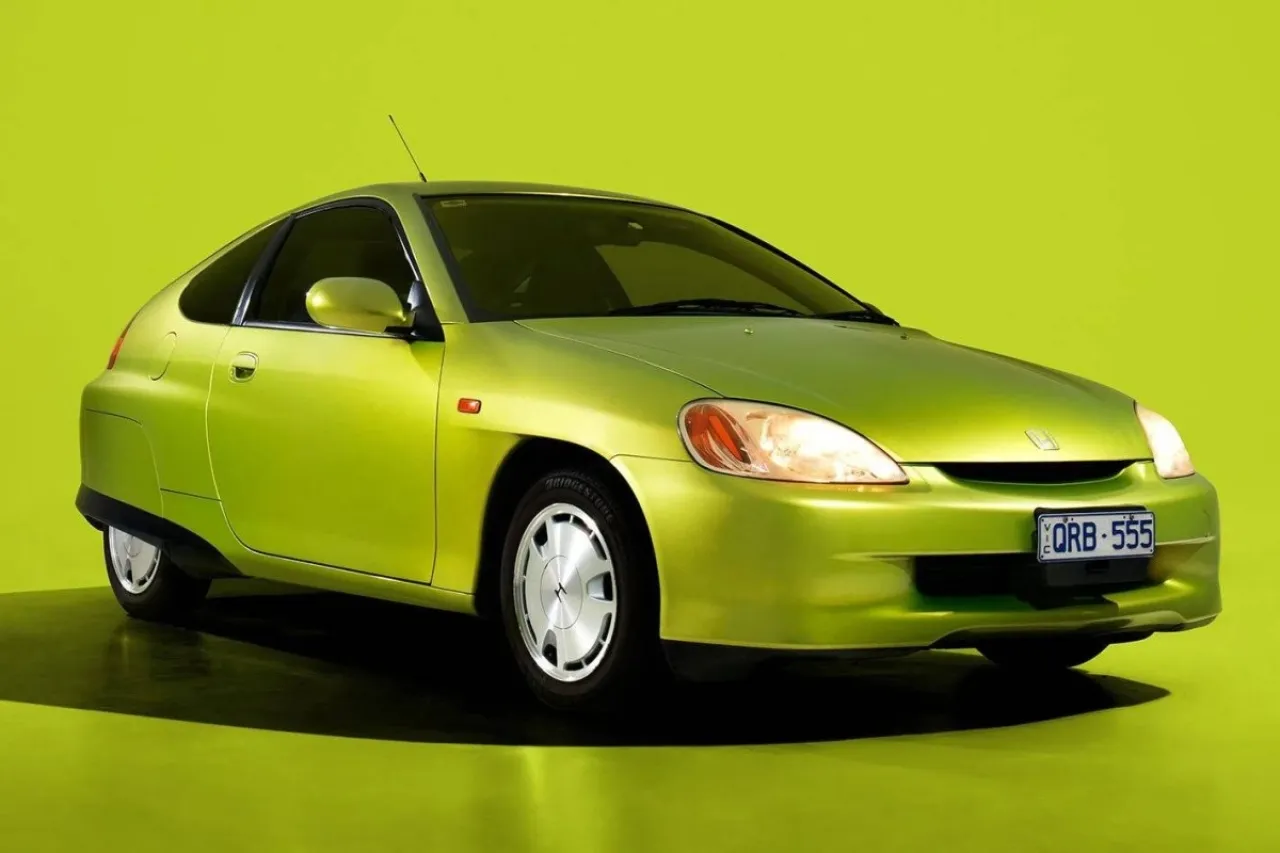
Khaberni - At a time when hybrid cars have become a fundamental part of the global automotive industry scene, attention turns back to one of the boldest experiments in this field, the Honda Insight, introduced by Honda for the first time in 1999. It was considered an early model that combined engineering innovation and unconventional design to achieve the highest possible fuel efficiency.
Widespread adoption of hybrid technologies
Today, the markets witness an unprecedented spread of hybrid cars, as most manufacturers now offer multiple options including trucks, SUVs, and luxury vehicles.
In this context, Toyota has announced that all new models of the Toyota Camry and Toyota RAV4 from 2026 will come with standard hybrid systems, clearly indicating a shift in the industry towards this type of technology.
Unconventional design for a clear purpose
Upon its launch, the Honda Insight was not just any hybrid car, but a comprehensive project to achieve maximum efficiency. It was equipped with a 1.0-liter three-cylinder engine using lean burn and VTEC technology, supported by an electric motor as part of the Integrated Motor Assist system, enabling it to achieve fuel consumption of up to 70 miles per gallon on highways according to the US Environmental Protection Agency.
The car featured an extremely lightweight chassis weighing just about 1,856 pounds, with an advanced streamlined design that included extended front arches and covers for the rear wheels to enhance aerodynamics. Additionally, it was limited to two doors and two seats, in a clear approach to reduce weight and improve economic performance.
Advanced technologies and sporty touches
The car also stood out by offering a five-speed manual transmission, a rarity in hybrid vehicles, combining efficiency with the pleasure of driving. It was manufactured in the same facility that produced prominent sports models such as the Honda NSX and Honda S2000, adopted an aluminum structure similar to the NSX, and the cabin design was inspired by the S2000.
Evolution of the model across generations
Although the first generation remained the most distinguished, Honda continued to develop the model through two subsequent generations. The second generation featured a traditional hatchback design competing with the Toyota Prius, while the third generation turned into a hybrid version closer to the Honda Civic.
At the beginning of the last decade, the company introduced the Honda CR-Z model, which was considered closest to the philosophy of the first generation due to its two-door design and reliance on a hybrid system with a manual transmission.
Modern technology eliminates the need for strange designs
With technological advancements, hybrid systems have become more efficient and smoother, as demonstrated in models like the Honda Civic Hybrid, Honda Accord Hybrid, and Honda CR-V Hybrid, where there is no longer a need for unconventional designs to achieve fuel consumption efficiency.
An enduring legacy with a contemporary spirit
Still, observers believe that the new Honda Prelude model might carry some of the original Insight's features in terms of combining a two-door design with a hybrid system, but with a more advanced sporty spirit.
Historical significance
The Honda Insight remains one of the most prominent milestones in the history of hybrid car manufacturing. It embodied an important transitional stage that preceded the widespread adoption of this technology and laid engineering foundations that are still evident in today's vehicles.