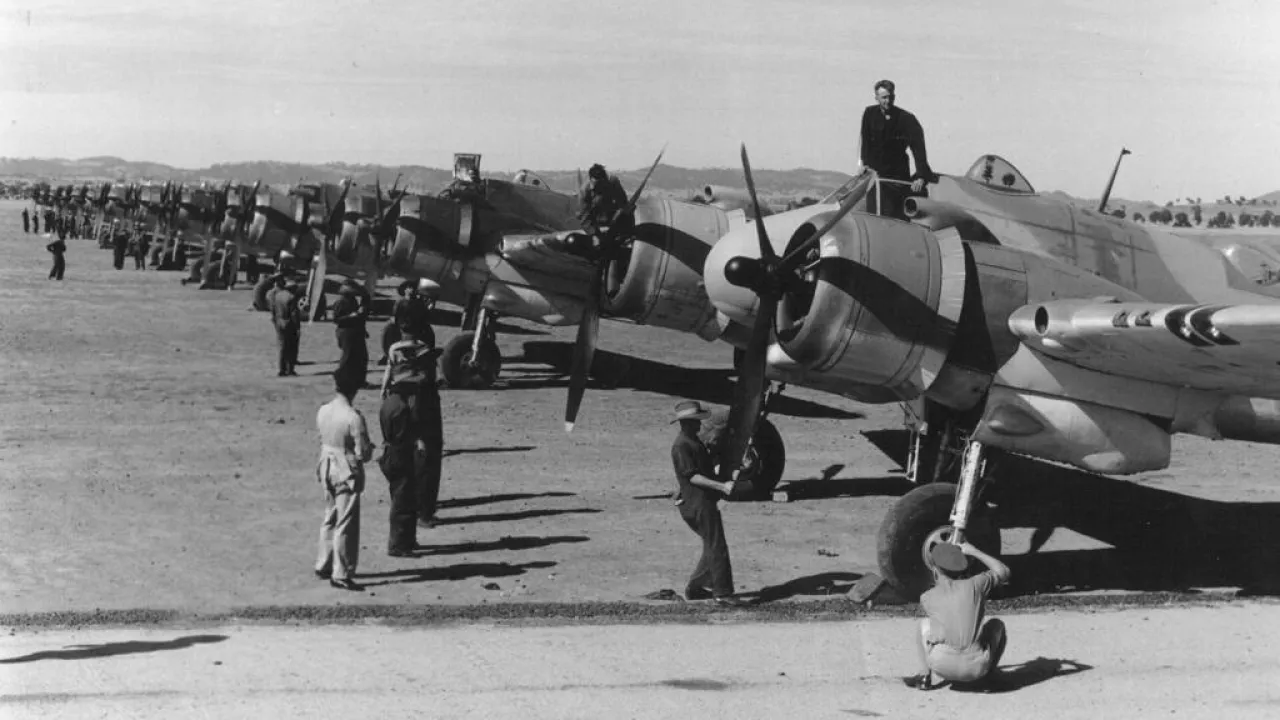
Khaberni - An Israeli newspaper revealed for the first time an operation carried out by Tel Aviv to smuggle Beaufighter aircraft from Britain, which were used to attack Egyptian forces and cut their supply lines during the 1948 Palestine war.
The Israeli newspaper "Calcalist" reported that an Israeli pilot named Emmanuel Tzur found a treasure in Britain in 1948, consisting of 12 powerful Beaufighter aircraft - exactly what Israel, which was under a global arms embargo, needed.
The Hebrew newspaper added that Tzur brought them to the country through a crazy conspiracy and a big deception plan for Britain.
It pointed out that the hero of the story is a pilot named Emmanuel Tzur, who was born in Galicia and was attracted to aviation from an early age, and traveled in 1930 to study air navigation in France.
Calcalist reported that Tzur became the first flight instructor in Israel and taught Zionist Haganah and Palmach gangs how to use aircraft. In 1936, he played as a principal pilot in the activities of "Aviron," Israel's first airline, and established relations in France and Britain.
The Hebrew newspaper added that at the end of 1947, the Jewish community was subjected to an international arms embargo initiated by Britain and the United States, noting that Tzur was summoned to the Jewish Agency building in occupied Jerusalem and met David Ben-Gurion, who told him that the declaration of the state of Israel was imminent but the war with Arab armies was inevitable.
It indicated that Ben-Gurion warned that the chances of survival in battle were very slim and the chances of victory microscopic, explaining that on the ground there was no room for discussion: Arab armies would invade with superior equipment, ammunition, and resources compared to what the defenders of the Jewish community had.
The newspaper said that the pressure would turn to making the invaders' supply lines very sensitive: if shipments of weapons, medical equipment, spare parts, and reinforcements were damaged, the fighting would significantly slow down, and the Arab forces might have to stop or even withdraw.
It added that Tzur was asked to acquire as many aircraft as possible - large, small, complicated, definitely, everything that flies and shoots is worth its weight in gold, noting his appointment as director of air force procurement in Britain, which in 1947 was a treasure trove for those looking for cheap aircraft.
Calcalist said that the Royal Air Force and Navy had about 9,000 aircraft, in addition to a similar number leased from the United States, adding that most of its aircraft that survived the Second World War had become less appropriate and were destined for sale or scrap.
The newspaper pointed out that Tzur began to activate contacts and recruit pilots and technicians, and employed people across Britain to look for opportunities, and managed to find training, transport, and reconnaissance aircraft and bring them to Israel by falsifying documents and permits.
It reported that it was not easy: the British were not naive and knew well that the Jews had sent agents trying to buy aircraft and breach the embargo, adding that in June 1948, one of Tzur's men informed him of the opportunity of a lifetime: a British aircraft collector had bought 12 fighter aircraft - an entire squadron - and was restoring them for sale.
The Hebrew newspaper continued, saying that when Tzur heard about the type of aircraft, he confirmed that his eyes shone: they were of the Beaufighter type - not just an ordinary fighter plane, but a boxing aircraft.
Calcalist reported that the Beaufighter was developed by Bristol from a light bomber called Beaufort, and belongs to the category of heavy fighters; powerful twin-engine aircraft that sacrifice maximum speed, climb rate, and agility for the sake of firepower, flight range, and suitability for diverse missions.
It mentioned that the Beaufighter had a pair of cylindrical valve engines that produced a different sound from other engines of the same size, appearing more muted - and traveled shorter distances, noting that the idea was to enable the aircraft to sneak up on ground targets and ships, detecting them later and improving the chances of a successful attack.
The newspaper said that there were many attacks like this: during the Second World War, the Beaufighter hunted ships in the Mediterranean with bombs and missiles, destroyed tanks and trucks in North Africa, and devoured bombers at night - discovered via the first type of aerial radar.
It added that the Beaufighter had important protection and ample space for backup systems, enabling it to take successive hits and continue fighting, indicating that the Beaufighter wielded a battery of ten cannons, more than any other European aircraft at that time.
Calcalist reported that inside the aircraft's belly sat four 20 mm Hispano Suiza 404 cannons, and in the wings - six Browning 7.7 mm machine guns, adding that this battery could fire 170 rounds per second at anything that appeared in the Beaufighter's sights; more than a modern Vulcan cannon.
The newspaper pointed out that a fire like this could annihilate a ship's command room, crush a plane into aluminum pieces, and turn trucks and armored vehicles into burnt wreckage in an instant, explaining that a single Beaufighter swooping down on an Egyptian supply convoy could literally wipe it out; exactly what Ben-Gurion wanted, exactly what Israel needed.
It remarked that the British collector sold the twelve Beaufighters for 1,500 pounds sterling per aircraft, a tenth of the original price, adding that with inflation adjustments for today, this amounts to about 280,000 shekels per piece, and what is more Jewish than buying at discounts.
The Hebrew newspaper noted that here, as you guessed, the story begins to complicate, pointing out that the British police had noticed Emmanuel Tzur and understood that he was an international fraudster, and Scotland Yard - the London detectives, tracked him and his men.
Calcalist reported that with great difficulty, he managed to sneak from France to the United Kingdom, and to see and examine the goods, adding that for this purpose, he obtained a light aircraft and crossed the English Channel at night, flying low under the British radar, while interceptor jets guarded the borders.
It indicated that when he arrived to meet the collector and the desired boxing aircraft, he discovered that what was offered for sale was more damaged than damaged: they were worn out, broken, some in stages of disassembly for spare parts, and only six were in a state that allowed repair.
The newspaper stated that the situation in the country was really difficult as Ben-Gurion predicted, and such an opportunity could not be missed - especially since the seller was willing to offer an additional discount and include repairs in the price, adding that Emmanuel Tzur shook his hand and struck the deal.
It added that now only the hardest part remained: to get six relatively slow fighters out of a country that prevented their sale to Israelis, sought him personally, and do not forget the interceptor aircraft that swept its borders.
Calcalist reported that according to an article in Segula magazine, interviews in the media featured on a dedicated site that immortalizes Emmanuel Tzur, and the Air Force bulletin and additional sources, here began the plan that was promised: Tzur turned to his partner Terence Fernfield, and together they founded a production company.
The newspaper specified that they named it Air Pilot Film Company, and jumped on one of the hot trends in cinema in the late forties: films that glorify fighters of the early forties, adding that it approached the authorities in Britain as a legitimate business that would start filming a movie about a New Zealand pilots' battery in the Second World War.
It said that real heroism was there: they fought shoulder to shoulder with British pilots in Europe, the Middle East, Africa, and the Far East and yes, among other things, they operated Beaufighter aircraft, adding that real production was there: a scenario was written, about 40 people were recruited - actors, photographers, recorders, drivers, pilots.
The Hebrew newspaper added that aircraft were also present: the Beaufighter was repaired as well as possible and filming began on August 2 in North London, pointing out that British investigators tracked the production with skepticism that dissipated day by day: this war movie progressed exactly as one might expect from a war film, and exactly according to the schedule presented to the local aviation administration.
Calcalist stated that after a week, work at the first site was completed, and the production moved to the next location: Scotland, whose rocks resemble those of New Zealand; a good movie has to be authentic, adding that imagine everyone's surprise when the planes took off for Scotland but did not arrive there.
It noted that all production workers were very worried: without planes, there is no movie, and who would pay them? And these are old, rickety planes; one Beaufighter even crashed at the beginning of filming.
The newspaper stated that imagine everyone's surprise when the planes appeared, simply not in the planned place, adding that imagine the shock of the British government when it realized that really, heroism and production and planes and filming were there, but no film.
It added that Emmanuel and his men simply made a turn after takeoff, dived to zero altitude, and hijacked the Beaufighter to the state of Israel, pointing out that headlines in Western European newspapers echoed: the Israelis pulled a legendary trick on Britain; in fact, from the movies.
Calcalist stated that matters did not stop there: one Beaufighter crashed on the way to the ground, and even those that arrived were not a great gift, pointing out that the flying boxer turned out to be a very difficult aircraft for maintenance, due to its design and the need for special equipment for repair, and because those that arrived were very worn out.
The newspaper noted that they were placed in Squadron 103 and there it turned out that they were dangerous - and not just for the enemy: the Beaufighter tended to turn to the left at slow speed - during takeoff and landing - and thus another aircraft was lost during a local test flight.
It stated that even when everything worked properly, the fighter was very difficult to fly: the steering was heavy, and very stiff - every maneuver required effort, and the Beaufighter really tired those who controlled it, adding that Beaufighter of Squadron 103 were sent to fight in the southern region, as part of operations to stop the advance of the Egyptians, and attacked moving targets.
The Hebrew newspaper added that on August 15, one of them participated in a battle with the Egyptian navy off the coast of Gaza, when a Fury - a very fast and powerful fighter - attacked from behind, pointing out that the pilot maneuvered and pulled the Egyptian behind him in a steep dive; while the Beaufighter was comfortable at low altitude, and exited the dive in time, the Egyptian adversary did not see it and crashed into the sea.
Calcalist stated that on October 19, a pair of Beaufighter participated in an attack to take over Iraq Suweidan police station - a fortress that controlled the road between the Asqalan area and Jerusalem, causing many casualties, adding that this was the sixth attack, and it also failed: one Beaufighter was hit by anti-aircraft fire and its crew were killed.
The newspaper noted that pilots of 103 did everything in their power to extract the maximum from this rare aircraft, but nonetheless, it happened more than once that the cannons malfunctioned, and its power remained more potential than actual, adding that ground crews also innovated and eked out 100% and more from the worn-out boxers - to the point where other fighter aircraft began to arrive, justifying the effort.
It stated that a total of the Beaufighter that Emmanuel Tzur brought served in the Israel Defense Forces for only four months; the two that survived the journey and the battles were stopped due to a lack of spare parts, adding that by the end of the war, Tzur had acquired 18 aircraft, including Mosquito fighter-bombers, which enabled the Israel Defense Forces to detect enemy attacks, movements, and preparations.
It added that Tzur also managed to buy a Handley Page Halifax heavy bomber, registering it as a passenger aircraft, pointing out that the plane unfortunately crashed on landing in the country and did not participate in the war.
Calcalist stated that after the war, Tzur became the first director of Lod Airport, which is today named as Ben Gurion Airport, and founded and supported airlines, helped in planning the West Wind aircraft belonging to the aerospace industries and greatly supported aviation in the country.
It added that Emmanuel Tzur died in 1991.
It is worth noting that Egypt and Israel fought several wars since 1948, starting with the first Palestine war (1948-1949) in which Egyptian forces participated to prevent the establishment of the Jewish state, followed by the Suez War (1956) when Israel attacked Sinai in coordination with Britain and France, then the Six-Day War (1967) during which Israel occupied the entire Sinai, and the War of Attrition (1967-1970) along the Suez Canal, and finally the October War (1973) during which Egyptian forces crossed the Bar Lev Line and achieved great victories, before the Camp David Accords (1978) and the Peace Treaty (1979) led to Israel's withdrawal from Sinai and the end of the state of war between the two countries.