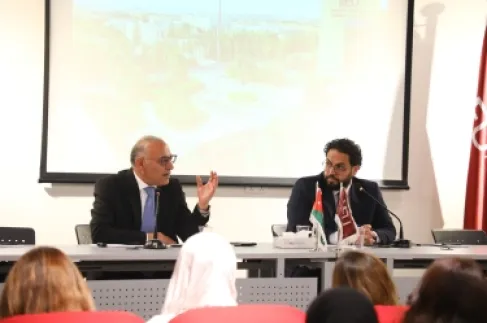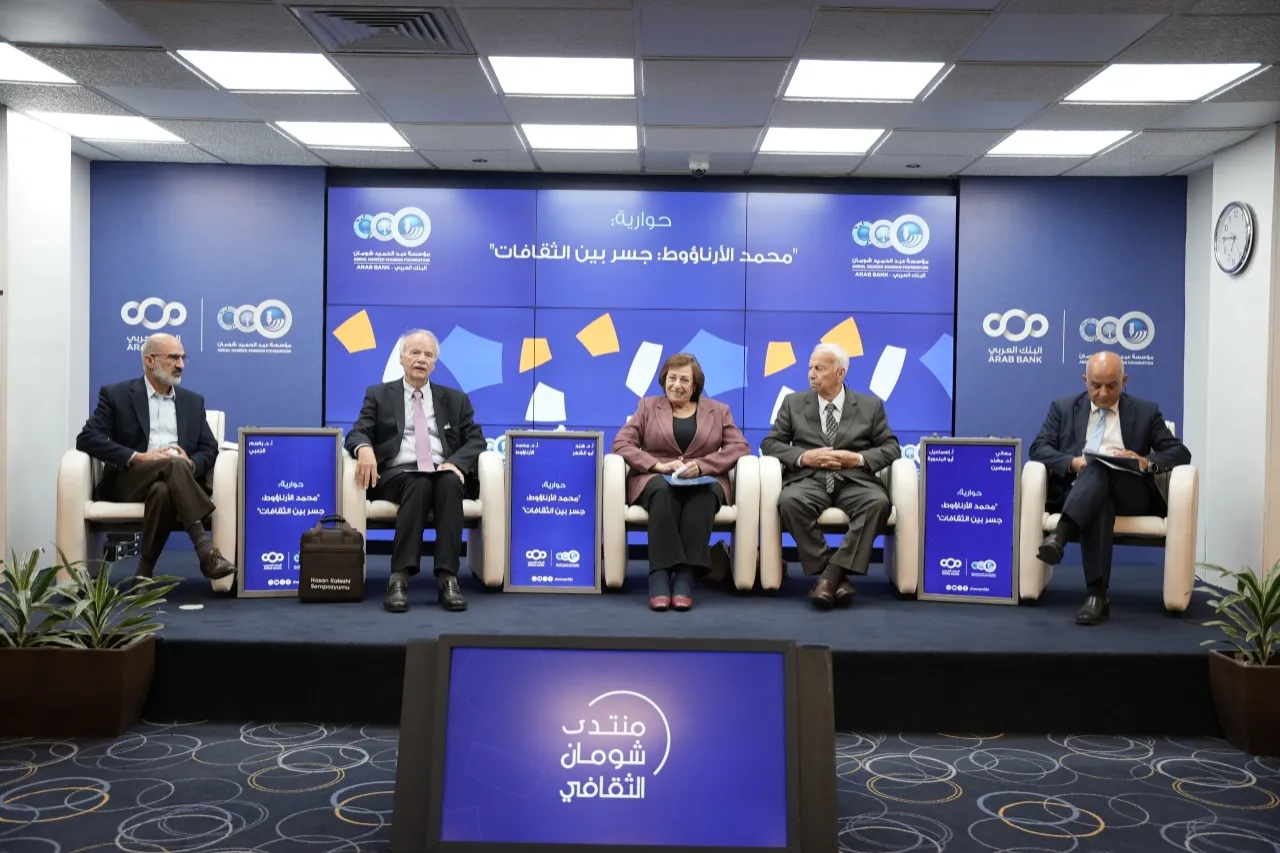
Khaberni - A tribute seminar organized by the Abdul Hameed Shoman Cultural Forum, this Monday evening, examined the literary works of the thinker and historian Dr. Mohammad Arnaut, attended by an elite group of literati, thinkers, and invited guests.
The seminar titled "Mohammad Arnaut: A Bridge Between Cultures" was reviewed during which, in addition to Arnaut, Dr. Hind Abul Shaar, former Minister of Government Communications Dr. Mohannad Mubaideen, researcher Ismail Abu al-Bandoura spoke, and it was moderated by Dr. Basem Al-Zu’bi. They discussed the significant achievements of Arnaut, who is considered one of the most prominent Arab figures in the field of historical studies, especially concerning the history of the Balkans and Ottoman-European relations.
Arnaut's value stems from him being a knowledge bridge between the Arabic and the global research community, a researcher who reinstated significance to a region neglected in the Arab narrative, and a translator who conveyed knowledge not merely as texts, but as tools for thinking.
Dr. Mubaideen, in his address, mentioned that Arnaut was known for his clear efforts in presenting several specialized research and translations, and remained committed to giving even after retiring from universities. He also held a prestigious place in contemporary studies of Islamic Waqf and its link to the past.
He pointed out that Arnaut produced several works that cemented his scholarly status and his broad cultural perspective of history, noting that in his pursuit to dismantle the mental image of the Ottoman state and the Devshirme institution in his cultural biography, we find a significant maturity in his scholarly career and his translation choices, along with a critical view of previous works that historians usually passed on about the Ottoman era at the time of its inception, rise, and collapse.
From Pristina in Kosovo to Damascus and Istanbul to Irbid, to Mafraq and Amman, then to the United States, Arnaut gave history a new vision, far from the usual portrayal by our historians focusing on time and heroes, but rather on phenomena, traditions, and culture, and completed a journey of knowledge with a rich contribution of articles, scientific reviews, and translations, with his journeys evidently influencing his scientific choices and re-discussing historical junctions that the Middle East went through in modern times.
For her part, Dr. Abul Shaar said that "Arnaut’s name has been associated with the Balkans and specifically Albania, relying here on my follow-up of his published research. His work focused on the Waqfs during the Ottoman era, Jerusalem during the Ottoman periods, and other subjects concerning the Ottomans, highlighting his prolific intellectual output which manifested in his many works, most of which linked the Arabic world culturally and linguistically with the Balkans, Islam, and Europe. His background studying Arabic at the University of Damascus played a major role in his studies, which makes him attentive to the cultural and historical side in a unified framework."
She said, "I always expected that Dr. Arnaut’s efforts in introducing us to the culture of the Balkan states, particularly in Albania, Macedonia, Serbia, and Kosovo, and in introducing the people of the Balkans to Arabic culture, specifically Damascus and Jerusalem, would be celebrated. Now that he has won the translation prize in the eleventh edition of the Sheikh Hamad Award for Translation and International Understanding, he is somewhat given what he deserves."
In turn, the researcher Abu al-Bandoura emphasized the role of Arnaut when he served as the director of the House of Wisdom Institute at Al al-Bayt University, by transforming the institute into a global intellectual forum, attracting the best and major thinkers from the Arab world and internationally where global conferences on important contemporary issues concerning our Arab culture were held through it.
He said, "When Dr. Arnaut moved to Kosovo, his initiatives and aspirations to continue the leading role he assumed from the beginning did not stop. He soon presided over an institute for Balkan studies and began working on translating several books and studies into Arabic, gathering around him many Albanian scholars who were connected to our Arab culture, publishing their works in Amman, and enabling the Arab intellectual to access literature and cultures that would have been impossible to access translated to Arabic without such exceptionally important initiatives.. A complete library of books from the Balkan region contributed by Dr. Arnaut for the Arab intellectual."
Arnaut expressed his gratitude and appreciation for the Shoman Foundation's initiative to organize this seminar now after he recently won the Sheikh Hamad international award for translation and international understanding, which encompasses broad cultural perspectives including intellectual, literary, and academic aspects.
He said, "I feel grateful to be honored in Jordan, the country I arrived in 1989 from Yugoslavia to work for two or three years but ended up staying for thirty years, more than I lived in my birth country (Syria) or in the Balkans (former Yugoslavia and Republic of Kosovo). This includes also honoring me by winning in the achievement category of the Sheikh Hamad international award for translation and international understanding, where half of what I was honored for, I achieved in Jordan and much of what I published was released in Amman."
Arnaut reviewed his upbringing and his academic journey and interests in language, literature, and history in the various countries and places he worked in.
He said after leaving Jordan at the end of 2018, he remained present through what was published by him, particularly mentioning the Ministry of Culture which supported the publishing of his book "From Government to State: The Arab Government Experience in Damascus 1918-1920" on the centenary of its occasion in 2020, and republished it as part of the Family Library project in 2025.
It is noteworthy that Mohammad Mufiq Arnaut is a Kosovar/Syrian historian, born in an Arabic cultural environment, who took an early interest in history, especially the history of the Ottoman Empire and the Balkan region, a complex space where identities, religion, and politics intersect. This interest led him to specialize academically in history and to engage in scientific research connected to original sources, including Ottoman and European documents.
He translated a significant number of Western studies on the Balkans and Ottoman history into Arabic, recontextualizing them within the Arab framework, paving the way for Arab researchers to access different historical schools and modern critical approaches.
His writings are characterized by combining rigorous historical analysis and the ability to deconstruct ideological discourses surrounding Balkan history, striving to correct the distorted images of the Ottomans in Arab consciousness, as well as the simplified views on Eastern Europe.
Arnaut participated in numerous scientific seminars and conferences and contributed to developing the field of Balkan studies in the Arab world. He also worked_hosting_batch update_simulation in research institutions and played a role in directing a generation of researchers towards this field, which remained outside Arab interest for a long time.
He has received international awards, including the Republic Medal in Kosovo for his entire works in 2012, and the Sheikh Hamad Award for Translation and International Acquaintance for his entire works translated from Albanian to Arabic in 2025.