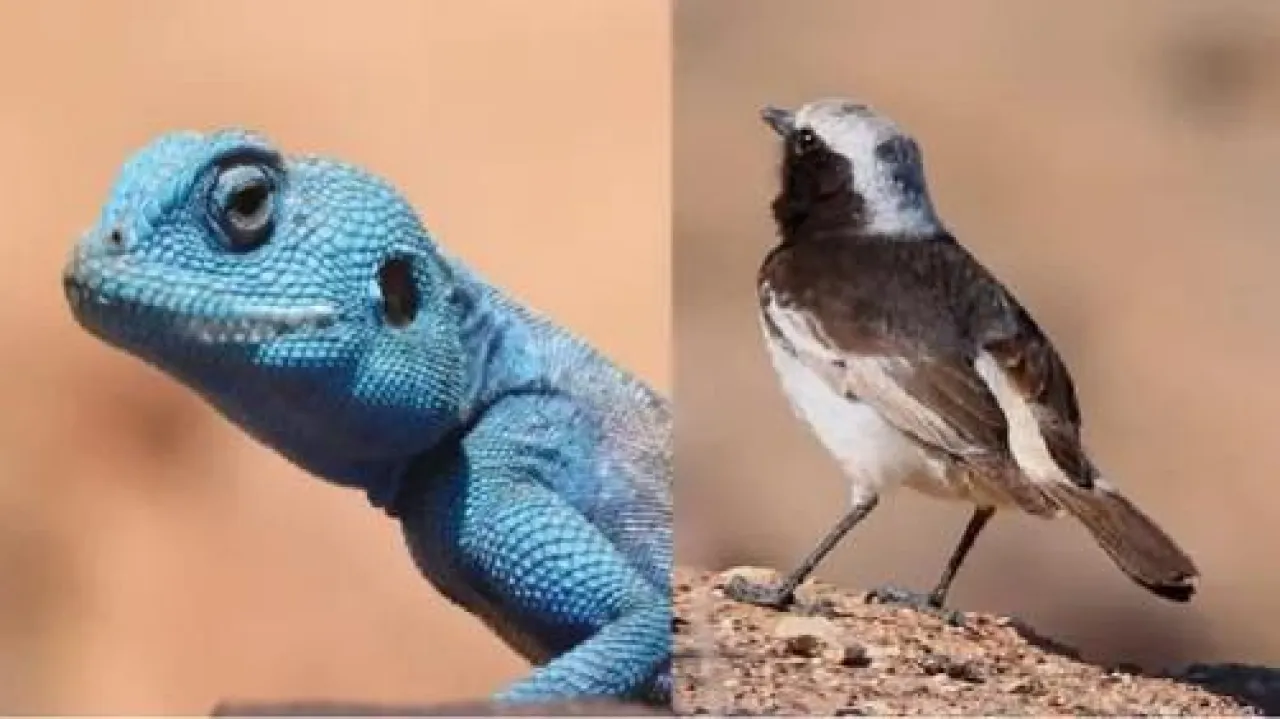
Khaberni - The Royal Society for the Conservation of Nature team through the Aqaba Bird Observatory recorded the sighting of the "Red-rumped Wheatear" in the Al-Humayma Al-Abbasia area south of Aqaba, alongside documenting the appearance of the "Sinai Agama" in the desert environments surrounding the city, in observations that collectively reflect the richness of the region's biodiversity and its uniqueness as an important natural habitat for wildlife and a main corridor for wild life.
Firas Al-Rahahleh, the director of the Aqaba Bird Observatory, stated that the team was able to document the sighting of the "Red-rumped Wheatear," which is a rarely observed species in the kingdom, despite being a bird that might breed in some local environments, pointing out that this bird attracts great interest from birdwatchers and environmental photography enthusiasts due to its beautiful colors and distinctive behavior.
Al-Rahahleh explained that the sighting of this bird in the Al-Humayma Al-Abbasia area underscores the environmental significance of the area, and supports national efforts to preserve biodiversity in the south of the kingdom, noting that the Aqaba Bird Observatory continues its monitoring and documenting programs throughout the year to record resident and migratory species and enhance the national database and raise environmental awareness
In the same context, Al-Rahahleh mentioned the recording of the appearance of the "Sinai Agama" in the desert environments surrounding Aqaba, affirming that this observation is an important indicator of the health of the natural ecosystems in the area, as it is one of the reptiles adapted to dry and rocky conditions.
He detailed that this species is found in the south of Jordan and the Sinai Peninsula, and is characterized by its diurnal activity and reliance on sunlight to regulate its body temperature, usually seen atop rocks during morning hours, and feeds on insects, making it an important element in ecological balance, explaining that during the breeding season, male Sinai Agamas acquire a striking blue color to attract females, while the females remain in earthy colors that help them camouflage in the desert environment
Al-Rahahleh reiterated that documenting these species reflects the richness of biodiversity in Aqaba, calling for the protection of natural habitats and promoting environmental awareness to preserve these unique creatures
This observation is part of the ongoing efforts of the Royal Society for the Conservation of Nature and in collaboration with the Aqaba Special Economic Zone Authority, to monitor wildlife and highlight environments attractive to eco-tourism in the region