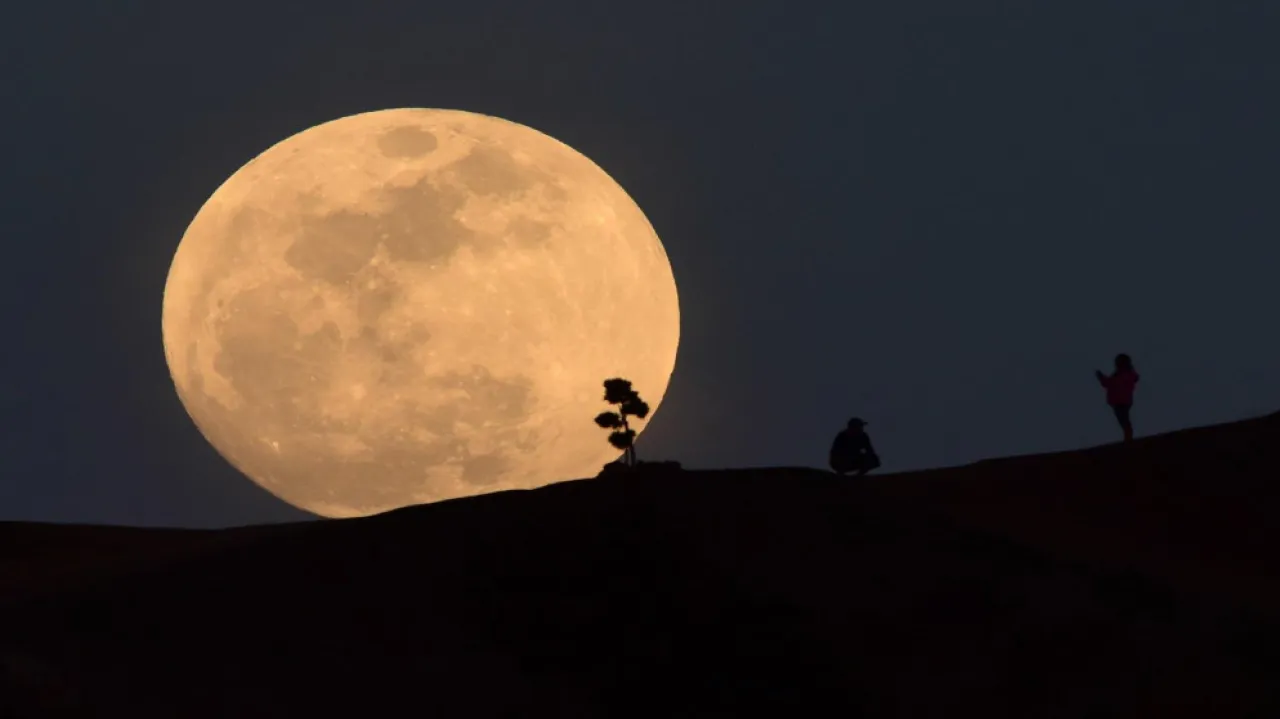
Khaberni - Ammar Alsakaji, president of the Jordanian Astronomical Association, said that the Moon will conjoin with the Pleiades star cluster, obscuring some of its stars on Sunday, April 19th, as the Moon approaches the Pleiades in the evenings in the north-western horizon of Jordan.
The Moon's approach will be around one degree at 8 PM, and it will get closer by 9 PM to about 38 minutes until they both set, according to Jordanian time and geographic location.
Alsakaji explained that this conjunction can be observed with the naked eye in areas less polluted by light, such as deserts and rural areas, if the weather and astronomical conditions are clear, while its viewing is clearer using a telescope or a camera, where the Moon approaches the Pleiades cluster closely, forming a distinctive conjunction, and the Moon appears low in the sky, with the Pleiades twinkling beside it as a fine star cluster resembling beads of pearls.
He pointed out that the Pleiades is one of the most famous open star clusters in the sky, located within the constellation Taurus, and seen with the naked eye as a small cluster of bright stars resembling a cluster of pearls, containing hundreds of stars, but the most prominent are seven bright stars that made their presence in ancient cultures, hence named "the Seven Sisters." It is relatively close to Earth astronomically (about 430 light years), making it a favored target for observation and astrophotography, calling upon astrophotography enthusiasts to observe and document this phenomenon.
Alsakaji added that this beautiful scene of the conjunction paves the way for the launch of "Global Dark Sky Week" during the period of April 13 to April 20, emphasizing the need to protect the night from light pollution to recover the ability to see the pearls of the Pleiades and the depth of the universe clearly.
He indicated that the Pleiades holds a special place in Arab heritage, within what is known in global literature as cultural astronomy or "ethno-astronomy," where its rising and setting were linked to the seasons of rain and fertility, serving as a chronological reference for Bedouins and farmers to determine the change of seasons, and was not just a star cluster, but a "heavenly clock" in which the star calendar and weather patterns are read, and used as an approximate sign of the Earth’s and climate transformations.
Alsakaji mentioned that the Moon's conjunction with the Pleiades star cluster, which occurs almost monthly, was linked to the agriculture seasons and weather, but it holds a particular significance at this time, as the Arabs said in the Bedouin proverbs "a conjunction on the third day of spring," referring to the Moon's conjunction in its early days (third) with the Pleiades, indicating an "approximate sign" of the beginning of the end of spring, where greenery diminishes, pasture weakens, and the land begins to dry up, stating in the heritage: "When the Moon and the Pleiades draw near, prepare your caravan for the pasture has passed, and with the fall of the Pleiades, the soil dries up."
He explained that the Moon's conjunction with the Pleiades at this time represents a unique transitional moment, where remnants of winter stars meet the signs of the end of spring, in a celestial artwork reflecting the movement of the seasons accurately, as the Moon gradually descends toward the horizon followed by the stars one after another, while the Pleiades remain a witness to this transformation as it has been for thousands of years, when humans used it as a guide for time and a mirror for the transformations of Earth and sky.
Alsakaji noted that Jordan’s sky this evening will present a rich scene combining remnants of the winter hexagon, in addition to the gradual descent of the Moon and the Pleiades toward the northwestern horizon, under this scene Venus shines as the brightest celestial body in the sky after the Sun and the Moon, accompanied by Uranus for those observing with appropriate tools, and to the left, the star Aldebaran appears with its orange color surrounded by the stars of Pleiades like a fine pearl cluster, while the constellation Taurus extends upwards where the north horn star (El Nath) appears, and to the right of the scene the star Alhecka shines high, while the remnants of the winter sextet are still clear, including Alcyone near the southwestern horizon, and Orion's Betelgeuse and Gemini's Pollux in the constellation Orion, in addition to Castor's rear head and Castor's leading head in the constellation Gemini, and over time after 8 PM these stars all tend to set, as if the winter sextet gradually bids farewell to the sky, leaving space for the spring stars, in an astronomical scene accurately reflecting the transition of seasons where the end of spring meets the remnants of winter in a single celestial tableau.