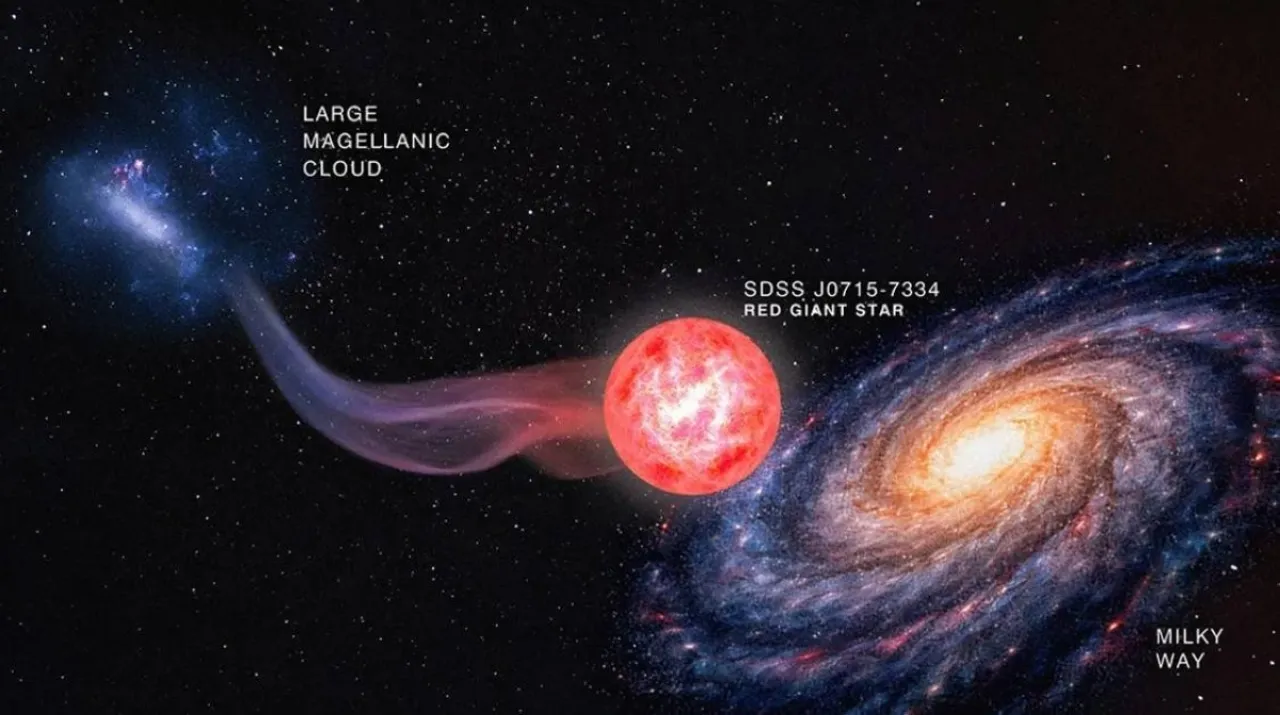
Khaberni - A team of astronomers has announced the discovery of the purest star in the universe to date, known as J0715−7334, believed to have come from another galaxy, and possibly formed from pure gas of a third-generation star. Third-generation stars are known to be the first stars formed after the Big Bang from almost only hydrogen and helium, without heavier metal elements.
Due to the immense size and heat of these stars, none of them have been directly observed so far, and it is believed that most did not survive to this day, but their low-mass descendants may still exist according to iflscience.
These nearly pure stars are extremely rare as they contain the lowest proportion of metal elements. In the case of star J0715−7334, measurements show it possesses the lowest known upper limit for metallicity Z < 7.8 × 10⁻⁷, less than half the value of the previous record holder J1029+1729, and notably, it also has a significantly reduced carbon content, which distinguishes it from other metal-poor stars that typically contain a lot of carbon.
This star was discovered using data from the SDSS-V survey and Magellan telescopes, where high-resolution spectra of this red giant in our galaxy were observed, appearing peculiar compared to other stars. The team believes the star formed in the Large Magellanic Cloud, and has maintained its purity due to the distance of its orbit in the galactic halo and its large thermal envelope, which prevented any surface contamination from interstellar gas.
Researcher Alexander Ji and his team indicate that the properties of this star align with nuclear synthesis models for supernovae that may arise from third-generation stars, and they estimate that the ancient star that formed it was massive, approximately 30 times the mass of the sun, and its explosion released high energy amounting to about 5 × 10⁵¹ ergs.
This important study was published in the journal Nature Astronomy, and it opens the door to a deeper understanding of the origin of the first stars in the universe and how they evolved.
Although this discovery is not a direct observation of a third-generation star, it represents a rare example of an almost pure star, and may aid in understanding the formation of the first stars and the early evolution of the universe.
Scientists continue to search for other stars of this kind, while the James Webb Space Telescope has enabled the discovery of metal-poor galaxies, but they are still far from the minimum threshold that distinguishes true third-generation stars.