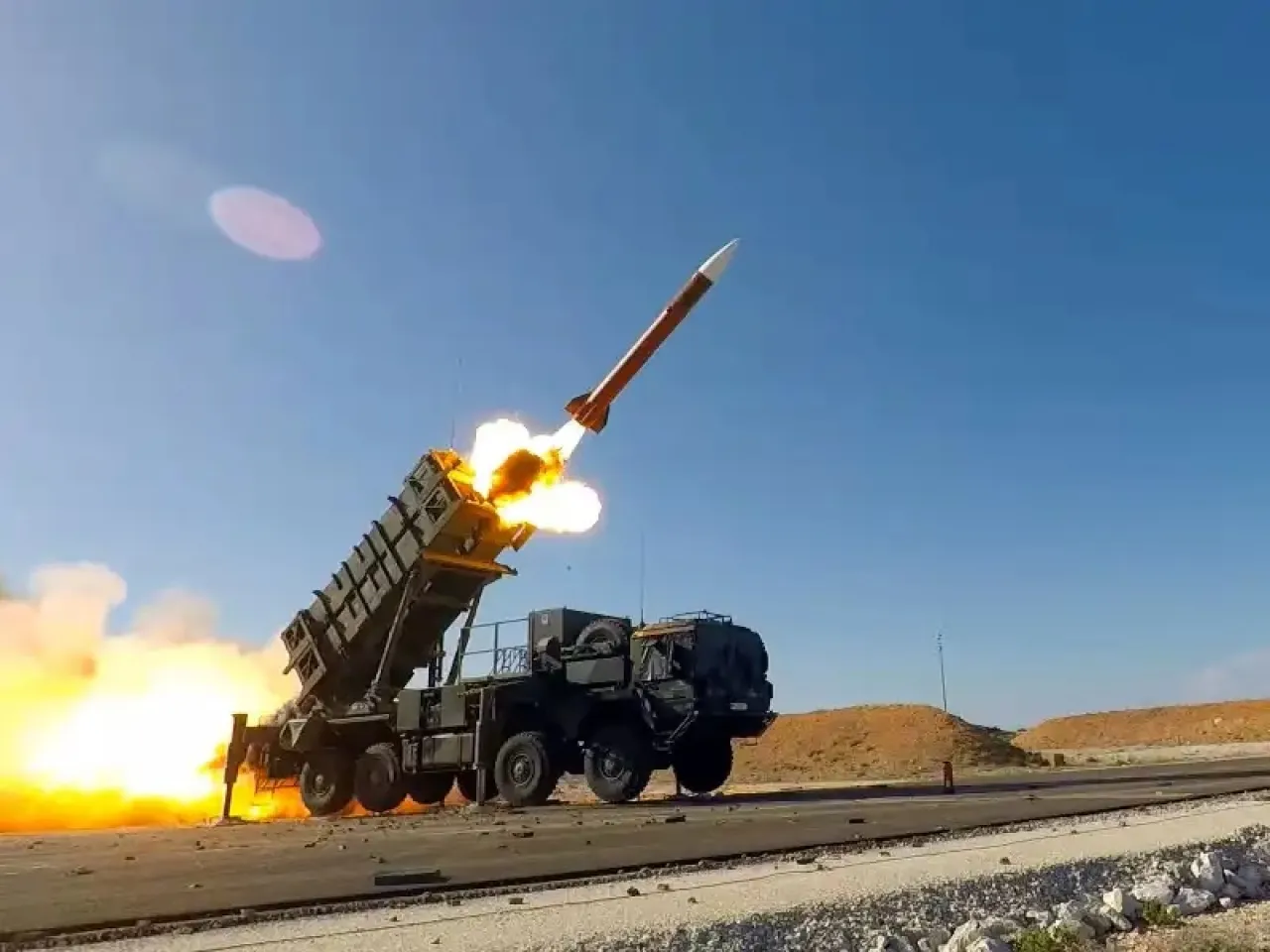
Khaberni - With escalating regional tensions and the development of aviation and missile technologies, air defense missile systems have become a fundamental element in the national security strategies of countries.
These systems, described as the shield of the sky, operate through an integrated system of monitoring, analysis, and interception to prevent aerial threats from reaching their targets.
Detection and Monitoring Mechanism
The air defense process begins with the detection phase, where long-range and medium-range radars scan the airspace around the clock.
These radars are capable of detecting fighter jets, drones, missiles, and even ballistic missiles that move at very high speeds.
In some modern systems, radars are supplemented by thermal and optical sensors to increase detection accuracy, especially in environments experiencing electronic jamming or complex weather conditions.
Target Tracking
After spotting the target, the system moves to the precise tracking phase where the target's speed, altitude, and direction are calculated, in addition to estimating its potential point of impact.
Based on these data, the system determines whether the target poses an actual threat. Many modern systems rely on advanced software to make decisions almost instantly, prioritizing the most dangerous targets, such as missiles headed towards populated areas or critical facilities.
Launch and Guidance
Upon deciding on interception, a defensive missile is launched towards the target. Various guidance technologies are used, including radar guidance that relies on ground signals or on radar integrated into the missile itself, and infrared guidance that follows the target's heat.
Some systems also rely on command guidance from a ground control center, where the missile's trajectory is corrected during flight to ensure hitting accuracy.
Interception Moment
The process ends with the interception phase, which may occur through a direct hit on the target, or through the explosion of the intercepting missile near the attacking missile using a proximity fuze that releases fragments to destroy it in the air.
This method aims to increase the chances of success even in cases of non-direct hits.
Global Systems
The United States relies on several air defense systems including the Patriot system, a medium to long-range system designated for intercepting aircraft and tactical ballistic missiles and is one of the most widely used systems globally.
There is also the THAAD system, designed to intercept ballistic missiles at high altitudes, within the atmosphere or in its upper layers.
The United States also depends on the Aegis Ashore system, a land version of the Aegis naval system, designated for defense against ballistic missiles.
Russia, on the other hand, relies on the S-400 system, a long-range system capable of handling aircraft, ballistic missiles, and cruise missiles, and the S-500 system, a newer generation designed to handle targets at higher altitudes, including some near-space threats.
They also depend on the Pantsir-S1 system, a short to medium range system, combining missiles and guns, effective against drones.
European countries rely on the SAMP/T system, a European medium to long-range system that uses Aster missiles.
Additionally, European countries depend on the IRIS-T SLM system, a German medium-range system that has proven effective against drones and cruise missiles.
China relies on the HQ-9 long-range system similar in its class to the Russian and American systems, and the HQ-22 medium to long-range system designated for export and domestic use.
It is noted that some advanced countries rely on a concept of multi-layer defense, where short, medium, and long-range systems are distributed to provide more than one opportunity to intercept the same threat.
While short-range systems deal with drones and close-range missiles, long-range systems intercept ballistic missiles at high altitudes.
Israel, for its part, has the Iron Dome system designated for intercepting short-range missiles and artillery shells, and "David's Sling" which covers the medium range between the Iron Dome and long-range systems, and the Arrow-3 system designated for intercepting ballistic missiles outside the atmosphere.