Khaberni - Just steps southeast of the city of Krakow in Poland, and specifically after descending 380 steps into the depths of the earth, a door opens onto a mysterious world, with rough gray walls resembling rocks, tasting salty, where history transforms into a complete sensory experience, beginning with a touch and sometimes a lick in the strange Wieliczka Salt Mine.
The Wieliczka Mine is not just an archaeological site, but an entire city carved out of salt, listed as a UNESCO World Heritage site in 1978, after it operated for nearly seven centuries before commercial production stopped there in 1996.
Spanning more than 150 miles of hand-dug tunnels, the miners left an engineering legacy that still attracts up to nine thousand visitors daily, according to CNN.
9 Levels Underground
At a depth of up to 330 meters, there are nine levels of tunnels and chambers, of which only 2% is accessible to the public, but it is enough to impress any visitor. The classic tourist path runs for over two miles and takes about two hours, while the "Miners' Path" offers a more adventurous experience, where participants wear helmets equipped with lamps and emergency devices, and they embark on a three-hour journey deep into the mine.
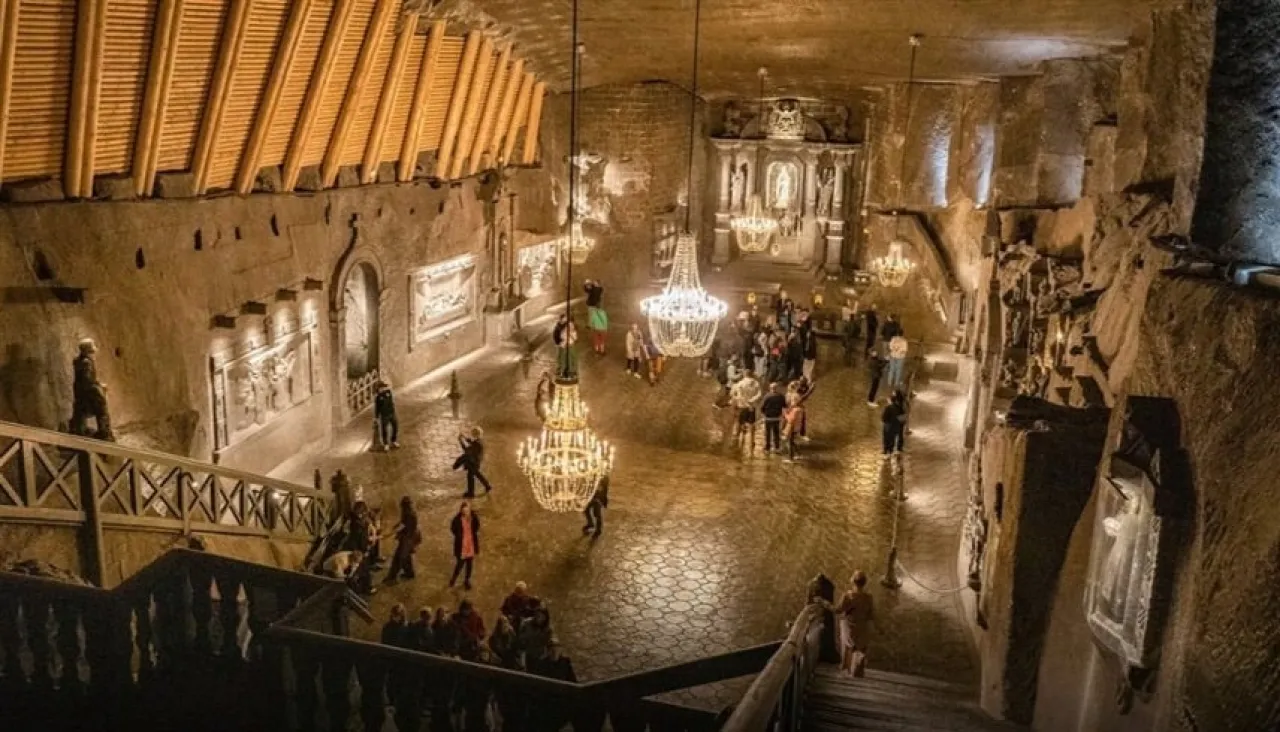
The winding passages lead to chambers fully carved into the salt rock, adorned with statues and massive chandeliers, and historical scenes documenting the lives of those who worked here.
According to the tour guide Patricia Antoniak, the gray color of the walls is due to natural impurities, as the rock is composed of up to 95% sodium chloride, while other minerals and sediments give it its distinctive color.
Halite, or rock salt, forms when ancient water bodies evaporate. The Wieliczka deposits date back to about 13.5 million years ago, when tectonic movements in the Carpathian Mountains pushed the salt layers towards the surface, later becoming an economic treasure.
Salt Mine.. and a Gold Mine
Salt extraction from the mine began in the late thirteenth century, but it peaked during the reign of King Casimir III, known as "Casimir the Great", who recognized the economic value of salt, even though its revenues constituted about one-third of the royal treasury's income, contributing to funding Poland's first university, and by the fifteenth century, the mine was producing between 7,000 and 8,000 tons annually.
Although the work was not easy, it was considered less dangerous than other mines, although some tasks, such as burning methane gas to avoid explosions, were risky. Horses used since the sixteenth century to lift salt to the surface never saw daylight again after their descent.
During the World War
During World War II, the face of the mine changed, during the Nazi occupation, it was converted into an underground factory for aircraft components production, with forced laborers from the nearby Plaszow camp, but the humidity and salt proved to be unsuitable environments for metal industries, and the experiment quickly ended, leaving behind a dark chapter in the site's history.
The main attraction of the mine today is St. Kinga's Chapel, a huge hall entirely carved from salt, completed in 1964 after 67 years, which still hosts prayers and weddings, with chandeliers made from salt crystals hanging from its ceiling, and its walls decorated with biblical scenes.
Tourism and Therapy
Tourism in Wieliczka is not a new phenomenon, as the mine has been welcoming visitors since the eighteenth century, including the astronomer Nicolaus Copernicus, who is believed to have visited it in 1493. Today, the site includes party halls, unusual adventures like rope jumping underground, and even a hot air balloon tied inside one of the halls.
It also hosts a spa at a depth of 450 feet, benefiting from air rich in minerals and low in bacteria, making it a destination for allergy sufferers and respiratory issues. The salt absorbs moisture and limits microorganisms, naturally creating an almost sterile environment.
Despite the cessation of mining, more than 380 workers still maintain the site, especially in the face of the biggest danger: leaking water that could dissolve the salt and threaten the internal structure. Their daily tasks include pumping water, reinforcing ceilings, and ensuring the safety of the thousands of visitors who descend into this kingdom carved in rock.