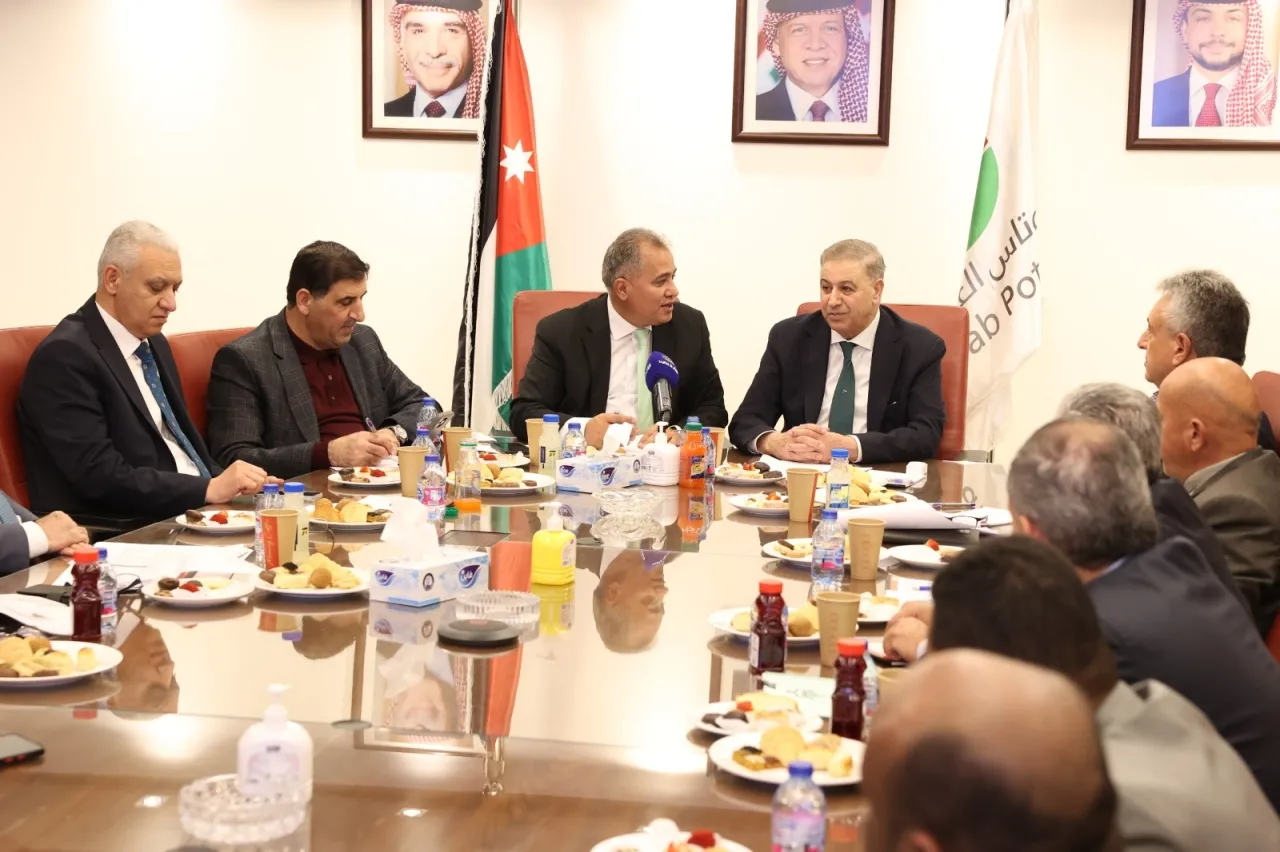
Khaberni - The Chairman of the Board of Arab Potash Company, Engineer Shahada Abu Hudaib, received a delegation from the Initiative Parliamentary Bloc chaired by MP Ahmad Al-Humaisat, where he briefed them on the pivotal role the company plays in supporting the national economy, and the general outlines of the modernization and development plans adopted by the company for the upcoming phase.
Al-Humaisat said that the bloc's visit came as part of activating the supervisory role of the House of Representatives, and enhancing the approach of direct openness to major economic institutions and companies of the state, to see their actual performance on the ground, and follow their developmental programs and future plans, considering them pivotal national companies on which the structure of the Jordanian economy is based, and contributing directly to supporting the state's treasury.
Al-Humaisat added that "Arab Potash" achieves advanced results on operational, investment, and financial levels, reflecting a successful model of sound institutional management, and confirming its ability to continue expansion and growth in a highly competitive global environment, thus supporting the path of comprehensive economic development in the Kingdom, and praising the company’s effective contributions in the field of corporate social responsibility.
The meeting was attended by the Bloc's records keeper, Yusuf Al-Rawadieh, Dr. Hussein Al-Amoush, Firas Al-Qabalan, and the media spokesperson in the Bloc, Issa Nassar, Feryal Bani Salman, Dr. Abdel Hadi Al-Barizat, Engineer Nesim Al-Abadi, Mohammad Al-Mohamid, and Bakr Al-Hayaseh, who praised the efficiency of management and the national expertise working in the company, confirming that it constitutes a fundamental pillar in the results achieved, and contributed to consolidating its position as one of the leading companies in the industrial sector, and a fundamental pillar of the national economy, and an advanced national model in institutional work and governance.
And they affirmed the support of the "Initiative" Parliamentary Bloc and the House of Representatives for the developmental directions adopted by the company, and their readiness to support its efforts and future plans, ensuring the continuation of its national role and achieving more successes during the upcoming phase.
For his part, the Chairman of the Board of Arab Potash Company, Engineer Shahada Abu Hudaib, reviewed in front of the parliamentary delegation the main pillars of the company's expansion and development plans for the upcoming phase, which aim to enhance its global competitiveness, maximize the benefits from national natural resources, and expand in value-added manufacturing industries, in line with the rapid developments in the global fertilizer sector, and consistent with the goals of the Kingdom's Economic Modernization Vision.
Engineer Abu Hudaib confirmed that the company is currently implementing a package of strategic projects, several of which have been completed over the past years, contributing to increasing operational efficiency and enhancing production and operational readiness, alongside proceeding with implementing major expansion projects, explaining that these projects contributed to increasing the production capacity of the company from about (2.44) million tons in 2018 to about (2.84) million tons in 2024, an increase of (400) thousand tons with a rate of 16%; due to the implementation of several distinctive projects that contributed to increasing production efficiency before the expansion projects came into service.
In this context, Engineer Shahada Abu Hudaib detailed the Southern Expansion project, which is considered the largest project in the history of the Arab Potash Company, aiming to increase the production capacity to about (3.7) million tons per year with an expected investment cost of about (1.1) billion US dollars, expecting the project to be completed by the end of 2029.
Engineer Abu Hudaib pointed out that "Arab Potash" succeeded in penetrating the toughest global markets in terms of quality and specification requirements, especially the European market, through developing specialized products, including "Red Granular Potash", which enabled the company to expand its presence in high-return markets and enhance the status of the Jordanian product within the global supply chains, explaining that the company was able during the past few months to establish strategic international partnerships and sign long-term supply agreements with major fertilizer manufacturing companies in the world, ensuring increased demand for the company's products, and enhancing the competitiveness of the Jordanian product in the global markets, highlighting that the company's sales in 2025 achieved a new record after reaching (2.87) million tons.
Engineer Abu Hudaib also referred to the Arab Potash Company as one of the main tributaries of the national economy, where it contributed along with its affiliated and allied companies to more than (1.3) billion US dollars in the foreign currency reserves of the Kingdom by the end of the first nine months of last year, in addition to its continuous contribution in supporting the state treasury through taxes, mining returns, licensing fees, and ports, besides its pivotal role in supporting national exports and strengthening the solidity of the Jordanian economy, indicating that the company's value increased by (1.4) billion dinars and by 107% during the period from the end of 2018 until February 2025.
Engineer Shahada Abu Hudaib emphasized that the successes achieved by the Arab Potash Company over the past years came as a result of the institutional alignment and synergy between the board's presidency and the executive management, working as one team within a clear vision and shared goals, which contributed to speeding up the implementation of strategic plans, enhancing decision-making efficiency, and achieving tangible results on the operational, financial, and developmental levels.
The parliamentary delegation was also briefed on the company's efforts in the "green economy" file, through implementing renewable energy projects, developing innovative water management solutions, and reducing the carbon footprint of its operational processes, in line with the environmental requirements of global markets, especially European markets.
Eng. Abu Hudaib added that the Arab Potash Company invested more than (66) million dinars in community responsibility projects in the fields of education, health, infrastructure, and youth empowerment in various governorates over the past five years, confirming that the company's approach has shifted to supporting sustainable development projects with long-term impact. He explained that these programs focused on creating job opportunities for young people, women, and less fortunate groups, and enhancing their economic integration, reflecting the company's commitment to the principles of sustainable development and its national role towards local communities.