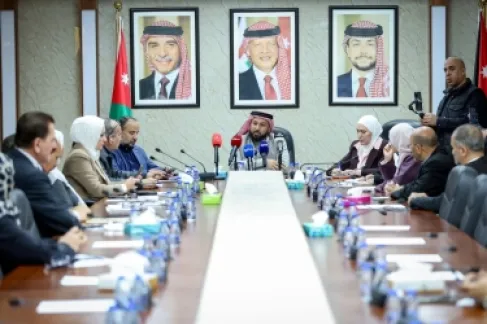
Khaberni - The House of Representatives is holding a legislative session on Wednesday morning to discuss a draft law amending the Real Estate Ownership Law for the year 2026.
The cabinet has recently approved the amended draft of the Real Estate Ownership Law for 2026 to proceed with the ratification procedures according to the constitutional norms.
The amendments aim to achieve legislative stability and have a positive economic impact by enhancing confidence in the real estate system and supporting the objectives of the economic modernization vision.
The draft law addresses the issues of removing joint ownership by simplifying and accelerating its procedures, which will help resolve many long-standing issues concerning thousands of properties and bring unused properties into the economic cycle.
The amendments in the draft law include provisions that allow electronic selling and the adoption of electronic signatures, along with the digitization of all procedures and transactions, including payment, partition, and sale; thus, making all procedures electronic in accordance with the Notary Public Law provisions, in addition to reducing the financial and procedural burdens associated with paper publishing, aimed at facilitating for the citizens and reducing cost, time, and effort on them.
The amendments allow selling and partitioning on the plan before construction begins on the property, provided that a bank-approved allocation certificate is issued; this contributes to encouraging investment and real estate development.
The amendments also include replacing the requirement for unanimity of partners in partitioning properties with buildings on them to merely requiring the consent of three-quarters of the property owners, without infringing upon the rights of the other partners.
The draft law obliges the government, municipalities, and the Greater Amman Municipality to pay compensation for expropriations within a maximum period of 5 years, with a delay compensation payable for each year, in addition to addressing the conflict of provisions of removing joint ownership with the legislation related to agricultural units, ensuring compatibility with the Jordan Valley Development Law provisions to prevent dual application.
The draft law includes many steps to facilitate for the citizens and reduce the procedures related to their transactions, through delegating powers to managers in different provinces and regions to reduce centralization.
```