



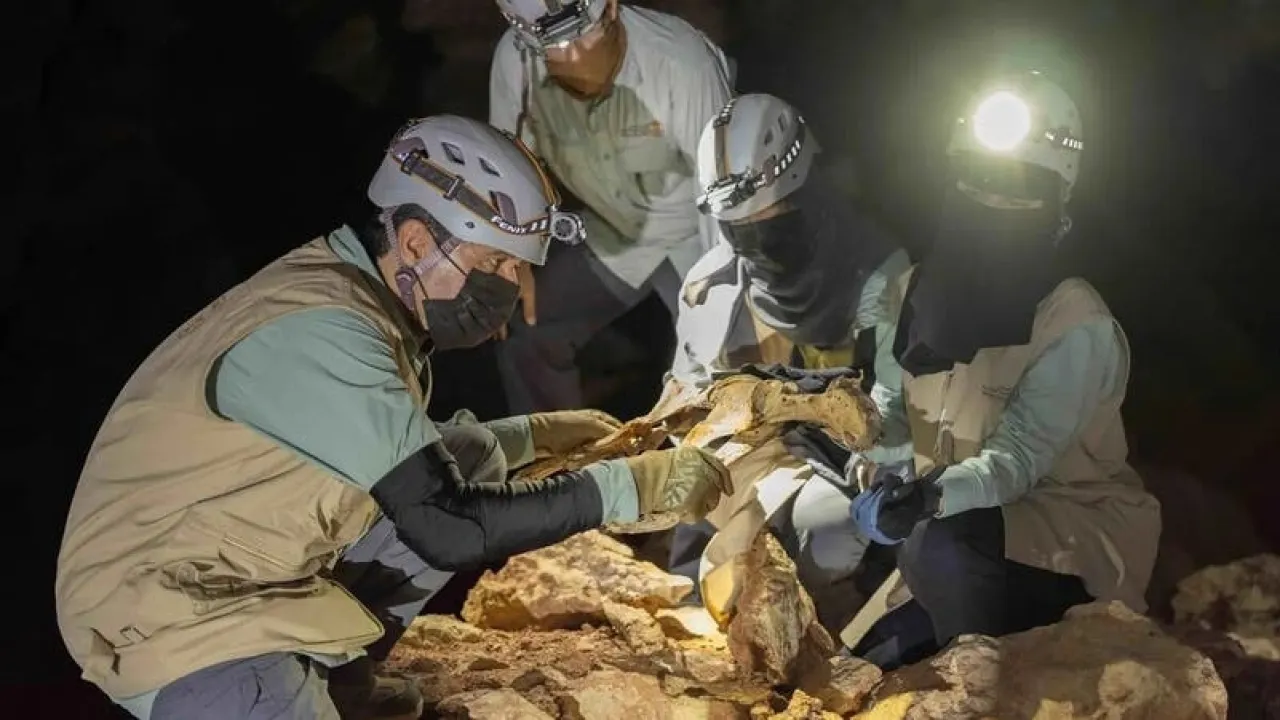
Khaberni - In a first-of-its-kind discovery, 7 naturally mummified cheetahs were found in caves in northern Saudi Arabia. A scientific paper was published in the journal Nature:Communications Earth &Environment by the National Center for Wildlife Development, covering the documentation of the first scientific discovery of naturally mummified cheetahs in caves within the Kingdom, and the analysis of its scientific implications for supporting cheetah reintroduction programs.
The published study relied on extensive field surveys that included exploring 134 caves in northern Saudi Arabia, where 7 naturally mummified cheetahs and 54 skeletal remains of cheetahs from different time periods were documented.
About 4800 years ago
Analysis results showed that the discovered cheetahs lived in widely separated time periods, the oldest being about 4800 years ago, and the latest about 127 years ago, confirming that the cheetah was present in the Arabian Peninsula until relatively recently. Genetic analyses also revealed that these cheetahs are genetically linked with two subspecies, the Asian cheetah and the north-west African cheetah, providing a precise scientific reference for selecting the most suitable strains for reintroduction programs.
The study also highlighted the role of caves as natural repositories for biodiversity, where environmental conditions helped preserve animal remains, providing a rare opportunity to reconstruct the evolutionary history of the cheetah on the Arabian Peninsula and bridge a knowledge gap about its ancient geographical range.
A qualitative addition
The scientific paper affirmed that these results represent a qualitative addition to Saudi efforts to restore ecological balance, especially in view of the successes achieved in recent years in reintroducing natural cheetah prey, such as gazelles and the Arabian oryx, scientifically paving the way for the return of top predators to their natural habitats.
The CEO of the National Center for Wildlife Development, Mohammad Ali Qurban, clarified that publishing this scientific paper in one of the "Nature" journals reflects the level of scientific maturity reached by the center's research programs, pointing out the importance of employing genetic and historical evidence to support decisions on reintroducing endangered species.
The journal Nature:Communications Earth & Environment is among the prestigious peer-reviewed scientific journals globally, ranked in the top 25% in its field in terms of research quality and scientific impact. It focuses on pioneering research in earth sciences, environmental studies, and biodiversity, and receives extensive citations in international academic and research circles.


