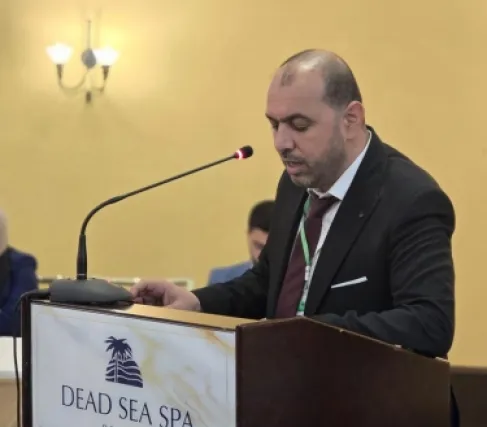
Khaberni - Written by Awad Dhifallah Al-Malahmeh:
The word "Faza'at" or "Faza'a," originally derives from the word (Faza'a, or panic) meaning fear, and the random, unstructured spontaneous reaction.
In some Arab countries, the term "Faza'a" means "relief." It conveys providing aid or assistance in situations of panic or fear during a crisis.
When a person (the brave one) feels compelled to offer help and support to someone or some entity, it means that person has been struck by a disaster or calamity that threatens their life or the lives of their family, or their property, and the event has occurred unexpectedly and violently, and may be fatal or destructive. Then he screams and pleads for help from those around him to assist and rescue him. The danger is abrupt, and the one affected by the danger is unprepared to face it and mitigate the damages whether to property or lives, or perhaps both. And the state of the person (the brave one) is not better than the one who pleaded for help—where the element of surprise dominates—lacking readiness and capability to provide aid because he isn't equipped, lacking tools that enable him to offer ideal help to eliminate the danger and save lives or property. Yet, he has no choice but to offer help and assistance to the best of his modest physical abilities. He rushes to the aid of the one in distress, and maybe his intervention makes a positive—or negative—difference, and makes the situation messier.
"Faza'a" can make a positive difference among individuals. Suppose someone witnesses a violent car accident, perhaps the involvement of individuals in rescuing people trapped inside the car if it catches fire, by pulling them out before the fire reaches them, and moving them away from the vehicle for fear of an explosion due to the flames and the presence of flammable materials.
However, acting on "Faza'a" on the level of countries and homelands can be a major, destructive disaster. Running homelands cannot be random, managed by panics, ever.
Countries are governed and their affairs managed by making early preparations, which require providing equipment, supplies, staff, training, mechanisms, and organized precautions according to a civilized scheme that makes a significantly positive difference. And this preparation is done in advance following mechanisms and steps called "strategies," which lead to "policies," and "plans," and "alternative plans." These plans are short-term, medium-term, and long-term.
Even strategies are useless if they do not meet certain conditions, which keep them connected, alive, renewed, evolved, and flexible, adaptable to change and expansion.
What has been mentioned above entails that these strategies be "transgovernmental." This allows building on achievements to maximize positives and avoid negatives.
We should never underestimate managing homelands, ever. Because underestimation begets regret, and the accumulation of regrets will lead to consecutive and sequential collapses, resulting in the total collapse of the homeland.
There's nothing more wonderful than homelands whose building, development, prosperity, and flourishing processes are according to well-studied, pre-prepared strategies and policies, during times of prosperity and calm, when things proceed smoothly and properly, and during which precautions and preparations are made to face disasters and crises preemptively, as they usually occur unexpectedly.
What protects homelands from regression, backwardness, and collapse is articulated in a comprehensive vision for the homeland, where we want to elevate it and see it after a decade or two, and what status we hope it would attain among other nations.
Traditionally, even until the 1970s, Jordanians practiced a method of cooperation and solidarity called "Al Awna."
It means assisting each other and was very organized. They would rotate activities like threshing, harvesting, sheep shearing, or plastering roofs.
And I conclude with a famous saying by Benjamin Franklin, where he said:—
((If you fail to plan, you are planning to fail)).