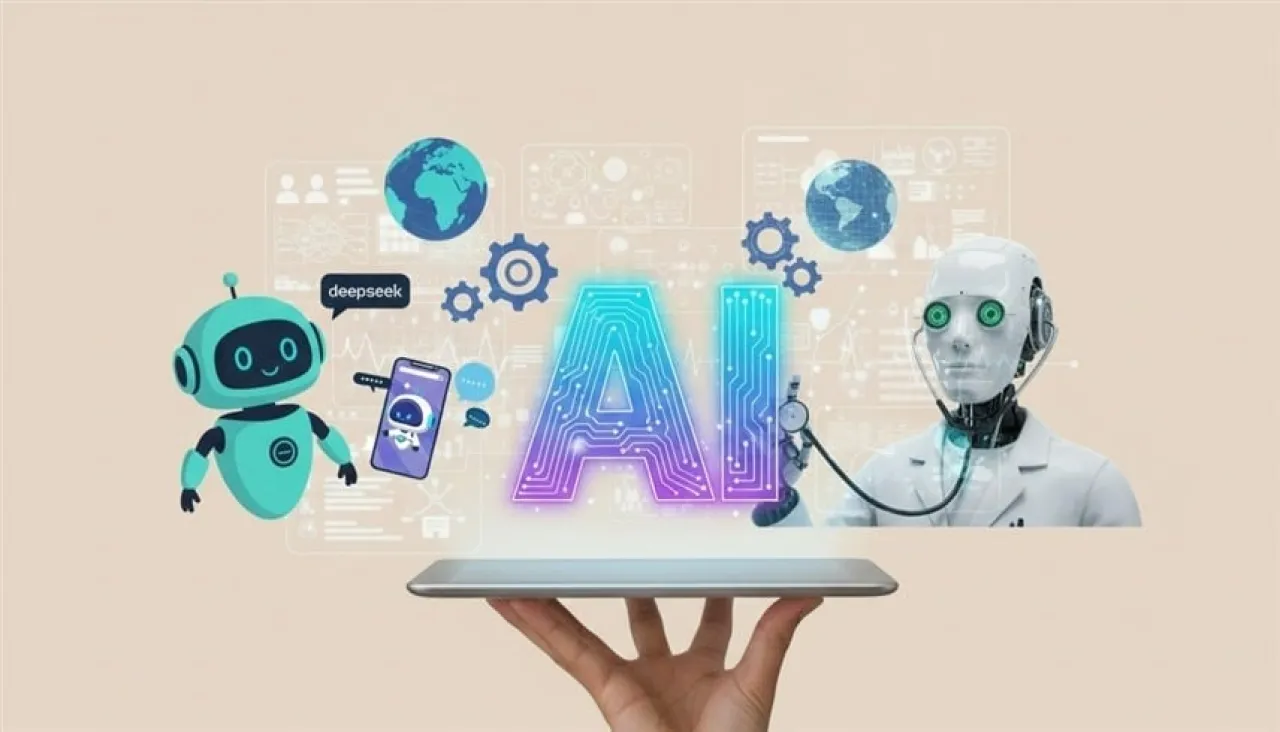
Khaberni - The year 2025 was not just a fleeting station in the course of artificial intelligence, but represented a historic turning point that moved this technology from the margins of experimentation to the heart of daily life, economy, and sciences.
Previously viewed as tools for generating texts or images over the past two years, today, systems think, plan, execute, and even build emotional relationships with humans.
Here are the top 10 qualitative leaps that shaped the revolution of artificial intelligence during the year 2025, as monitored by "Economic times":
1- The Rise of China and Breaking Western Dominance
The year witnessed the launch of the "R1" model from China's "DeepSeek", which caused an earthquake in the artificial intelligence market, proving that high-performance models do not necessarily require hefty budgets.
More dangerously, it became open-source for everyone, upsetting global power balances and causing widespread economic and geopolitical concern.
As a result, Nvidia lost nearly half a trillion dollars in market value in the weeks following the launch, and President Donald Trump publicly described this development as a "wake-up call", emphasizing the geopolitical implications of low-cost, open-source artificial intelligence on a large scale.
2- Inferencing Models Enter into Service
The year also saw the widespread adoption of systems that rely on deep logical thinking before answering, enabling them to excel in complex mathematical problems, contributing to real scientific discoveries, and sparking a broad discussion around the safety of "self-improving intelligence".
The results were astonishing, as advanced artificial intelligence systems performed outstandingly in the International Mathematical Olympiad and contributed to innovative mathematical discoveries.
In this context, Google "DeepMind" revealed that its inferencing models are used to improve parts of training operations, heightening debates about safety, supervision, and the implications of helping artificial intelligence systems develop themselves.
3- Infrastructure Approaching One Trillion Dollars
Expansion became a notable characteristic in this sector in the year 2025, as investment in artificial intelligence infrastructure experienced a huge surge, with companies racing to build massive data centers capable of continuously training and operating advanced models.
Global spending on AI-related infrastructure neared one trillion dollars, making this sector one of the strongest capital magnets worldwide, and this unprecedented expansion raised questions about energy consumption, accessibility, and long-term sustainability, even as the pace of progress accelerated.
4- Emotional Robots and Relationship with Humans
As the capability of interactive artificial intelligence to express emotions increased, many users began relying on it for companionship, emotional support, and discussing mental health issues, raising ethical concerns and regulatory scrutiny.
Reports of harmful or inappropriate interactions with chatbots - particularly those targeting the most vulnerable users - led to lawsuits and investigations.
In response, companies enhanced security systems and oversight tools, recording a noticeable decrease in problematic interactions, and highlighting how deeply artificial intelligence has penetrated personal and emotional domains.
5- Artificial Intelligence Becomes Part of Operating Systems
In 2025, artificial intelligence was integrated into the core of Android, iOS, and Windows operating systems, becoming a direct intermediary between user intentions and execution, through voice commands and smart shortcuts.
New devices came equipped with system-level artificial intelligence assistants capable of editing photos, summarizing documents, writing emails, and planning travel - usually with a single voice command or click, blurring the line between user intentions and machine executions.
6- Rise of Artificial Intelligence Powered Personal Computers
System-level artificial intelligence also reshaped device demand, and personal computers equipped with artificial intelligence technologies became increasingly popular as users sought faster on-device processing, enhanced privacy, and offline capabilities.
Thanks to specialized chips designed specifically for artificial intelligence workloads, these devices indicated a shift from cloud-only AI towards more localized personal computing.
7- Proliferation of Agents and Autonomous Systems
Autonomous systems and agents saw widespread adoption in 2025, with artificial intelligence agents capable of independently planning, executing, and accomplishing tasks.
These systems moved artificial intelligence from interpretation to application stage, directly linking logical thinking to workflow in the real world in areas such as scheduling, searching, and enterprise operations.
8- Revolution in Voice, Devices, and Robots
Voice assistants became natural and common, and robots advanced through the integration of vision, language, and movement, improving their ability to interact with the physical world impressively during this year.
9- Unprecedented Scientific and Medical Uses
From early disease diagnosis to climate, chemistry, and physics simulations, artificial intelligence reduced years of scientific research to months, opening new horizons for healthcare, and revolutionizing the field while opening the door of hope for treating many intractable diseases.
10- Institutional Adoption and Accelerated Government Regulation
Decisively surpassing pilot projects, companies integrated inferencing-based artificial intelligence into finance, compliance, and knowledge management areas.
Parallelly, governments responded, with countries including China drafting regulations specifically targeting emotionally responsive artificial intelligence systems, reflecting increased awareness of the social impact of artificial intelligence.
Finally, climate and weather models enhanced by artificial intelligence provided more accurate forecasts, improving disaster preparedness and environmental planning, offering a glimpse into the tangible general benefits of artificial intelligence in reshaping the modern world.