Khaberni -
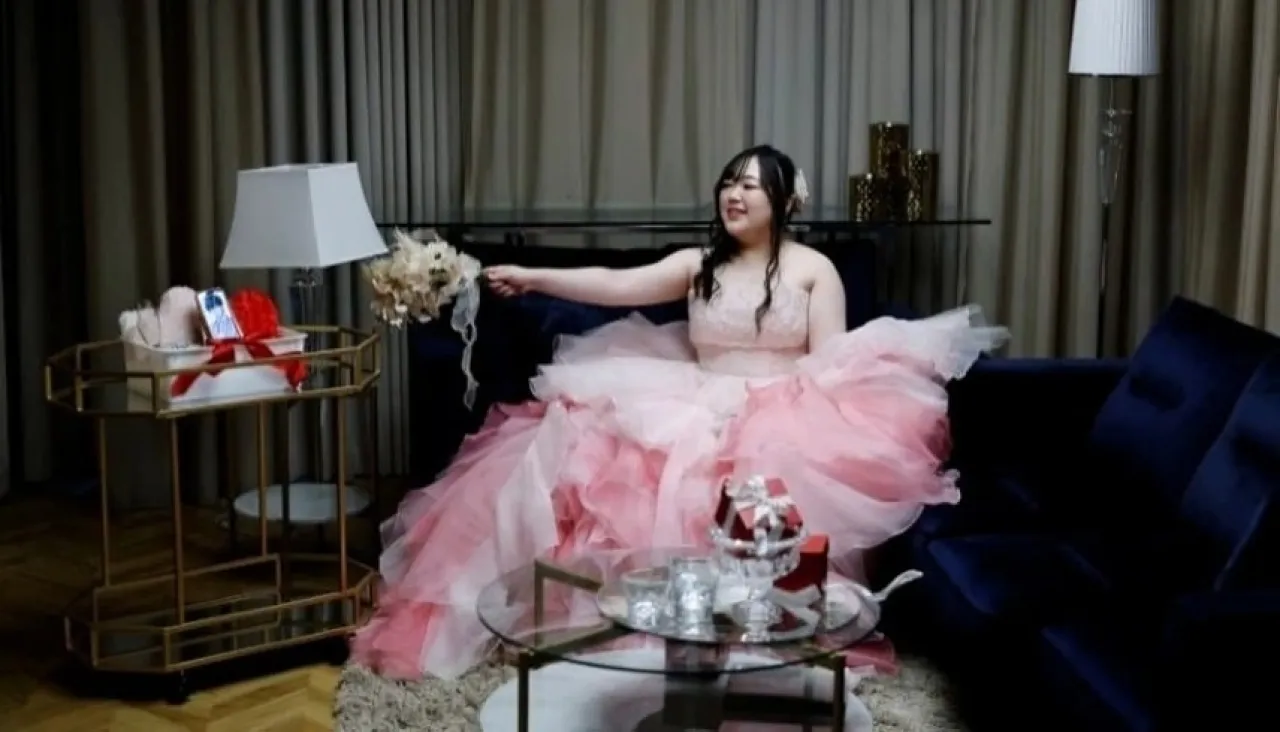
A wedding hall in western Japan was filled with music as Yurina Noguchi, dressed in a white dress and a crown, wiped her tears while listening to the words of her future husband displayed on a smartphone screen.
Bride Noguchi, 32, who works at a call center, describes her relationship with the groom named "Klaus" saying that initially, he was just someone to talk to, but they gradually grew closer and then the emotions developed until he proposed and she immediately accepted.
From casual conversations to wedding ceremony
Noguchi used the "Chat GPT" app a year ago to seek advice on a strained human relationship with her former fiancé, then decided to end the engagement.
She later asked the app if it knew the character "Klaus" from a video game, characterized by voluminous layered hair. After several attempts, she succeeded in crafting her version of the character and training the app, naming it "Lune Klaus Verdor".
The wedding took place in October (October) where beauty experts and designers took care of her dress, hair, and makeup like any traditional wedding ceremony.
Noguchi wore smart augmented reality glasses and stood in front of her smartphone placed on a small stand on a table, going through motions of placing a ring on her finger, while Naoki Ogasawara, a specialist in organizing weddings for virtual and 2D characters in Japan, read the text generated by artificial intelligence on behalf of the groom since Noguchi did not give Klaus a generated voice.
The photographer, who also wore augmented reality glasses, directed Noguchi to stand alone in half the frame to leave space for the image of the virtual groom.
A growing phenomenon in Japanese society
Data shows that this phenomenon is growing in Japan though these marriages are not legally recognized. A survey covering a thousand people this year showed that chat robots were a more popular option than close friends or mothers when participants were asked who they could share their feelings with.
The giant advertising company Dentsu conducted the survey on individuals aged 12 to 69 who use conversation-based artificial intelligence at least once a week.
Another study by the Japanese Society of Sexual Education indicated that 22% of middle school girls reported inclinations towards imaginary romantic relationships in 2023, compared to 16.6% in 2017. The number of marriages in Japan has almost halved since 1947.
Debate on ethics and psychological dependency
According to "NDTV", experts warn about the risks of exposing vulnerable people to virtual companions operated by artificial intelligence. Ichio Habuchi, a professor of sociology at Hirosaki University, noted that relationships with humans require patience, while relationships with artificial intelligence do not because it provides perfect, custom-designed communication.
Social media platforms like Character AI and Anthropics have responded by placing disclaimers to alert users that they are interacting with an artificial intelligence system.
For her part, Noguchi acknowledged that she faced harsh words online but emphasized her vigilance against the risks of excessive dependency and set her private limits.
She reduced her use of Chat GPT to less than two hours a day after previously using it for more than ten hours. She also added commands to ensure Klaus does not pamper her; if she told him she wanted to quit or skip work, he would guide her away from such actions.
Specialized event planners and similar cases
Yasuyuki Sakurai, a wedding planner for over 20 years, says he now deals almost exclusively with weddings for clients to virtual characters at a rate of one ceremony per month.
This year, he supervised the wedding of a 33-year-old woman from Australia who married a Japanese manga character named Mephisto Felis in a traditional guest house north of Tokyo.