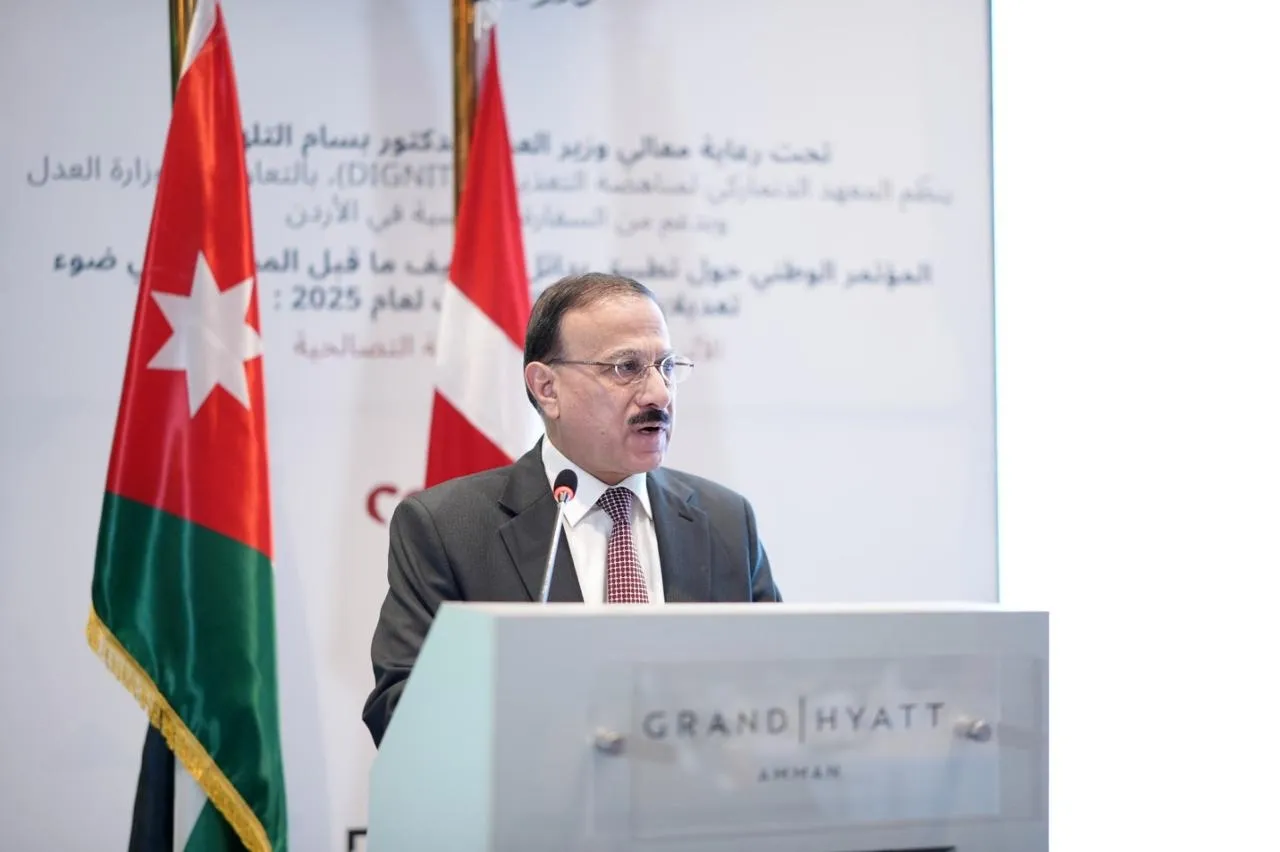
Participants in the national conference hosted by the Danish Institute Against Torture-DIGNITY in partnership with the Ministry of Justice emphasized the need to expand the use of detention alternatives in rulings and judicial decisions to enhance the approach of restorative justice.
The conference, titled "National Conference on Implementing Pretrial Detention Alternatives in Light of Criminal Law Amendments for 2025: Impact on Society and Restorative Justice"" aimed to promote public dialogue between the judiciary, civil society, and relevant parties.
Participants also recommended, within the framework of proposing a roadmap, the necessity to review international experiences during the next phase, including aligning detention alternatives with sentencing alternatives to ensure consistency and the philosophy of reform through various stages of criminal proceedings, from investigation to judgment and implementation.. Additionally, studying the introduction of amendments to Article (114) of the Criminal Procedures Law, which enhances the priority of resorting to detention alternatives, introduces clearer criteria for appropriateness and necessity, and limits unjustified detention. And studying the possibility of incorporating a principle of gradation in precautionary measures, so that detention is only considered after exhausting less restrictive alternatives.
In the institutional practical framework, participants recommended the importance of preparing standardized procedural guides for public prosecutors and judges on using detention alternatives, which include clear standards, decision models, and practical examples. In addition to expanding specialized and ongoing training programs for members of the public prosecution and judges, focusing on practical application and case studies and expanding towards targeting related categories, especially lawyers.
The conference also carried specific recommendations like expanding the scope of application of alternatives to include foreigners and expatriate workers and using detention alternatives for foreigners, particularly expatriate workers, considering the principle of equality before the law, international obligations of the kingdom, and the legal and social specificity of this category. And developing specific procedures for labor or administrative cases, which reduces unnecessary use of detention and enhances alternative justice solutions.
In the context of developing legal mechanisms, participants recommended the necessity to deal with detainees of undetermined residence, through alternatives such as alternative bail, judicial supervision, or monitoring mechanisms, balancing attendance guarantees and humanitarian considerations.
And the repetition of the recommendation to focus on the importance of raising legal and community awareness through enhancing media coverage related to raising public legal awareness about the philosophy of detention alternatives and their goals, which reduces the misunderstanding that links alternatives with leniency towards crime. In addition to engaging civil society organizations and national human rights institutions in awareness, monitoring, and providing legal support within clear collaborative frameworks.
Participants also emphasized the importance of reviewing related regulatory frameworks, including the provisions of the Bar Association Law or its instructions, in a way that allows organizing lawyers' participation in general legal awareness activities, without conflicting with professional rules or independence, and in coordination with relevant official bodies, and encouraging partnerships between the Ministry of Justice, the Bar Association, and civil society organizations, to develop joint awareness programs that contribute to enhancing society's understanding of detention alternatives and justice guarantees.
In the context of monitoring and evaluating impact, some recommendations carried the importance of establishing a national mechanism for monitoring and evaluation to measure the impact of applying detention alternatives, including quantitative and qualitative indicators, such as detention rates, duration, and the effect of alternatives on recidivism rates. ( The Observatory), with the need for applied studies to monitor best practices, and utilize them in developing public policies. And impact studies on those who received detention alternatives compared to those who did not
The conference was opened with speeches by the Executive Director of Operations at DIGNITY, Mr. Morten Olsen, and His Excellency the Deputy Head of Mission at the French Embassy in Jordan, Mr. Jean Christophe Oujé, along with His Excellency the Jordanian Minister of Justice, Dr. Bassam Talhouni, where speakers emphasized the strategic importance of this event in supporting justice pathways and enhancing legal frameworks, contributing to the public interest and consolidating principles of restorative justice.
The first session discussed the legislative amendments to the Criminal Procedures Law and their implementation mechanisms, focusing on the legislative and institutional opportunities to enhance the application of pretrial detention alternatives. The session included speeches by the Secretary-General for Judicial Affairs at the Ministry of Justice, Walid Knakriyah, along with the Secretary-General of the Judicial Council, Ali Al-Masimi, and the Attorney General, Hassan Al-Abdallat.
The session highlighted the amendments made to alternatives to detention, the conditions for their application, and related practical challenges, contributing to a more efficient and balanced justice system and enhancing institutional integration among relevant entities.
The second session focused on the role of civil society and legal institutions in supporting the application of pretrial detention alternatives and contributing to facilitating sustainable community reintegration.
The session was attended by the Country Representative for DIGNITY (DIGNITY) in Jordan, Mohammad Shamma, and the Executive Director for the Empowerment Center for Legal Aid and Human Rights, Ms. Linda Kelsh, along with Dr. Amal Abu Anzeh from the Law Faculty at the University of Jordan, and Dr. Nahla Al-Momani, the Commissioner for Protection at the National Center for Human Rights.
The session was chaired by the General Director of the Awareness Center for Human Rights, Professor Taghreed Al-Daghmi, where it was affirmed that tangible steps were being taken towards progress in the use of detention alternatives. Ms. Kelsh emphasized the pivotal role of civil society as a complementary partner to the justice system, especially in raising public awareness. The discussions contributed to enhancing the shared understanding of the roles of community partnerships and affirming the integration between legal and institutional efforts, which supports the sustainability of applying alternatives and enhances their positive impact on society.
The third and final discussion session focused on the importance and impact of applying pretrial detention alternatives, where