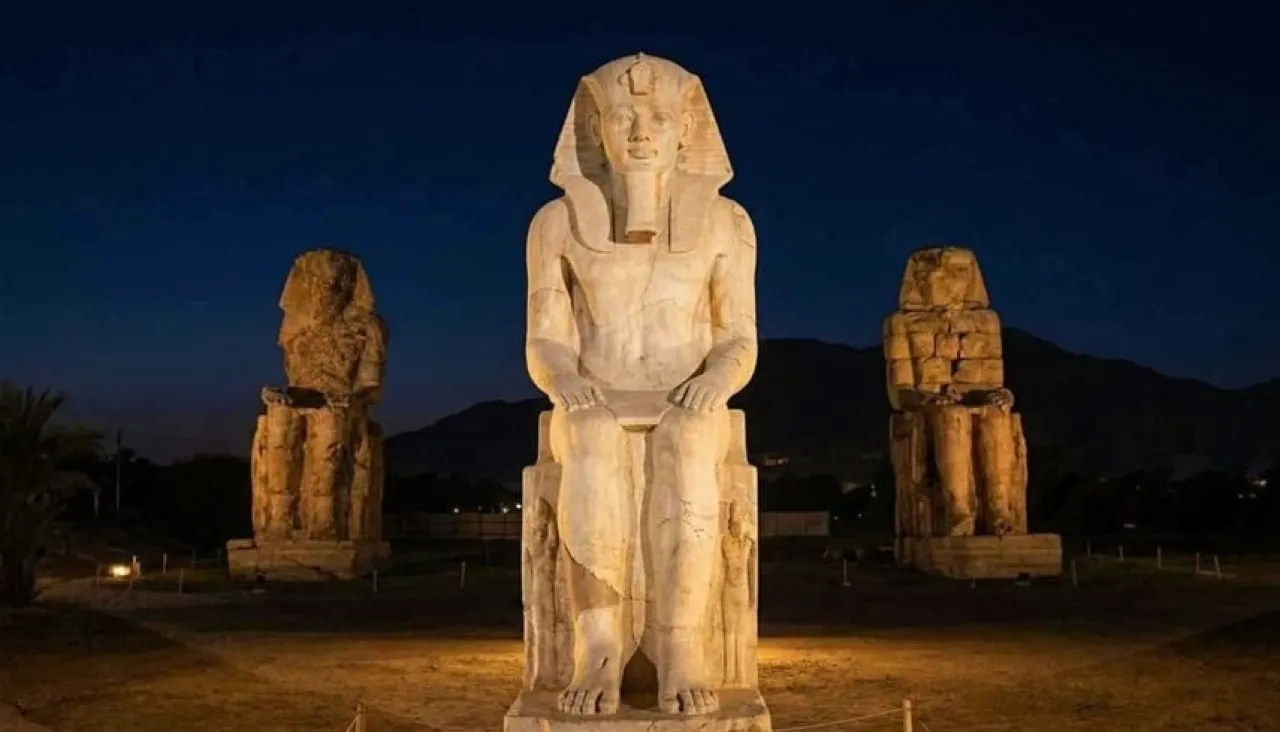
Khaberni - On Sunday, the city of Luxor witnessed the unveiling of two massive alabaster statues of King Amenhotep III, after their restoration, reassembly, and re-erection at their original location in the third pylon of the royal mortuary temple on the west bank of Luxor, which is part of the preservation project for the Memnon statues and the funerary temple of King Amenhotep III, one of the largest joint archaeological restoration projects aimed at protecting and revitalizing an important ancient Egyptian landmark according to the latest scientific methods and international standards adopted in the field of archaeological restoration.
The unveiling ceremony was attended by the Secretary-General of the Supreme Council of Antiquities Dr. Mohamed Ismail Khaled, and a number of leaders from the Ministry of Tourism and Antiquities and the Supreme Council of Antiquities, and other leaders from the Supreme Council of Antiquities in Luxor.
This event is part of the conservation project for the Memnon statues and the funerary temple of King Amenhotep III, which began in 1998 in cooperation between the Supreme Council of Antiquities and the German Archaeological Institute in Cairo, with support from the World Monuments Watch and World Monuments Fund programs, and Johannes Gutenberg University in Mainz, aimed at protecting what remains of the temple and restoring it to its original form as much as possible.
The Secretary-General of the Supreme Council of Antiquities explained that the restoration, documentation, reassembly, and lifting of the statues, which lasted nearly two decades, were carried out according to the latest scientific methods and international standards adopted in the field of archaeological restoration, using materials compatible with the nature of the archaeological stone, ensuring their authenticity and long-term sustainability.
He added that the restoration works included precise scientific studies and comprehensive documentation of the statues' condition, taking into account the environmental and climate conditions surrounding the site, describing what was accomplished as an important step within an integrated plan to revive and develop the western bank sites in Luxor, enhancing the visitor experience while fully preserving the archaeological and historical value of the site, noting the ongoing documentation and restoration works on the first pylon of the Ramesseum temple, and the near completion of the necessary studies to determine the preservation status of Queen Nefertari's tomb in preparation for potentially reopening it to the public.
Challenges
The site engineer reviewed the main challenges faced by the project, including the constant change in the groundwater level, which required precise engineering and technical solutions to maintain the stability of the archaeological site. She confirmed that the project contributed to training and qualifying over 30 Egyptian restorers, along with attracting about 10 architects to work in the field of archaeology, as part of an effective partnership between Egyptian and international expertise.
The project director explained that during the years of work, various parts of the statues were found on the site in poor conservation condition due to exposure to mud and salty water, and a number of granite blocks forming the bases of the statues were recovered from the open museum at the Karnak temples.
She added that in 2006, the team began cleaning and restoring the statues, conducting three-dimensional scanning and reassembling the scattered blocks, until the statues were raised in 2025 at their original exhibition location in the temple, with a height ranging between 13.6 and 14.5 meters.
The head of the Egyptian Antiquities sector mentioned that the statues depict King Amenhotep III seated, with his hands resting on his thighs, wearing the Nemes headcloth topped with the double crown and the royal pleated kilt, adorned with a ceremonial beard, and his attire is completed with the traditional bull's tail, accompanied by a number of queen statues, led by the Great Royal Wife "Ti", along with statues of the princess "Isis" and the queen mother "Mutemwiya".
He clarified that the sides of the throne were decorated with "Sema-Tawy" scenes symbolizing the unification of Upper and Lower Egypt, with remnants of the original colors still visible on some decorative elements.
It is noteworthy that the project to preserve the Memnon statues and the temple of King Amenhotep III resulted in the restoration, reassembly, and raising of a number of statues and architectural elements, including a pair of seated statues made of quartzite at the entrance of the second pylon, and two standing royal statues of quartzite at the north gate of the temple sanctuary.
The works also included implementing a comprehensive system to lower the groundwater level, which contributed to reducing the ground level by about three meters, thus rescuing disassembled antiquities from mud and salty water and safely returning them to their original locations.
During the project, 280 statues and parts of statues of the lion-headed goddess Sekhmet were found, documented, and restored, and they are currently awaiting display in the columned courtyard of the temple, along with discovering and rescuing two sphinx statues made of limestone, with ongoing restoration works, in addition to developing a comprehensive plan for managing and protecting the site.
The construction of King Amenhotep III's mortuary temple, known as "Millions of Years Temple," dates back to the first half of the 14th century BC, and its construction took about 39 years of his reign. It is considered the largest and richest of the mortuary temples in architectural elements and equipment.
The temple was widely damaged by a severe earthquake in 1200 BC, then its remnants were used as a quarry in later ages, before being submerged by floods and layers of Nile silt over time, and only the two giant statues of King Amenhotep III at the entrance to the temple sanctuary, known as the Memnon statues, remained standing, while the rest of its relics were destroyed and submerged in salty water, before the project successfully rescued and revived the site anew.