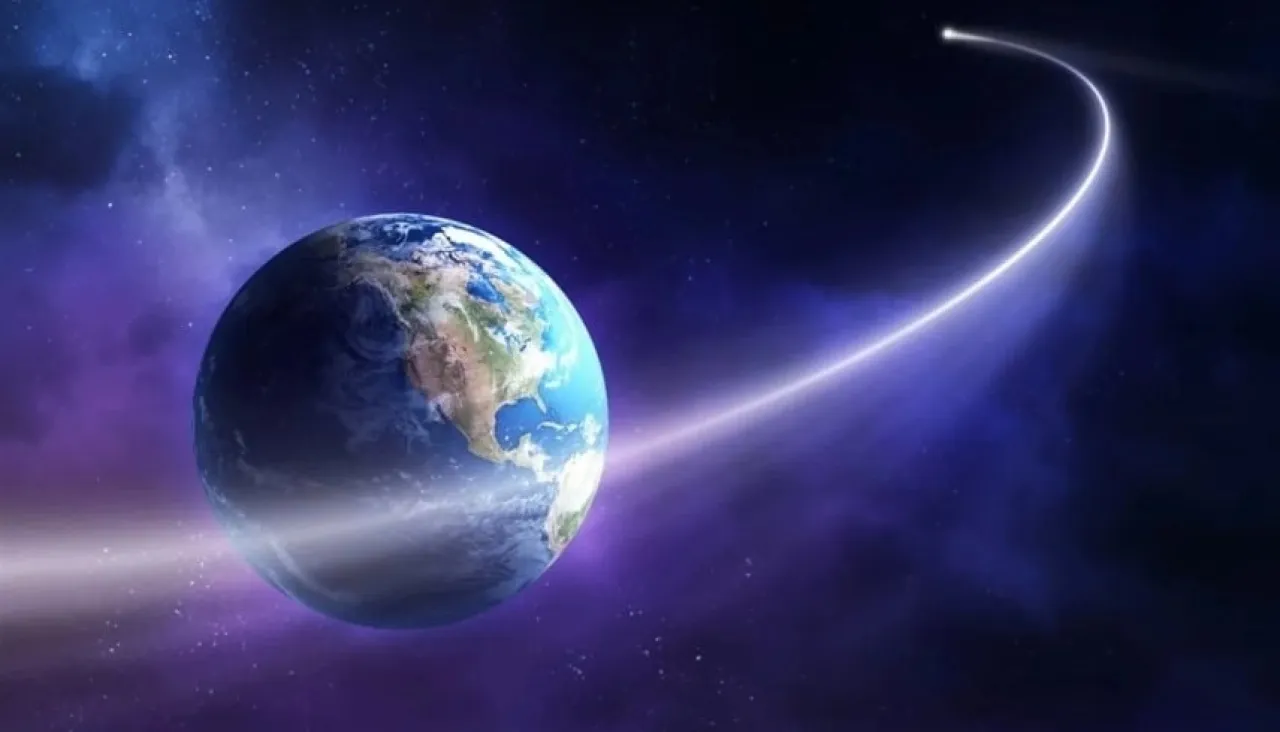
Khaberni - Planet Earth harbors a number of astonishing facts that remain unknown to many despite tremendous scientific progress, as scientists continue to discover new information about the only planet capable of supporting life in the solar system.
Here are 6 pieces of information that you might encounter - all or some of them - for the first time.
Earth was once purple in color
Scientific research suggests that life on ancient Earth might have been purple instead of the prevalent green today, as ancient microorganisms used a molecule different from chlorophyll to harvest light, giving them a purple appearance. Then, a light-sensitive molecule called retinal appeared, absorbing green light and reflecting red and violet light. Chlorophyll later developed to give plants a higher efficiency in capturing sunlight.
Earth lightning is hotter than the sun
Thunderstorms produce lightning that can reach temperatures five times hotter than the surface of the sun, heating the surrounding air up to 27,760 degrees Celsius. This happens as a result of rain, ice, and snow particles colliding inside storm clouds, increasing the imbalance between the negative charges in the clouds and the positive charges on the Earth's surface.
The origin of Earth's name remains a mystery
Researchers are unable to determine who named the planet Earth despite the Greeks and Romans naming most of the planets in the solar system. According to the official record of planetary discoveries, the name goes back to the Indo-European root, which produced the Germanic name that evolved in various European languages.
The inner Earth is characterized by a flexible composition
The inner Earth has a semi-solid or flexible composition due to high temperatures and pressure. This composition allows the Earth's mantle to move and flow through geological time, resulting in natural phenomena such as tectonic plates, volcanic activity, and earthquakes that continuously shape the planet's surface.
Europe ranks high in population
Europe is the second smallest continent after Australia but ranks third globally in terms of population after Asia and Africa with a population exceeding 746 million. It records one of the highest urbanization rates globally, with more than 75% of its population living in urban areas.
Moving rocks in Death Valley
Rocks weighing hundreds of pounds move in the Racetrack Playa area of Death Valley National Park in California. This strange phenomenon occurs when the rocks are covered with ice and then submerged by melting waters coming from the surrounding hills. When the ground becomes slippery, strong winds push the rocks across the flat surface, leaving clear tracks behind them.