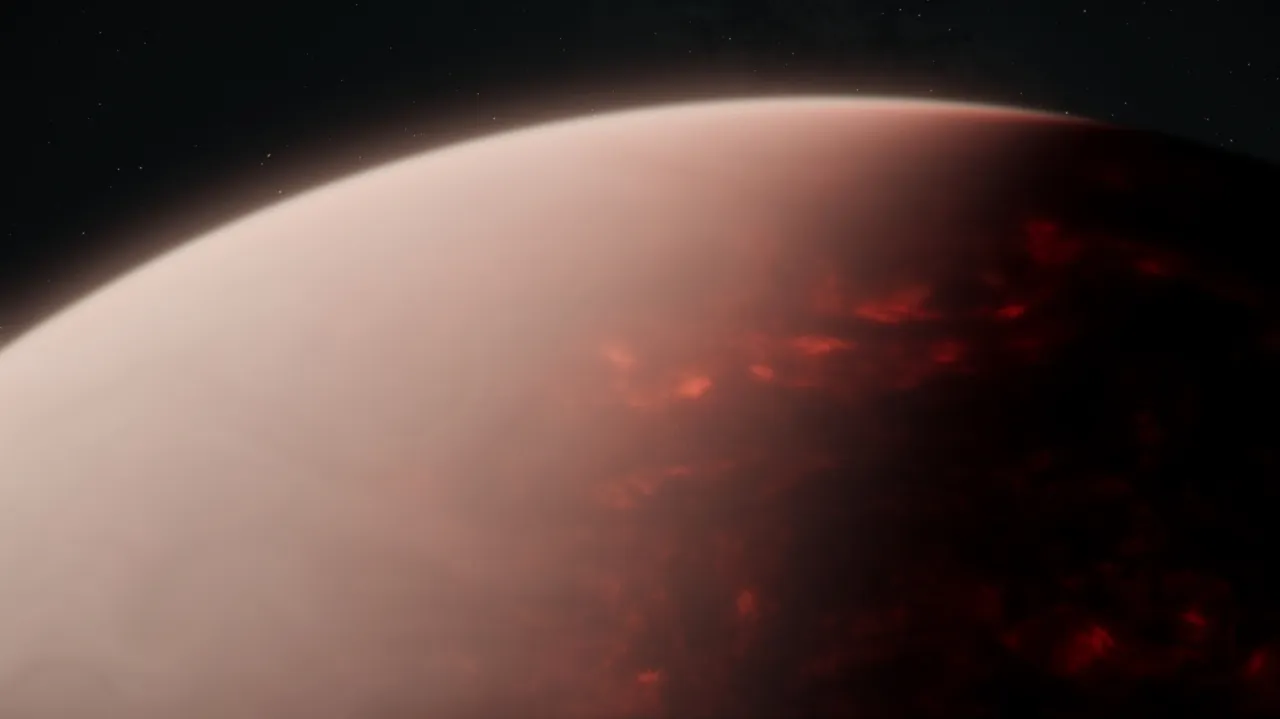
Khaberni - Astronomers have revealed the clearest evidence to date of an atmosphere surrounding a rocky exoplanet outside the solar system, in a discovery that opens up prospects for understanding the nature and evolution of extreme worlds.
A team led by the "Carnegie" institution, using NASA's James Webb Space Telescope, has studied "TOI-561 b", an ultra-hot rocky planet that orbits its star in just 10.56 hours.
The existence of this planet's surprising atmosphere challenges long-held hypotheses about how small, ultra-hot planets evolve, which previously suggested that they rapidly lose their atmosphere after formation.
"TOI-561 b" is about twice the size of Earth but is completely different from it, as it orbits very close to its star, a tenth of the distance between Mercury and the Sun, making one side of it perennially lit and never lacking daylight.
It was expected that a small and hot planet like this would lose its atmosphere quickly.
Although the star of the planet is much older than the Sun, the planet's atmosphere appears intact, which is partly due to its lower density compared to Earth, but it is not one of the large, bloated gas planets known as "gas giants".
The team studied whether the planet's low density was due to a small iron core and a lighter mantle, consistent with the characteristics of the host star.
The main author, Joanna Teske, explained that "TOI-561 b" is distinguished from other planets with very short orbital periods by orbiting a very old and iron-poor star.