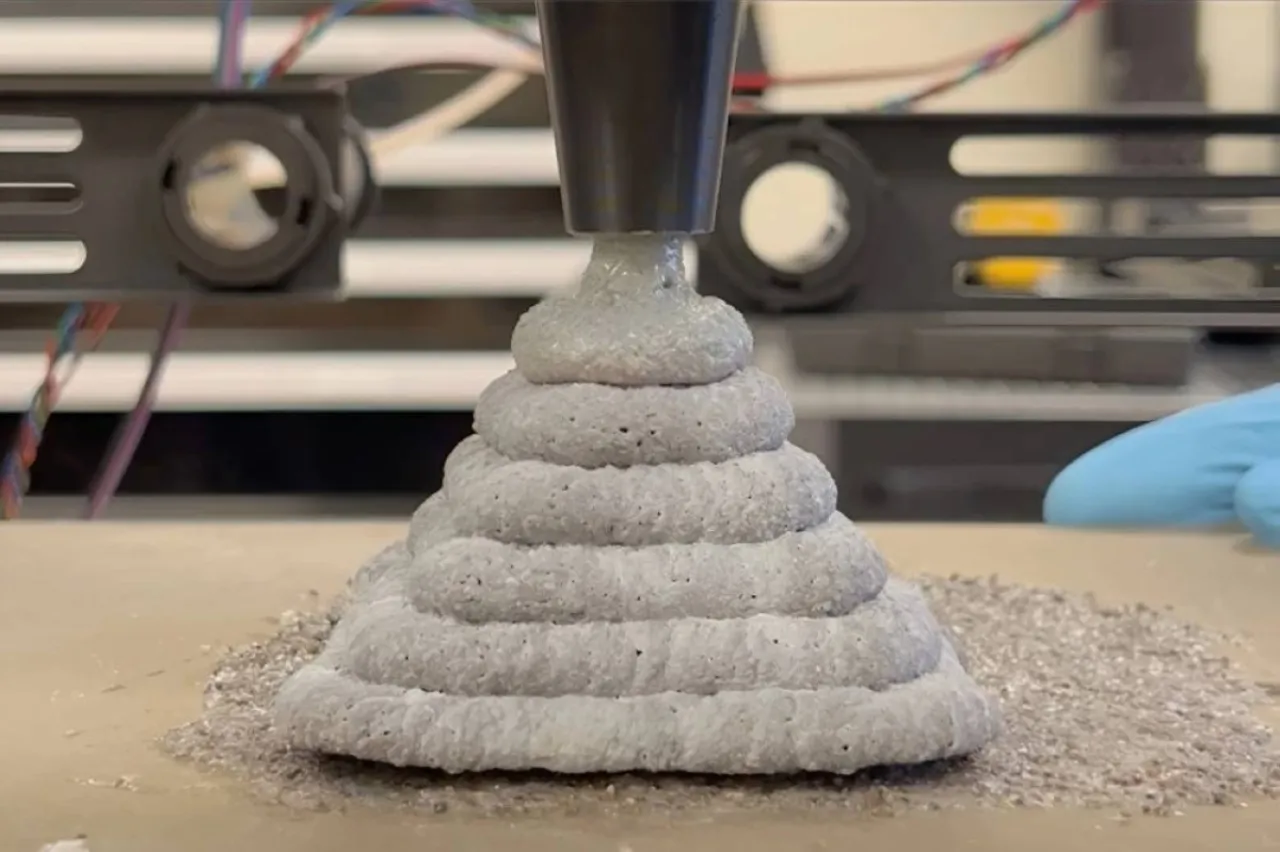
Khaberni - The building materials sector witnessed a qualitative development with the announcement by a research team from Oregon State University in the United States about the innovation of a new, 3D-printable material characterized by an unprecedented setting speed that could reshape the standards of modern construction. While traditional concrete based on cement takes up to 28 days to reach the strength needed for residential construction, this new alternative achieves the required strength in just three days.
Traditional concrete relies on a mix of water, aggregate, and cement, which is the component that consumes the most time in the setting process. Moreover, the production of Portland cement is one of the largest sources of carbon dioxide emissions globally, accounting for 5% to 8% of human emissions linked to global warming. This is due to the heating of limestone and other materials to temperatures exceeding 1400 degrees Celsius, in addition to the carbon dioxide emissions from the decomposition process during cement production, according to newatlas.
The new material invented by Assistant Professor Devin Roche and researcher Nicola Goncalves and their team represents a significant technological leap, as it relies on a mixture of clay soil reinforced with hemp fibers, sand, and biochar. Biochar is a lightweight carbon material produced through the pyrolysis of organic materials in the absence of oxygen. This mixture is more sustainable and less harmful to the environment compared to traditional cement.
However, the most notable point in the innovation is the complete abandonment of cement, replacing it with a thermosetting binder based on acrylamide, activated immediately upon exiting the nozzle of the 3D printer through a process known as "frontal polymerization."
This allows the material to gain immediate strength of 3 megapascals, enabling the printer to construct multi-layered walls and architectural formations that include projections and unsupported gaps, such as ceilings or areas above windows.
Roche confirmed that the new material exceeds a strength of 17 megapascals in just three days, the standard strength required for residential structures, while the final setting strength reaches more than 40 megapascals after a period ranging between eight and ten days. This speed opens wide possibilities for emergency construction, low-cost housing, and rapid urban development.
Although the current production cost is still higher than that of traditional concrete, the research team is working on improving efficiency and reducing costs in preparation for its commercial use. The detailed results of the study were published in the journal Advanced Composites and Hybrid Materials, reflecting a broad scientific interest in re-inventing building materials towards a faster, more sustainable future.