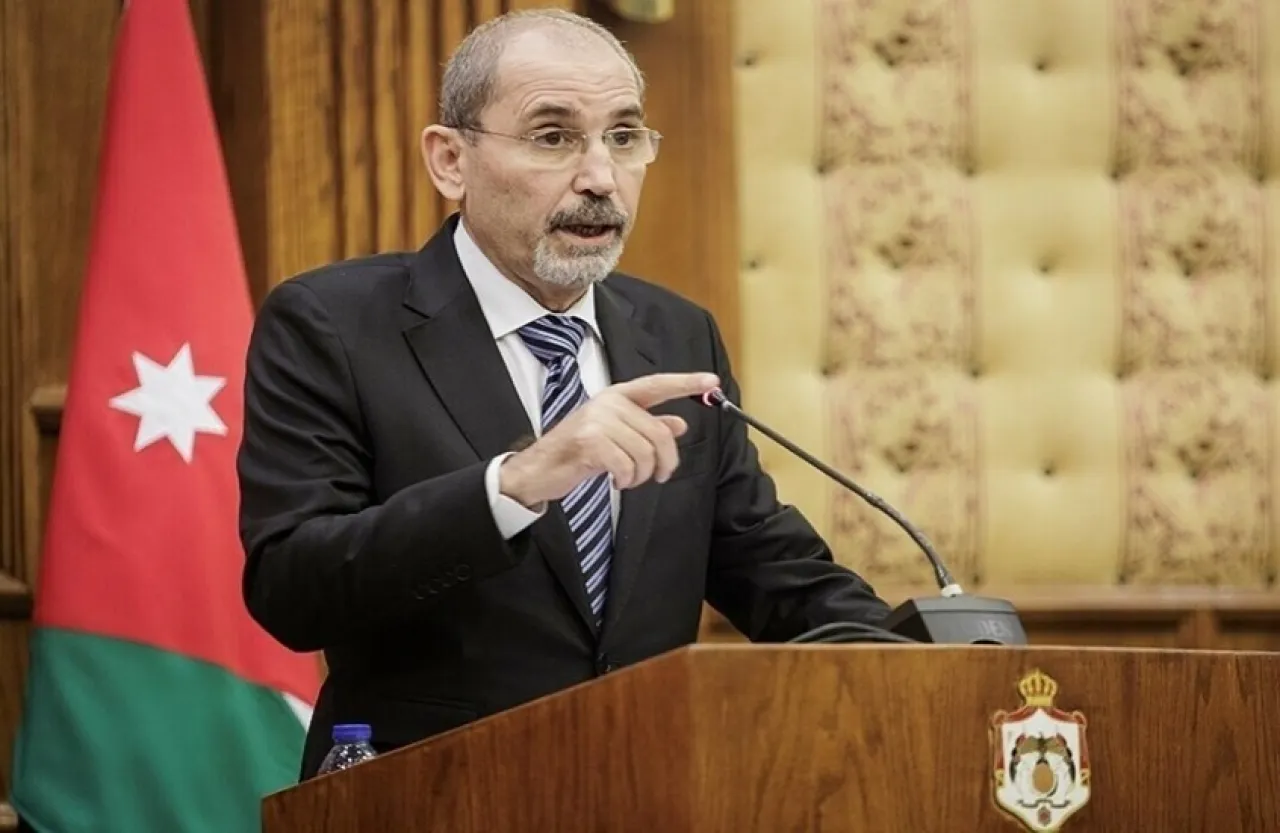
Khaberni - Deputy Prime Minister and Minister of Foreign Affairs and Expatriates, Ayman Al-Safadi, emphasized on Saturday the necessity of preventing the partitioning of Gaza, stating, "We cannot allow the partitioning of Gaza, as Gaza is one and it is part of the occupied Palestinian territories, and because we all agree that the two-state solution is the only path to the just and permanent peace we all desire, and for this solution to be realized, Gaza and the West Bank must remain indivisible from each other."
Al-Safadi also affirmed during his speech alongside the German Foreign Minister Dr. Johann David Fadivol and the British Foreign and Development Minister Yvette Cooper that the current priority is to ensure compliance with the ceasefire agreement in Gaza in all its clauses, and to move forward in addressing the disastrous consequences of the war on Gaza, linking stabilization efforts to a political horizon that achieves the just and permanent peace which the two-state solution exclusively paves the way for.
Al-Safadi pointed out that the Arab-Islamic group will continue to work with the United States and European partners to consolidate the ceasefire in Gaza, and he appreciated the role of US President Donald Trump that led to the ceasefire agreement.
Al-Safadi also emphasized the necessity of a comprehensive system following the ceasefire in Gaza, which includes the introduction of humanitarian aid, early recovery, security, governance, and a political horizon.
Al-Safadi referred to the confirmation by His Majesty King Abdullah II that Jordanian forces would not be deployed in Gaza, highlighting Jordan's principal role in serving as a hub for delivering aid to Gaza and its readiness to train Palestinian police and cooperate with the international force that should be established by a Security Council decision in terms of providing training, participating in leadership and command, and offering any possible assistance.
He stressed the need to set a timetable for the withdrawal of Israeli forces that still control 53 percent of the sector, as their presence will make security impossible.
Al-Safadi stated, "After securing Gaza, the Palestinians must take over governing themselves, and it is necessary for the technocrat committee currently under discussion to be linked to the Palestinian National Authority."
Al-Safadi pointed out the importance of having an international assistance mission with a clear mandate to help Palestinians face numerous challenges including reconstruction, planning, capacity and institutional building.
He also stressed the necessity of sustaining the entry of humanitarian aid into the sector adequately and sustainably, and for Israel to remove obstacles to the entry of aid into the sector, so that UN organizations and other humanitarian organizations can operate and distribute aid in Gaza.
Al-Safadi reiterated the stability of the Occupied West Bank is pivotal for the stabilization of Gaza, "because whatever we do in Gaza, if conditions deteriorate in the West Bank, it will undermine everything."
Regarding the Palestinian National Authority, Al-Safadi affirmed the necessity to support it as the representative of the Palestinian people and referred to President Mahmoud Abbas's commitment to reforms.
Regarding Syria and Lebanon, Al-Safadi affirmed the necessity to support the Syrian government in the reconstruction process based on foundations that ensure Syria's unity, stability, sovereignty, territorial integrity, and the welfare of its citizens, and he emphasized the necessity to stop Israeli interventions and aggressions on Syria which destabilize it.
Al-Safadi also affirmed the necessity to support the unity, sovereignty, security, stability, territorial integrity, and welfare of Lebanon, and preservation of the stability of its institutions.
In this context, and as part of his participation in the 21st session of the Manama Dialogue, Al-Safadi met several counterparts and officials participating in the 21st session of the Manama Dialogue, and discussed ways to enhance bilateral relations and coordination on issues of shared interest, and regional developments.
Al-Safadi met with German Foreign Minister Dr. Johann David Fadivol, British Foreign and Development Minister Yvette Cooper, Yemeni Minister of Foreign Affairs and Expatriates Dr. Shaia Mohsen Al-Zindani, Greek Foreign Minister Yorgos Yerapetritis, Czech Foreign Minister Jan Lipavský, Cypriot Foreign Minister Konstantinos Koumbos, Singapore Minister of State for Defense Zaki Muhammad; Lebanese Minister of Interior and Municipalities Ahmad Al-Hajjar, and the Middle Eastern affairs advisor to the French President Anne Claire Legendre.
Al-Safadi held discussions with the American Ambassador to the Republic of Turkey and the American envoy for Syria, Thomas Baric, to follow up on the joint Jordanian-American-Syrian roadmap for resolving the crisis in Sweida and stabilizing southern Syria, which was approved on September 16, 2025.
Al-Safadi also met with the Director-General of the International Committee of the Red Cross, Pierre Krahenbühl, and discussed with him ways to coordinate efforts to deliver adequate and sustainable humanitarian aid to all parts of the Gaza Strip.