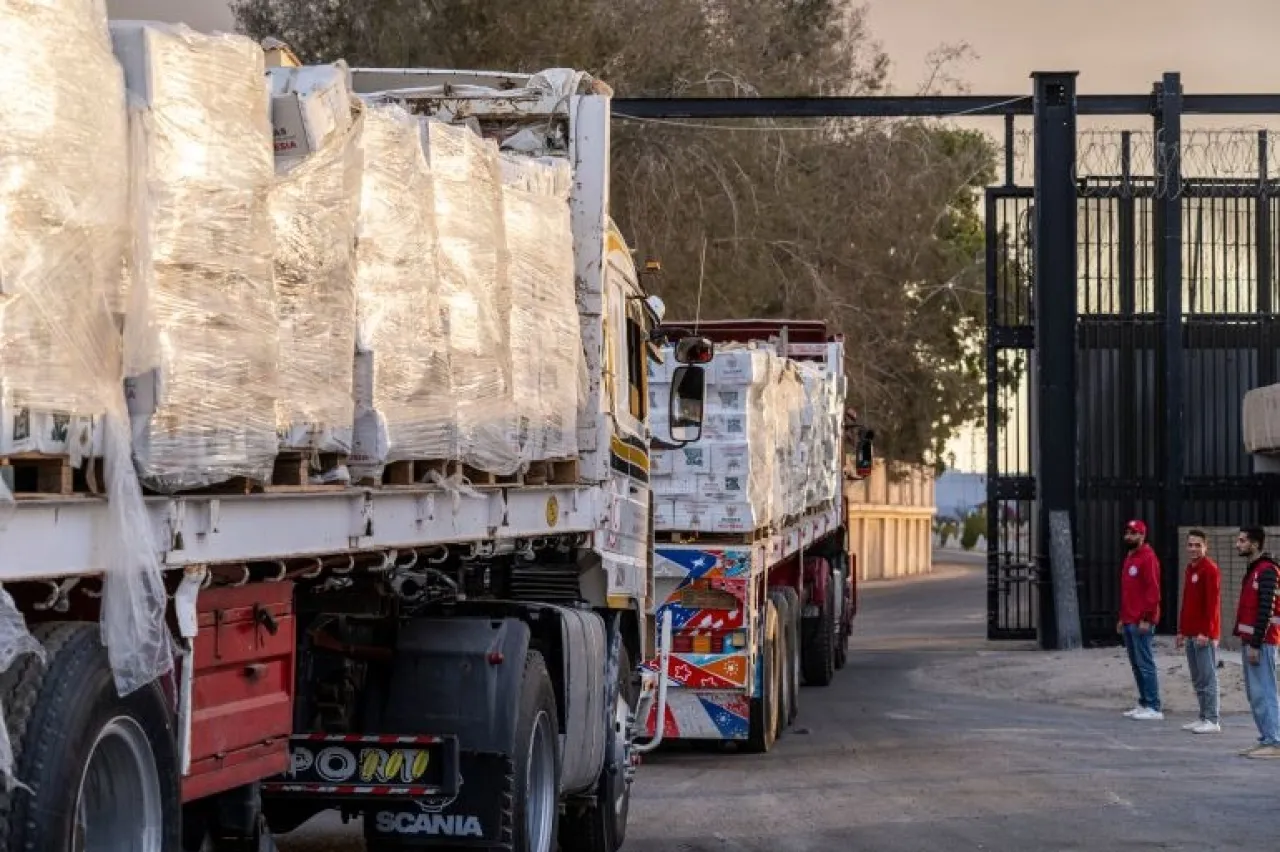
Khaberni - The Financial Times reported, citing humanitarian organizations, that Israel is obstructing the delivery of humanitarian aid to the Gaza Strip by imposing a new registration system specifically for international non-governmental organizations, which has led to tens of millions of dollars in aid being detained outside the sector.
The newspaper added that 40 international organizations, including Doctors Without Borders, Oxfam, and the Norwegian Refugee Council, said that Israel rejected 99 aid entry requests during the first 12 days of the ceasefire and that Israel nearly rejected all requests from the Norwegian Refugee Council.
The newspaper stated that three-quarters of the rejections were under the pretext that the organizations were not authorized to provide aid.
The Financial Times noted that in March, Israel imposed new rules requiring organizations working with Palestinians in Gaza and the West Bank to re-register with the Israeli authorities before the end of the year or they would lose their operating licenses.
The director of the Norwegian Refugee Council told the newspaper that the organization is now at an impasse and when it requests to bring in aid, they are told that its registration is under review and it is not permitted to bring in any materials.
In this context, the United Nations Relief and Works Agency for Palestine Refugees (UNRWA) said that winter shelter supplies sufficient for one million people are piled up in warehouses and banned from entering by an Israeli decision.
In turn, Aladdin Al-Batteh, mayor of Khan Younis and vice president of the Gaza Strip's Municipalities Union, said that thousands of displaced people are living in dilapidated tents that neither protect from the cold of winter nor the heat of summer. He added—in a talk with Al Jazeera—that these displaced people live in camps suffering from a severe lack of basic life necessities and water and sanitation services.
Al-Batteh mentioned that official figures showed that 93% of the tents were worn out and became uninhabitable, and revealed that more than 900,000 regional residents and tens of thousands of the displaced who were forcibly evicted from Rafah are crammed into the governorate.
The spokesperson criticized the absence of any movement, so far, to alleviate the daily suffering of the displaced and added that the sector urgently needs tents, cement, and spare parts for heavy machinery.
Despite the ceasefire agreement between the Islamic Resistance Movement (Hamas) and Israel since October 10, which includes the entry of aid into the Gaza Strip, Israel has only allowed the entry of meager amounts that do not meet the needs of the sector, which amount to 600 trucks daily.
The agreement followed a genocide war launched by Israel on the sector since October 7, 2023, which left 68,643 martyrs and 170,655 wounded, most of them children and women, with the United Nations estimating the reconstruction cost at about 70 billion dollars.