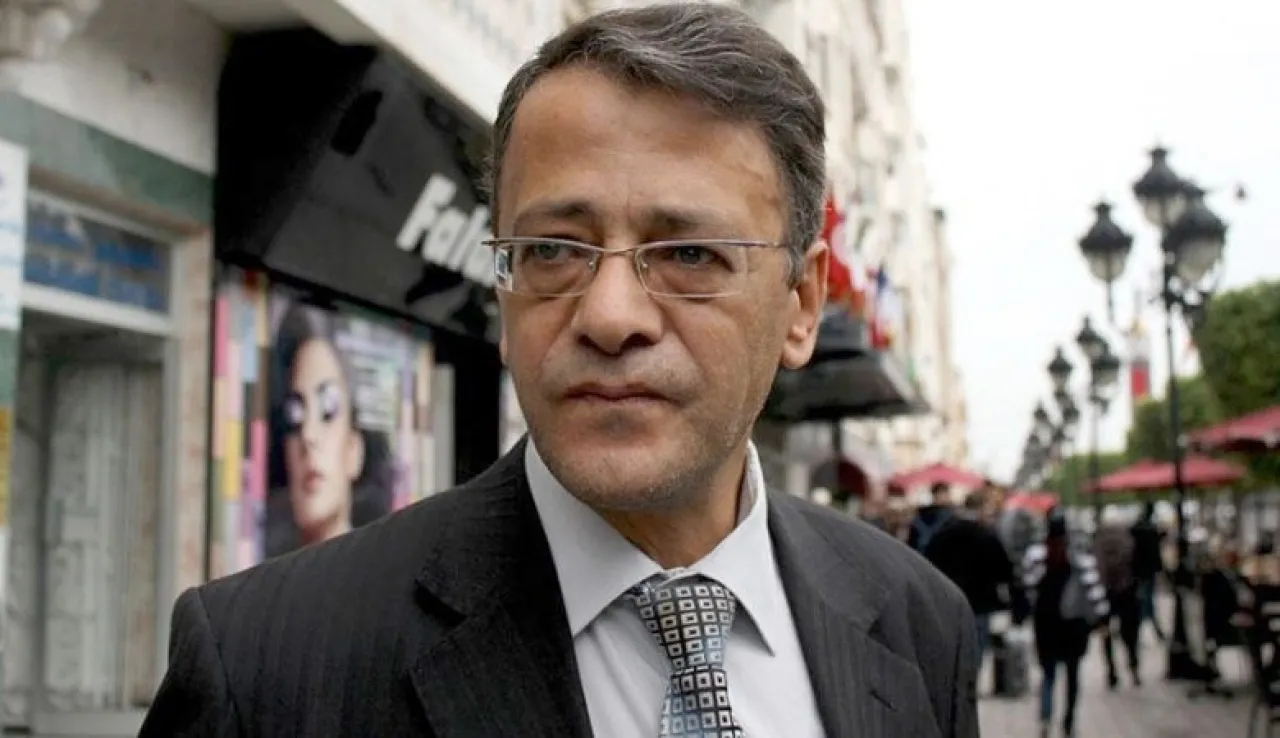
Khaberni - A Tunisian court, on Friday, issued a 5-year prison sentence for lawyer Ahmed Swab, one of the most prominent critics of President Kais Saied, whom the opposition accuses of using the judiciary to entrench his "authoritarian rule".
Swab, a former administrative judge, was arrested in April for statements criticizing the judiciary, describing Tunisian judges as working "with knives at their throats," highlighting the strong political pressures they face, which the authorities considered a threat to the judges.
His lawyer, Sami Ben Ghazi, said, "Five years in prison, for what? For a metaphorical phrase and spontaneous expression understood by everyone as symbolic, except by the authorities. Ahmed Swab is imprisoned in our place." Lawyers mentioned that the session lasted only a few minutes and was "unprecedented in the history of Tunisia," according to their description.
Dean of Lawyers Bou Bakr Ben Thabit addressed the judge, stating that the session was illegal in the absence of Ahmed Swab who refused a remote trial (via screen) from his prison and requested to be present in court, but the judge abruptly adjourned the session and announced that the verdict would be issued after the session.
External Funding
This week, three prominent non-governmental organizations stated that their activities were suspended due to external funding, a step described as aiming to silence the strong voice of civil society. Many other organizations complain about restrictions that included freezing their bank accounts.
Since Saied took over broad powers in 2021 and then dissolved the parliament and began ruling by decrees, opponents say that the president undermined the independence of the judiciary.
Saied dissolved the Supreme Judicial Council, and fired dozens of judges in 2022, steps denounced by opponents and human rights activists as a coup. Most opposition leaders are in prison on various charges, including Rached Ghannouchi, the leader of the Ennahdha party, and Abir Moussi, president of the Free Constitutional Party.
Human rights groups and activists say Saied has turned Tunisia into an open prison and uses the judiciary and police to target his political opponents.
Saied denies the accusations, asserting that the law is above all and the judiciary is independent, affirming his efforts to cleanse the country of what he describes as traitors and corrupt individuals and stating that the judges who grant them acquittal are their accomplices.