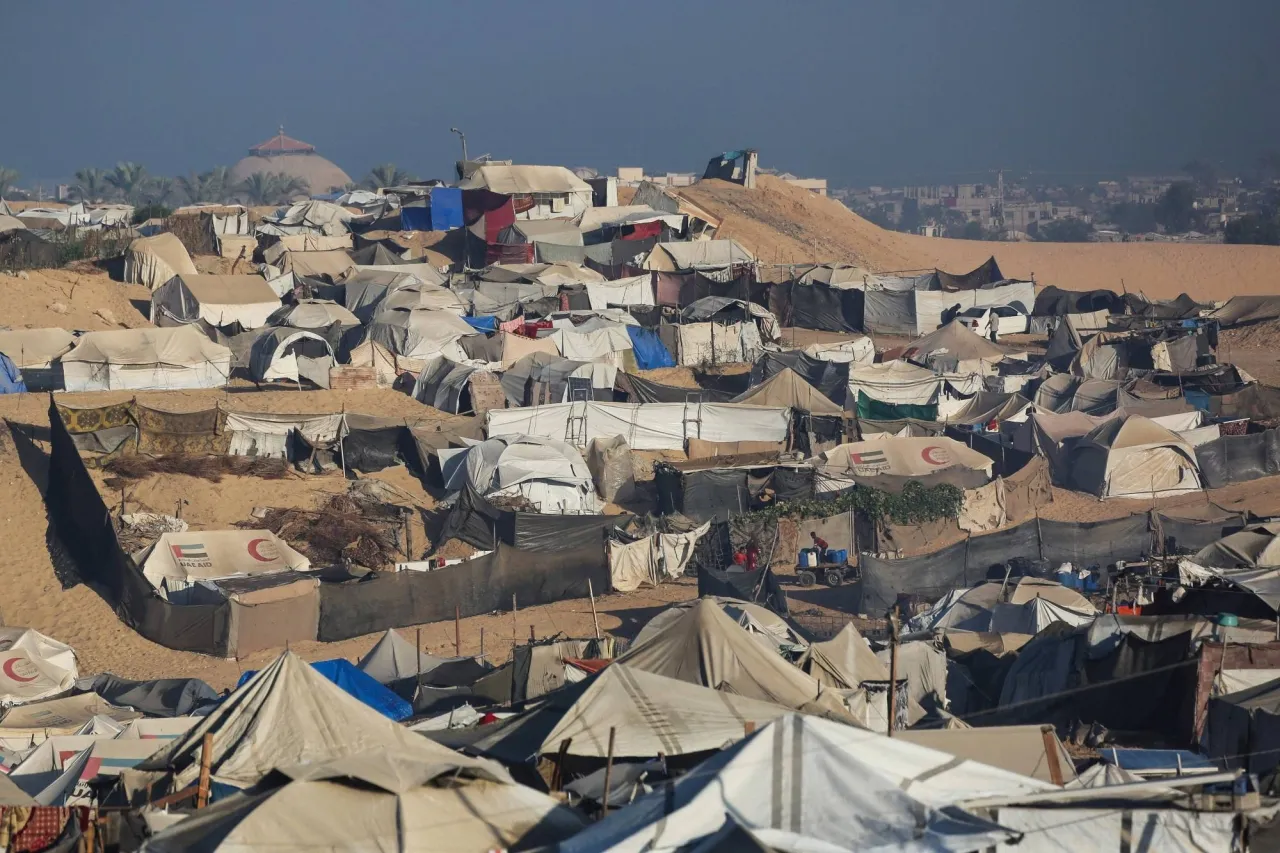
Khaberni - As the first days of winter approach in the Gaza Strip, residents, especially those whose homes have been destroyed or mildly damaged, face many difficulties in dealing with the anticipated winter weather, which the weather forecasts indicate will be harsher than the previous winter season.
Over two years of war, the residents of the sector have endured tough conditions as most of them lived in tattered tents, into which rainwater leaked, causing flooding and damaging their belongings like mattresses, covers, and tools that they kept inside these tents, which barely provided them with the ability to sleep in them, whether in summer or winter.
Despite the ceasefire coming into effect, as of this report, Israeli authorities have refrained from allowing the entry of any tents or mobile homes (“caravans”), even shelters, and other relief materials that could replace the tattered tents available inside the Gaza Strip.
Gaza resident Hassan Al-Laham (54 years old) from Al-Shati camp, west of Gaza City, whose home was destroyed in the latest military operation in the camp before the ceasefire, said he is currently living temporarily in Deir al-Balah where he fled to in a fabric tent, which he had sewn by a tailor to be livable.
Al-Laham mentioned that this tent, in which he lives with his wife and their six children, will be exposed to flooding and might be uprooted by any winds because it is not sturdy and not equipped for the winter season, pointing out that he searched extensively for ready-made tents that used to arrive with the aid that entered the Gaza Strip since more than a year ago but found nothing, according to Al-Sharq Al-Awsat.
Al-Laham said, "Winter is approaching and we don't know what we will do in such a tough life we have reached." He indicated that the options in front of him to look for alternatives are limited and that any residential apartment he will have to rent to spend the winter in will cost more than $1,200 a month, an amount he cannot afford, especially since he is just a government employee, barely earning about $700 a month.
The recent military operation that specifically targeted Gaza City, which caused the destruction of a large number of homes, exacerbated the scale of destruction and the number of displaced people, who no longer have any capacity to face the tough conditions that befell them.
Resident Reham Al-Banna, from Al-Nasr neighborhood in Gaza City, said her house remained standing throughout the war, but in the latest operation that renewed in the city, it was completely destroyed and she no longer has a shelter to go to, except to stay in the used tattered tent, for which she paid about $300, in order to cover herself and her family of 6 people, as she says.
Al-Banna pointed out that the suffering she will face in the winter will be extremely difficult, appealing to all international entities to work on bringing in good tents and mobile homes and others in order to place them in appropriate places and live in them and withstand the conditions of both winter and summer seasons.
She said, "Although the current tents can withstand the intense summer heat, the winter will usually be much harsher," noting that more than a year ago, she was displaced to the southern part of the sector and lived in a tent, in which she and her family spent the winter with great difficulty as her tent and belongings drowned, and the entire area where she was displaced in Khan Younis, while this time the conditions will be tougher, especially since she is displaced in the Zawayda area known for becoming muddy due to severe rains every year.
The "United Nations Relief and Works Agency for Palestine Refugees" (UNRWA) said that shelter materials and winter supplies for displaced people in Gaza are available in its warehouses in Jordan and Egypt, but they are prohibited from entering the sector.
They confirmed, in a post on the "X" platform, that as the winter season approaches in Gaza, the need for shelter and warmth increases, with the necessity of resuming allowing it to deliver humanitarian aid inside the sector, especially with the start of the first phase of the ceasefire agreement on October 10 (current).
Meanwhile, "Human Rights Watch" urged the international community to exert immediate pressure on the Israeli authorities to allow humanitarian aid to enter the Gaza Strip without restrictions, emphasizing Israel's obligation to cooperate with the United Nations to ensure that aid is provided to Palestinians without obstacles.
They stressed the need to allow UNRWA to urgently bring in aid to meet the catastrophic humanitarian needs in the sector. They said, "Continuing to prevent or hinder the entry of aid constitutes a blatant violation of international humanitarian law, leading to the aggravation of the suffering of civilians facing unprecedented humanitarian conditions due to the blockade and ongoing attacks."
UN organizations warned of a widespread famine in the Gaza Strip amid continued Israeli restrictions at crossings and the destruction of the infrastructure for aid.
On Thursday, the Israeli Broadcasting Authority quoted an Israeli government official as saying, "Israel does not intend to allow UNRWA to resume work in Gaza, despite the international court ruling," which demanded the Israeli government to allow the agency to continue its activities in the sector.
On Wednesday evening, the International Court of Justice said that Palestinians in the Gaza Strip "have not received adequate supplies" of aid, ruled that Israel must facilitate their access to the sector, and cease using starvation as a weapon in war.
Meanwhile, the Gaza government media office reported that the occupation had allowed only 1,100 trucks, which is 15 percent of the originally agreed 600 per day, to enter since the ceasefire came into effect.