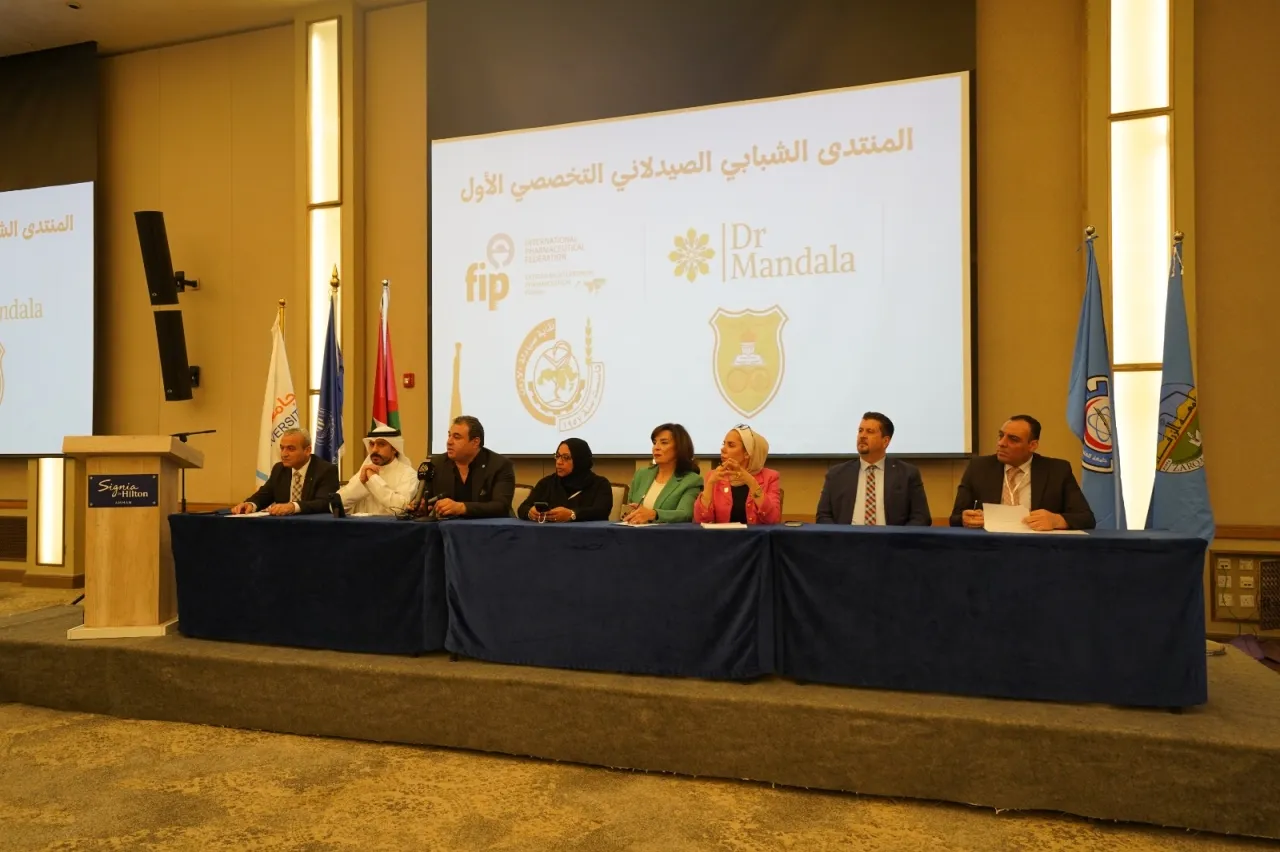
Khaberni - Today, the capital of Jordan, Amman, witnessed the conclusion of the first specialized forum for young pharmacists, which was held with the participation of a group of leaders and experts in pharmacy and pharmacy education from Jordan, Egypt, Kuwait, the UAE, and Lebanon, with the attendance of representatives from the regional office of the International Pharmaceutical Federation (FIP-EMRpharm), headed by Dr. Wael Ali, the President of the regional office of the International Pharmaceutical Federation in the Middle East, the Jordanian Pharmacists Syndicate, public and private universities, the private sector, several academics, and organized by Dr.Mandala.
Guests from Arab countries and universities:
• Dr. Nadia Mazrouei / Vice President of the International Pharmaceutical Federation (FIP)
Dr. Abdulaziz Al-Jadaan / Secretary General of Pharmacy Practices at the Regional Office
• Dr. Israa Mazen/ Director of Quality and Patient Safety at Millennium Hospital, Quality Director at Bahia Foundation
• Dr. Mohamed Attia/ Executive Vice President of the Drug Management Program and Oncology Clinics at Shefaa Al Orman Hospitals, Director of Clinical Pharmacy at Shefaa Al Orman Hospitals
• Dr. Heba Anis/ Deputy Director of Clinical Nutrition Unit at the National Cancer Institute-Cairo University, and a faculty member at Misr International University
• Dr. Mustafa Nawarq/ Marketing expert and PhD and Masters lecturer in Business Administration
• Dr. Mohamed Rahhal/ Dean of the Faculty of Pharmacy at the Lebanese International University
• Dr. Mohamed Tawkel
Deans of Pharmacy Colleges in Jordanian Universities:
• Dr. Rula Darwish, Dean of the Faculty of Pharmacy at the University of Jordan
• Dr. Qusai Al-Balas, Dean of the Faculty of Pharmacy at the University of Science and Technology
• Dr. Samar Dhiab, Dean of the Faculty of Pharmacy at the Applied Science University
• Dr. Rana Abu Huwaij, Dean of the Faculty of Pharmacy at Amman Arab University
• Dr. Arwa Al-Khatib, Dean of the Faculty of Pharmacy at Amman Ahliya University
• Dr. Ahlam Al-Kilani, Dean of the Faculty of Pharmacy at Zarqa Private University
• Dr. Saja Hamed, Dean of the Faculty of Pharmacy at Al Hashemiya University
• Dr. Iman Al-Basheeti, Vice President of Jadara University
• Dr. Hatem Al-Khatib, Vice Dean of the Faculty of Pharmacy at the University of Jordan
• Dr. Islam Hamad representing the Dean of the Faculty of Pharmacy at the American University in Madaba
• Dr. Mohammed Bayan representing the Dean of the Faculty of Pharmacy at Philadelphia University
• Dr. Inas Al-Mansur representing the Dean of the Faculty of Pharmacy at Mutah University
• Dr. Manal Al-Najdawi representing the Middle East University
• Dr. Reem Abu Tayeh, professor at the Applied Science University
• Dr. Sarya Al-Nablusi, professor at the University of Science and Technology
• Dr. Ali Al-Sumaidaie, professor at Amman Ahliya University
• Dr. Rund Al-Khasawneh, professor at the University of Science and Technology
• Dr. Aref Zayed, professor at the University of Science and Technology
• Dr. Anas Abed, professor at Amman Ahliya University
• Dr. Ali Abu Halima, professor at Amman Ahliya University
Honored guests from various institutions:
• Dr. Tareq Maqtesh, Secretary-General of the National Center for Diseases and Epidemics
• Dr. Noor Abu Ghosh, Jordanian House of Representatives
• Dr. Zaid Al-Kilani, Syndicate Head of Jordanian Pharmacists
• Dr. Wasfi Al-Nawafleh, Vice Syndicate Head of Jordanian Pharmacists
• Dr. Hakeema Hawasa, consultant in regulatory affairs
• Dr. Noor Aslim, Clinical Pharmacy Specialist
• Dr. Ali Al-Qaisi, director of Pillbox pharmacies and academy
• Dr. Ruba Samardali, deputy director of Pillbox pharmacies and academy
• Dr. Abeer Al-Rababa'a, director of pharmaceutical marketing
• Dr. Reem Ajlouni, director of the Jordanian Breast Cancer Program
• Dr. Ali Diabat, professor doctor at Al-Hussein Bin Talal University
• Mr. Maha Diabat, Department of Inspection and Control at the Ministry of Education
• Dr. Aram Ismail, representative of Dar Al Dawa Company
• Dr. Al-Mamoon Al-Louzi, representative of Dar Al Dawa Company
During the forum, it was officially announced that the National Project for the Application of Modern Pharmaceutical Specializations in the Hashemite Kingdom of Jordan has been launched, which is a historic step towards developing the pharmacy profession and repositioning the pharmacist as a comprehensive healthcare provider.
Participating personalities and their speeches:
• Dr. Wael Ali, President of the Regional Office of the International Pharmaceutical Federation (FIP-EMRpharm):
He affirmed that the launch of the national project reflects a comprehensive regional vision aimed at empowering the Arab pharmacist, noting that Jordan will be a launch point for this transformation across the Middle East. He added that modern specializations are not optional but necessary to address the challenges of the profession, with unemployment reaching 25% over five years.
• Dr. Nadia Mazrouei, Vice President of the International Pharmaceutical Federation (FIP):
She said that the project places Jordan in a pioneering position regionally and globally, and that the support of the International Pharmaceutical Federation comes from a firm belief that modern specializations are the future of the profession and that youth are the makers of this future.
• Dr. Abdulaziz Al-Jadaan, Secretary-General of Pharmacy Practices at the Regional Office:
He confirmed that the regional office will develop a practical roadmap including training and professional accreditation to ensure the integration of modern specializations in Jordanian healthcare institutions while closely monitoring the impact on healthcare quality.
Professor Dr. Mohammad Rahhal, Dean of the Faculty of Pharmacy, Lebanese International University:
He stressed the importance of academic regional cooperation and the exchange of experiences between Arab universities to support the building of generations of specialized pharmacists capable of serving the Arab and international community
• Dr. Wasfi Nawafleh, Vice Head of Jordanian Pharmacists:
He explained that the syndicate will adopt this project as a comprehensive national plan, calling on all parties to work together to develop the profession and protect the future of young pharmacists from increasing unemployment, by opening new specialized fields needed by the market.
He confirmed that the syndicate will establish specialized committees to follow up on the practical application of modern specializations and work on accrediting workshops and professional courses as official paths for employing youth in new specialized jobs.
• Dr. Abdul Qader Kitkat, General Manager of Dr.Mandala/Jordan :
He emphasized that the private sector is a key partner in the success of the project, through investment in training and opening new specialized job opportunities in hospitals and pharmaceutical companies.
Dr. Banan Abu al-Homs, Executive Director of Dr.Mandala/UAE
"The private sector's participation in the national project to apply modern pharmaceutical specializations represents a national responsibility before being an investment. We at Mandala believe that the pharmacist is a key partner in the drug industry, and in providing advanced therapeutic services. Through this project, we commit to supporting the training and qualification of young pharmacists and opening new job fields in the pharmaceutical industry and research and development, contributing to enhancing Jordan's role as a leading regional platform in the field of medicine and modern pharmacy."
• Professor Dr. Rula Darwish, Dean of the Faculty of Pharmacy, the University of Jordan:
She emphasized that public universities are committed to developing curricula to include modern specializations, and opening postgraduate professional programs that qualify pharmacists to lead the health sector and meet labor market needs.
Professor Dr. Arwa Al-Khatib – Dean of the Faculty of Pharmacy, Amman Ahliya University:
She confirmed that private universities will contribute to building flexible academic programs in partnership with hospitals and the private sector, providing training opportunities and entrepreneurship that open new doors for young pharmacists.
Recommendations:
• Support practical training for young pharmacists inside factories and laboratories.
• Open specialized job opportunities in the fields of pharmaceutical manufacturing and quality assurance.
• Invest in research and development in cooperation with Jordanian universities.
• Offer professional fellowship programs to pharmacists in advanced pharmaceutical industries.
• Enhance the partnership between the private sector, syndicate, and universities to ensure the project's sustainability.
The final announcement:
The National Project for the Application of Modern Pharmaceutical Specializations in Jordan not only represents a qualitative leap in the development of the profession but also a strategic investment in the national economy; where estimates indicate that the organized application of these specializations will contribute to:
• Increasing the efficiency of the health system.
• Reducing pharmaceutical waste.
• Improving the quality of care provided to patients.
• Generating economic returns exceeding 200 million Jordanian dinars annually for the benefit of the national income of the kingdom.
Moreover, the project aims to contribute directly to eradicating unemployment in the pharmaceutical sector, which has reached about 25% over the past five years, by opening new and diverse work pathways in specialized areas such as nutrition therapy, oncology, quality, and health and drug economics, in addition to supporting entrepreneurship pathways in pharmacy.
Thus, the Hashemite Kingdom of Jordan becomes one of the first Arab countries to adopt this qualitative transformation, positioning itself as a regional and international leader in the field of modern pharmacy, under the sponsorship and support of the regional office of the International Pharmaceutical Federation headed by Dr. Wael Ali.