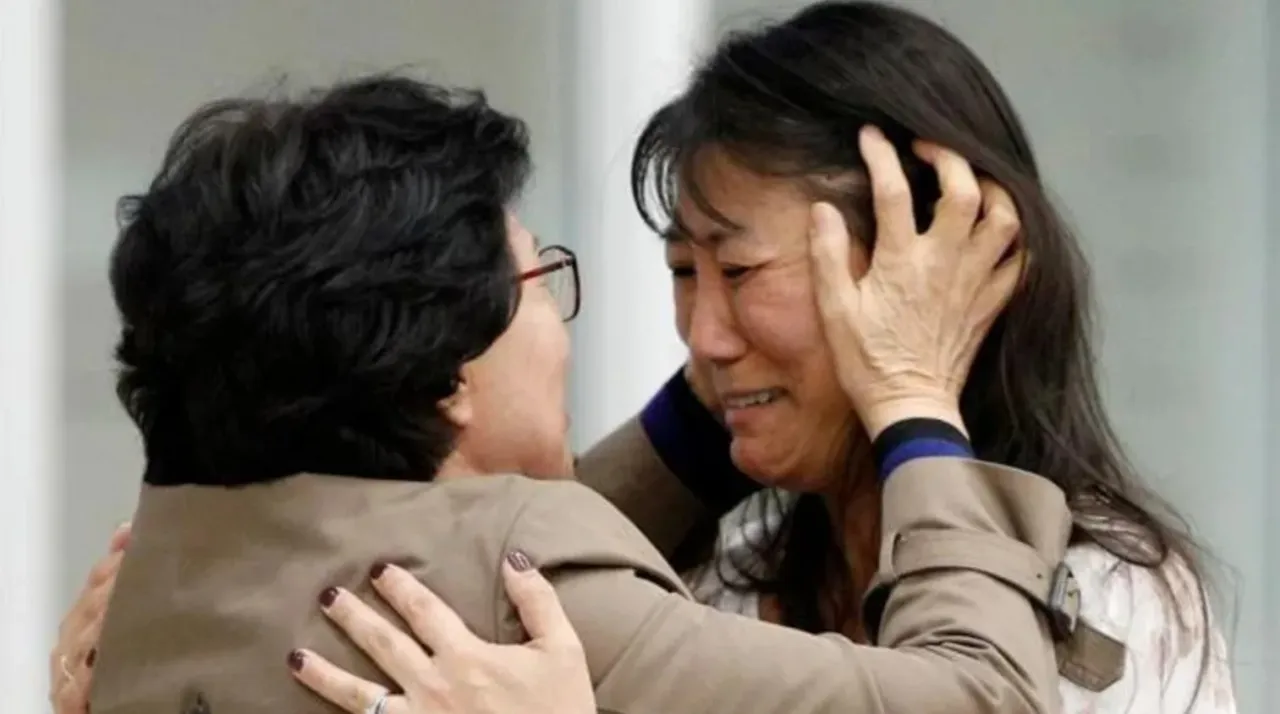
Khaberni -Tell Me - After South Korean Han Tae Sun met her daughter following 44 years of her disappearance, confirmed by a DNA match, the mother is suing the South Korean government for "violations in the adoption file".
After more than four decades of persistence and disappointments, Han reunited with her daughter Kyung Ha, who vanished without a trace in 1975. The poignant reunion occurred at one of the airports in the capital, Seoul, after DNA tests revealed that her daughter — now living in the United States under the name Lori Bender — had been kidnapped and adopted illegally abroad.
The story dates back to May 1975, when Han left her six-year-old daughter playing in front of the family home in Seoul to go to the market. She says, "I asked Kyung Ha: Won't you come with me? But she replied: No, I will play with my friends." When she returned home, she found no trace of her, and that was the last time she saw her daughter as a child.
In 2019, a significant breakthrough in the case occurred when Han sent a sample of her DNA to "325 Camera," a non-profit organization aimed at reuniting Korean adoptees with their biological families. The result confirmed that her daughter, now known as Lori Bender, worked as a nurse in California.
Lori traveled to Seoul to meet her mother, ending her lifetime search journey that was filled with suffering and unending hope.
Han is currently suing the South Korean government, accusing it of failing to prevent her daughter's kidnapping and unauthorized adoption. Her case is among the first of its kind and sheds light on the increasing scrutiny of South Korea's international adoption program, which has faced allegations of serious irregularities.
From 1950 through the early 2000s, South Korea exported an estimated 170,000 to 200,000 children for adoption, mostly to Western countries. A recent investigation concluded that successive governments committed human rights violations by allowing the widespread export of children, often without official documentation or parental consent.
The lawsuit Han filed could open the door to new legal challenges from victims of the system. The case is scheduled to be considered in court next month.
A spokesperson for the government told the BBC that the government "deeply sympathizes with the psychological suffering of the individuals and families who have been unable to find each other for many years," expressing "deep regret" and pledging to take "necessary measures" according to the results of the case.
Han and her husband spent years trying every possible means, from visiting orphanages, examining police records, posting posters, and even appearing on television, where she explained: "I spent 44 years destroying my body and mind searching for my daughter. But, has anyone apologized to me all this time? No one apologized. Not even once."
She spoke about the impact of the search journey on her physical health, saying: "All ten of my toenails fell off" due to the continual walking in her quest to find her daughter.
In 1990, a woman came forward claiming to be her daughter and lived with the family for a short period before confessing that she was lying. It was not until 2019 that Han got real answers, thanks to the organization 325 Camera, which connected her to Lori Bender.