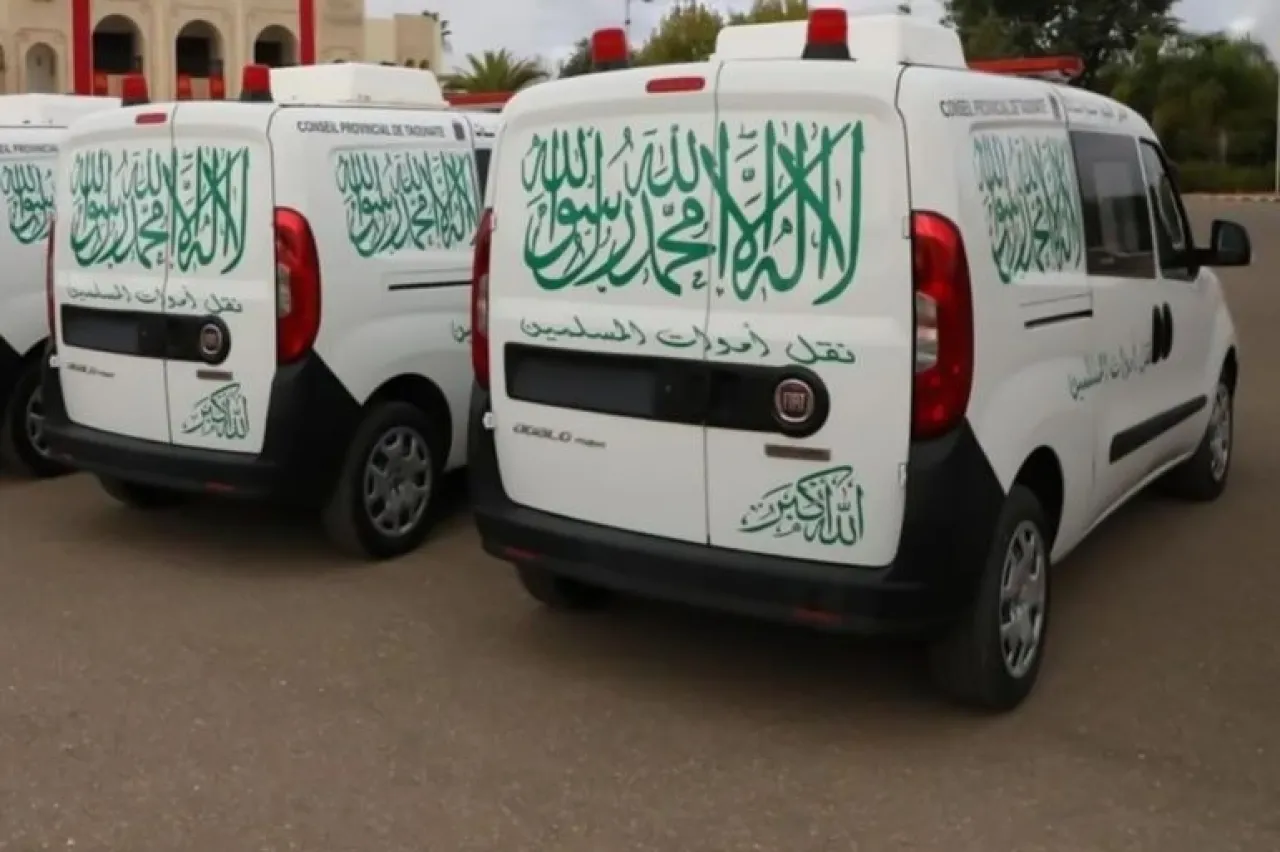
Khaberni - A decision issued by the Moroccan Ministry of the Interior, dictating the removal of religious phrases from hearses under the pretext of "religious neutrality", has sparked a storm of controversy in Morocco, extending from the streets to social media platforms.
The joint decision number 1250, issued by the Minister of Interior and the Minister of Health and Social Protection, stipulates that hearses should not include any religious phrases, only adorned with two green stripes on the sides and inscribed with "Transport of the Deceased" along with a reference to the vehicle's owner, as reported by local media.
In the digital space, the decision has topped the discussions among Moroccans, where some criticized the move while others supported it. Critics argue that the move affects a deeply rooted religious symbolism, asserting that removing phrases like "There is no deity but Allah, Muhammad is the messenger of Allah" or "Every soul shall taste death" is not merely about words on a vehicle, but about an emotional meaning linked to the most sacred moments of farewell.
Tweeters considered that the step, if true, represents a provocation to the feelings of the majority of Moroccans, and an obliteration of religious landmarks in the public space, emphasizing that death in Islamic culture is not an administrative act but a ritual that reminds the living of their inevitable fate.
Activists questioned the reasons behind intervening in a matter they see as purely religious and social, asking: "What harm would it do to the public space if a Muslim's body were transported in a vehicle inscribed with the testimony? And why are these phrases seen as provocative elements?"
Bloggers viewed the testimonies or phrases like "Every soul shall taste death" not as political slogans or sectarian symbols, but as expressions of a deeply rooted religious and social identity, pointing out that their presence in moments of farewell carries a profound emotional dimension for many families.
Others questioned the relationship between removing religious phrases from hearses or ambulances and achieving coexistence and equality, arguing that the debate goes beyond mere writings on a vehicle, to the limits of defining neutrality in a society where Muslims constitute the overwhelming majority.
Conversely, supporters defended the decision, considering it puts an end to the "disorder" that has characterized this sector, and unifies the external appearance of hearses within clear regulations.
These supporters believe the measure does not target religion, but rather falls within the organization of a public service that should maintain neutrality, ensuring equal treatment for all citizens, and preserving the sentiments of families with various beliefs, especially in sensitive services related to death.
Researchers considered that the measure aims to unify health standards and end disorder, guaranteeing the dignity of the deceased without discrimination, while promoting the principle of coexistence and respect for religious diversity, with calls to involve the High Scientific Council in matters of a legal dimension.
Proponents added that standardizing the visual specifications of hearses falls within the framework of modernizing facilities related to health and social protection, subjecting them to clear regulatory standards, affirming that religious rites remain guaranteed within private funeral spaces, and that organizing the external appearance of vehicles does not infringe on freedom of belief, but rather falls within the administration's prerogative in managing public affairs.