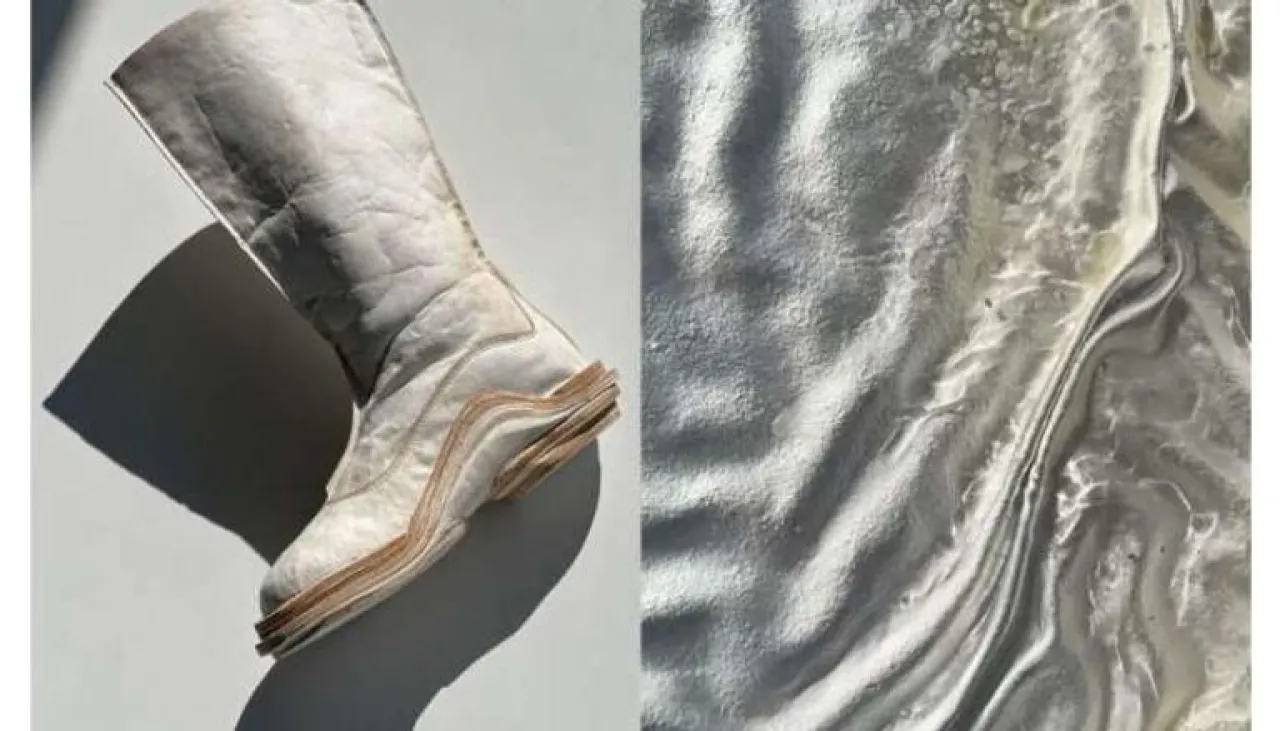
Khaberni - Milan Design Week events unveil a prototype for a shoe completely made from a part of the mushroom known as "mycelium".
Mycelium is a dense network of extremely fine threads that typically spread beneath the soil surface or within organic materials such as wood, and this network is not true roots like those of plants but performs similar functions in terms of absorption and anchorage.
The new shoe represents a significant advancement in the use of mycelium, as it is no longer just a surface material or a leather alternative but has been utilized as a structural component capable of bearing weight. The team managed to manufacture a cohesive sole by merging layers of mycelium into a dense, single structure without the need for additional reinforcement.
The project is the result of a collaboration between researcher and designer Lars Dietrich from the Free University of Brussels, and shoemaker Marie De Rieck, in an attempt to integrate biotechnological innovation with traditional crafts.
The project is based on advanced research conducted by the Microbiology Research Group led by Evelyn Peters and Elies Vandendriessche as part of the "Myco Matters" program, which aims to develop bio-based materials applicable on a wide scale.
Engineering challenges for a "live" material
It took about two years to develop the shoe, through an iterative process aimed at balancing the growth of microorganisms and the engineering performance requirements. The most significant challenge was transforming a material that grows in flat sheets into a three-dimensional sole capable of bearing pressure.
To achieve this, the team selected two different types of fungi: one for producing a moldable spongy material used in the sole, and the other to form a flexible, leather-like layer for the upper part of the shoe.
Between craftsmanship and biotechnology
The design reflects an attempt to reinterpret traditional shoe-making techniques, adapting leather lamination processes to accommodate the properties of mycelium. The shoe features clear layers and exposed edges that highlight the material's nature and irregularity, affirming its biological identity.
Designer Dietrich explained that the shoe represents a "model reflecting the current state of research, and how a live material can be transformed into a functional three-dimensional product".
For her part, Marie De Rieck confirmed that the project faced technical challenges in its initial stages, but it made remarkable progress thanks to the combination of craftsmanship and biotechnology, adding that this step represents important progress towards making biologically manufactured shoes a practical option in the future, within the framework of the "Green Opera" strategy aimed at enhancing sustainability in the arts.