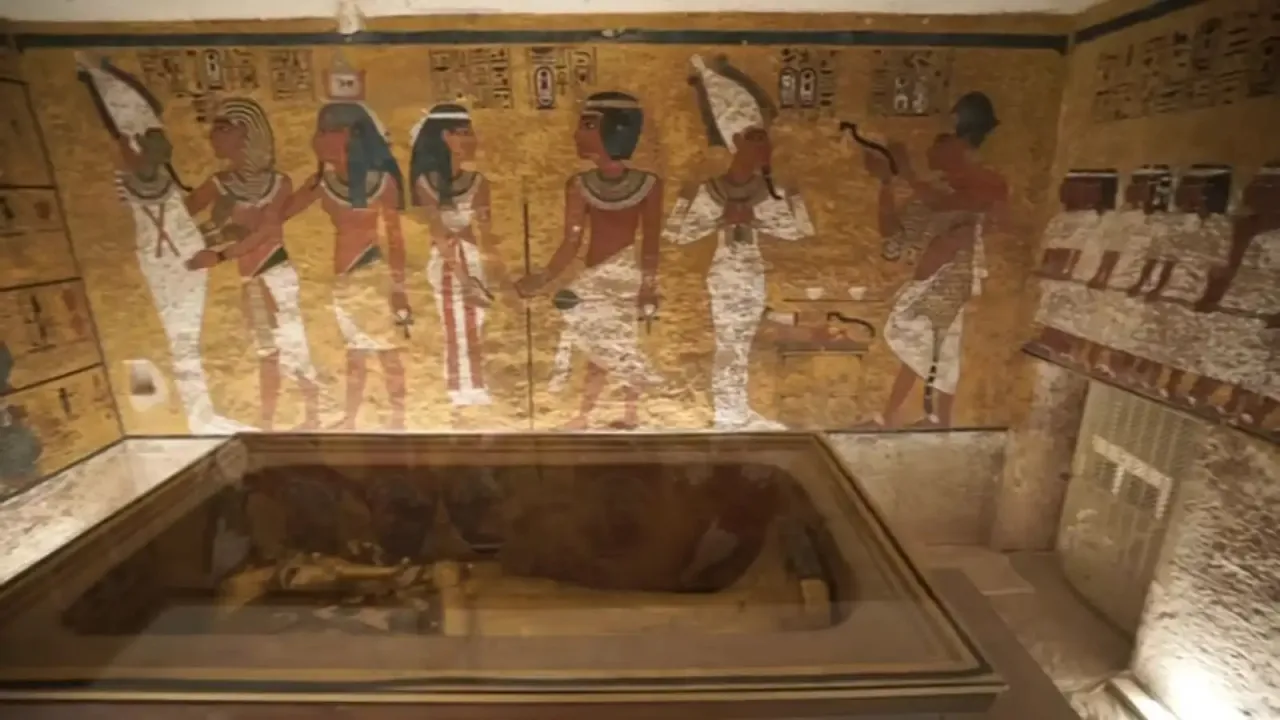
Khaberni - A recent Egyptian study revealed that the design of King Tutankhamun's tomb, one of the most prominent kings of the Eighteenth Dynasty in the era of the New Pharaonic State, was not random, but was based on precise astronomical guidance.
The study refuted new data related to the last days of King Tutankhamun's life, offering an interpretation that combines archaeological evidence and the astronomical interpretation of the royal doctrine, indicating that the design of the tomb reflects a deep religious conception linked to the movement of the sun and the moon, and the idea of a divine transition of power.
Astronomical phenomenon
Ahmed Awad, a researcher in astronomical archaeology, explained that this astronomical construction carries implications that go beyond the architectural dimension, as it is linked to granting religious legitimacy to the transition of power after the king's death.
He noted that the study, discussed during a scientific conference at Ain Shams University, concluded there was an astronomical phenomenon known as the "union of the revolutionaries," consisting of the alignment of the moonrise with the sunset, which repeated around the end of Tutankhamun's rule around 1322 BC.
The study believes this astronomical alignment was not a coincidental timing but was employed within an ideological framework to reinforce the idea of a divine transition of the throne to Minister Ay, who assumed power after the death of Tutankhamun, in enhancing this approach to observe similar alignments in the axes of major Egyptian temples such as Karnak and Edfu, where the link between celestial phenomena and the organization of religious and political space appears.
Exploiting astronomical phenomena
In a related context, the study concluded that the young king's health condition may have played a decisive role in the end of his short reign, but it also opens the door to a parallel hypothesis that exploiting astronomical phenomena conferred a sacred character on the transfer of power, reflecting the intermingling of religion with politics in ancient Egypt.
It is noted that Tutankhamun ascended the throne at the age of ten, during the New Kingdom era within the Eighteenth Dynasty, and his rule did not exceed nine years, and despite the limited scope of his military achievements, he gained an exceptional status due to the mystery surrounding his life and early death.
This mystery is further deepened by the rise of Minister Ay, who was not of royal origin, to power, especially after his marriage to the king's widow, a step widely interpreted as a means to legitimize his power, leaving the door open to historical questions that have yet to be resolved about the true end of this young king by illness or murder.