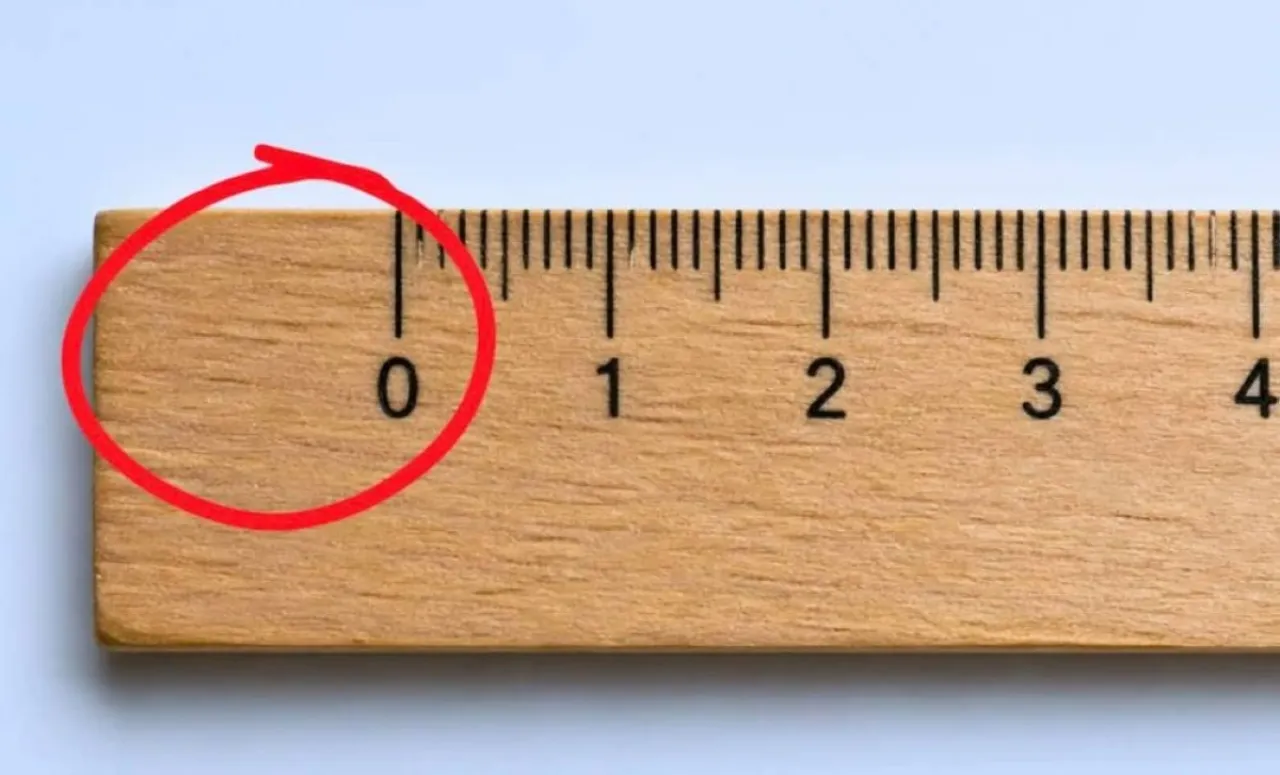
Khaberni - That small space that precedes the zero mark on the ruler may seem trivial and unimportant, but in fact, it performs a precise function that many do not notice, despite its essential role in maintaining measurement accuracy.
This simple detail has sparked widespread interaction on social media in recent days after a user posted a picture of a regular ruler on the platform "X", wondering about the reason for the small gap before the beginning of the numerical scale. What seemed a simple question opened the door to humorous speculations, where some linked this space to sarcastic ideas, while others went to non-scientific explanations, which increased the debate around this unnoticed part of the everyday tool.
However, the scientific explanation is simpler and more logical than it seems. The space before the zero is not a random void but a carefully designed protection area. The edge of the ruler is the part most susceptible to damage from frequent use, such as falling, friction, or breaking. If the zero mark were directly at the edge, any minor damage could lead to a complete deviation in measurements.
By slightly shifting the starting point inward, a "safety margin" is created that preserves measurement accuracy even with the wear and tear of the edges. Thus, the zero line remains the true reference for measurement, away from any damage that may occur to the tool's edge.
This principle is not limited to rulers alone but extends to include a wide range of more precise measuring instruments, such as calipers, tape measures, and other engineering equipment. In these tools, similar design solutions are adopted aimed at ensuring the stability of the basic measurement point and isolating it as much as possible from parts prone to friction or wear, thus maintaining the accuracy of results and reducing the likelihood of any measurement deviation over time and with frequent use.
This design also has an important practical dimension in manufacturing processes, giving factories greater flexibility during the cutting, shaping, and assembling of tools, without affecting the accuracy of the grading or the starting point of measurement, ensuring the production of consistent and reliable tools despite varying manufacturing conditions and speeds.
Despite the simplicity of this idea, it reflects a precise engineering philosophy based on a single principle of protecting the basic measurement point from any change that could disrupt accuracy, even if very subtle.
Amid a wave of questions circulating on social media, a limited number of commentators managed to reach the right answer without hesitation. Carpenters, tailors, machine technicians, and engineers are well aware of this explanation by virtue of their daily dealing with the results of this design. Workers involved in cutting wood or fabrics know that wearing the tool's edge with use could lead to errors accumulating across projects, so their work relies on the accuracy of the zero point itself, not on the shape of the ruler's edge.
This professional understanding reflects a broader dimension in the design philosophy, as the designers of rulers kept in mind that most users would not notice the wear of the edges until measurement errors or work damage appeared. Thus, this space came as a practical, integrated, silent, and unnoticed solution, continuously performing its function without drawing attention.
This design also holds an important educational aspect that is often overlooked. When learning to measure for the first time, this space visually clarifies that the true starting point is the zero line, not the edge of the ruler. This concept might seem obvious to adults, but it is not clear to children at the beginning of their learning, so this gap acts as indirect guidance that reinforces the correct way to measure without the need for additional explanation.